Portfolio
Book Projects
Two-dimensional Artwork

Three-dimensional Artwork
Graphic design, Digital, & Multimedia Art
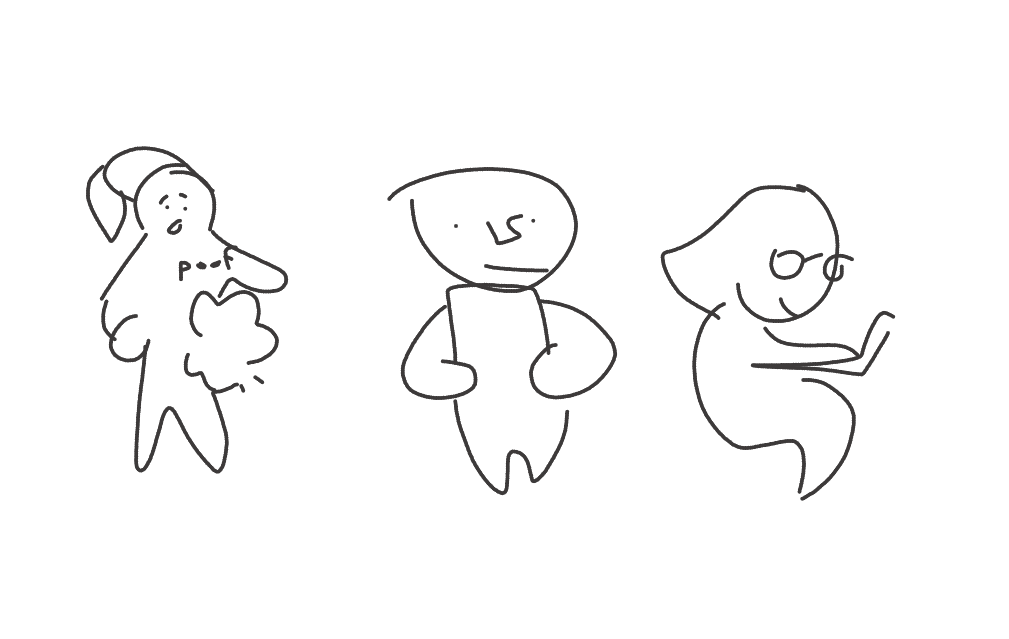
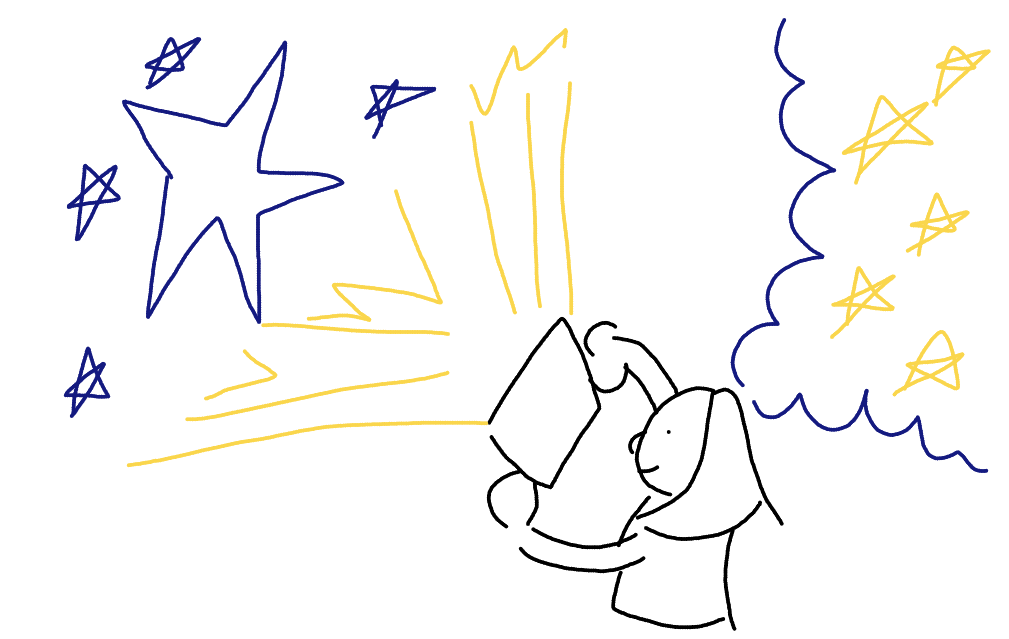

Book Projects
Detailed image description of picture book here.
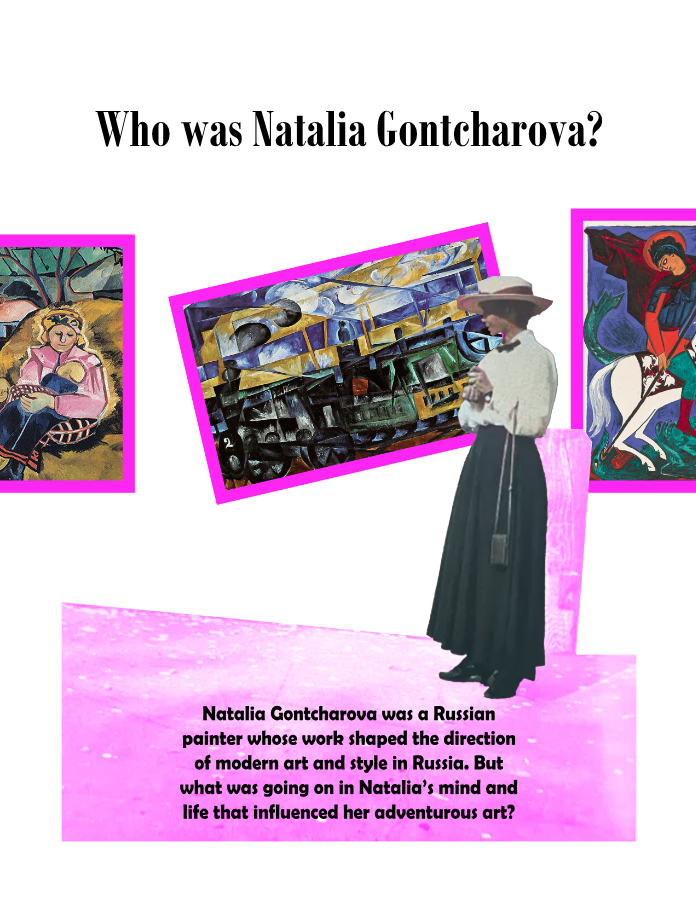
- Title reads "Who was Natalia Gontcharova?". There is a collage of Gontcharova's paintings with a colored photo of her. Text below says "Natalia Gontcharova was a Russian painter whose work shaped the direction of modern art and style in Russia. But what was going on in Natalia’s mind and life that influenced her adventurous art?"
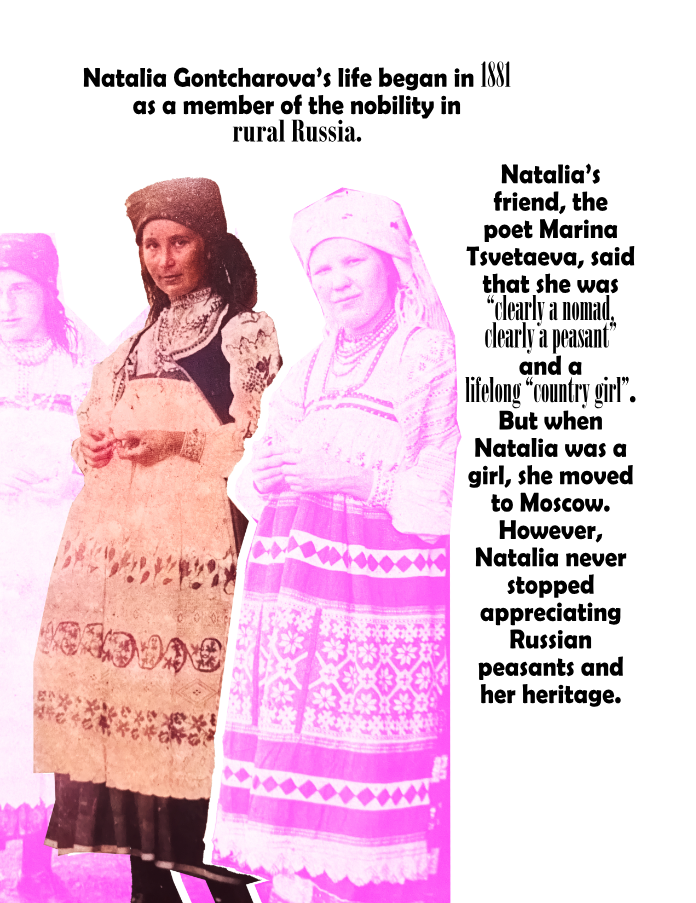
- There is a colored photo of Natalia Gontcharova with other women in traditional wear. Text reads "Natalia Gontcharova’s life began in 1881 as a member of the nobility in rural Russia. Natalia’s friend, the poet Marina Tsvetaeva, said that she was "clearly a nomad, clearly a peasant" and a lifelong "country girl". But when Natalia was a girl, she moved to Moscow. However, Natalia never stopped appreciating Russian peasants and heritage."
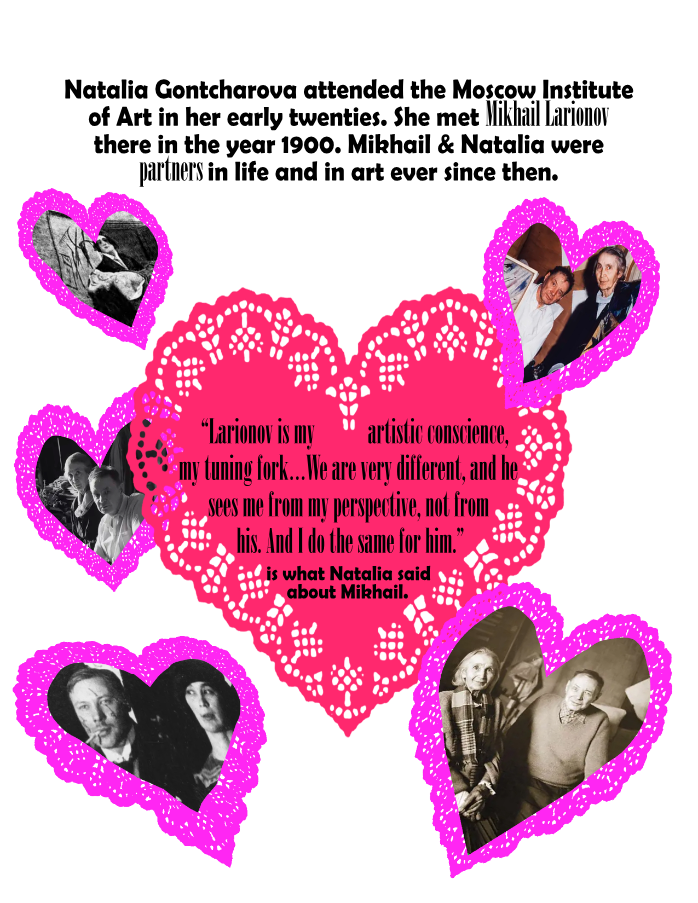
- Text reads "Natalia Gontcharova attended the Moscow Institute of Art in her early twenties. That’s where she met Mikhail Larionov in the year 1900. Mikhaila and Natalia were partners in life and in art ever since then. "Larionov is my artistic conscience, my tuning fork…We are very different, and he sees me from my perspective, not from his. And I do the same for him." is what Natalia said about Mikhail." There are photos of Gontcharova and Larionov in colorful hearts from different ages.
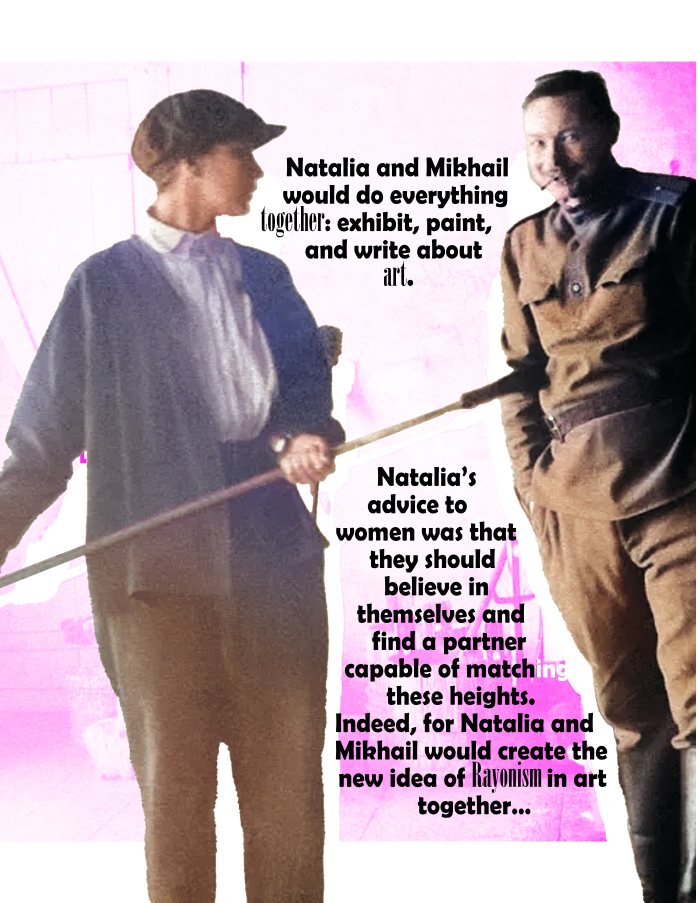
- Text is overlaid atop a colored photo of Natalia Gontcharova and Mikhail Larionov interacting which reads, "Natalia and Mikhail would do everything together: exhibit, paint, and write about art. Natalia’s advice to women was that they should believe in themselves and find a partner capable of matching these heights. Indeed, Natalia and Mikhail would create the new idea of Rayonism in art…"
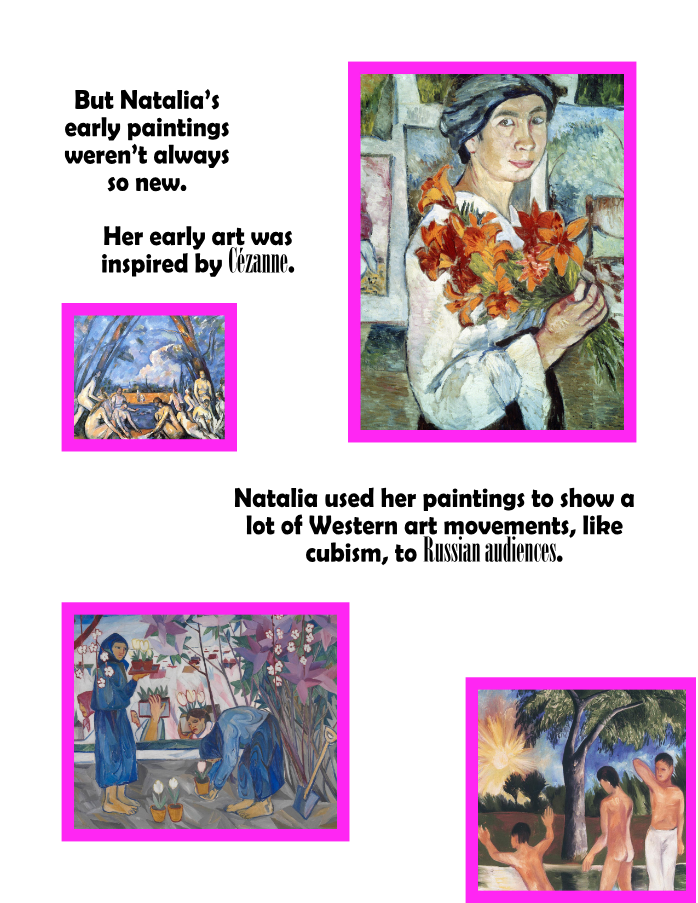
- There are paintings in an impressionistic style across the page. Text reads, "But Natalia’s early paintings weren’t always so new. Her early art was inspired by Cézanne. Natalia used her paintings to show a lot of Western art movements, like cubism, to Russian audiences."
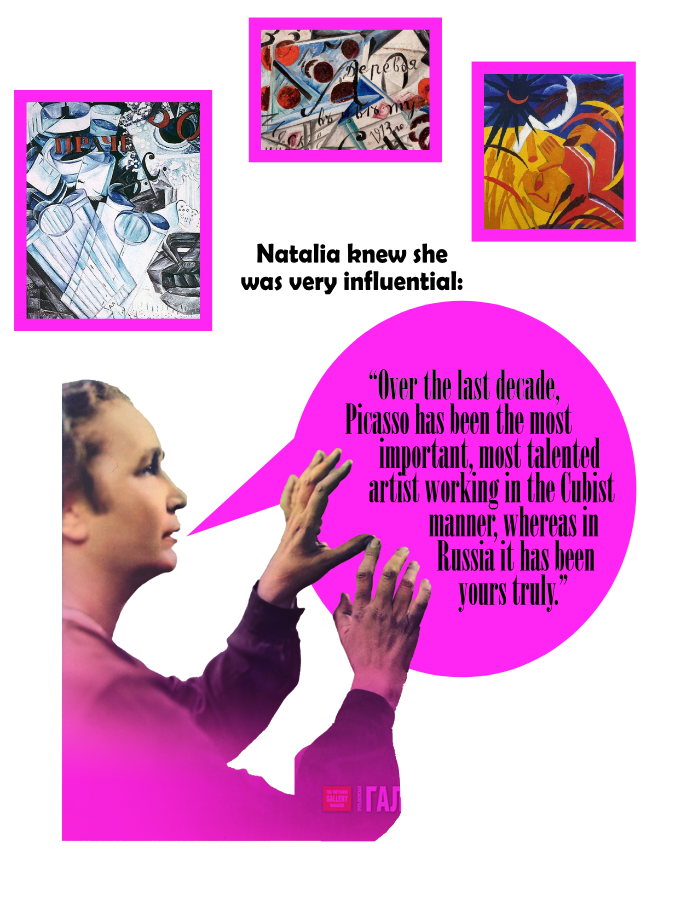
- There are impressionistic paintings and a photo of Natalia Gontcharova with her hands raised. Text above reads: "Natalia knew she was very influential:" and from within a speech bubble, a quote from Gontcharova says, "Over the last decade, Picasso has been the most important, most talented artist working in the Cubist manner, whereas in Russia it has been yours truly."
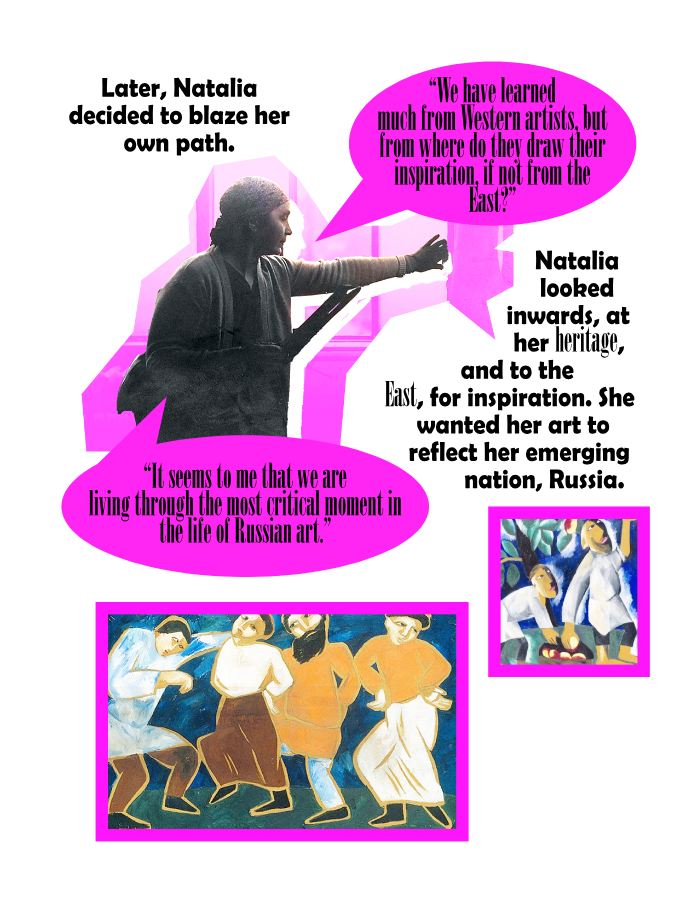
- Text above a photograph of Natalia Gontcharova reads "Later, Natalia decided to blaze her own path." From a speech bubble, Gontcharova is quoted as saying "We have learned much from Western artists, but from where do they draw their inspiration, if not from the East?" and "It seems to me that we are living through the most critical moment in the life of Russian art." Other text on the page says "Natalia looked inwards, at her heritage, and to the East, for inspiration. Gontcharova wanted her art to reflect her emerging nation, Russia."
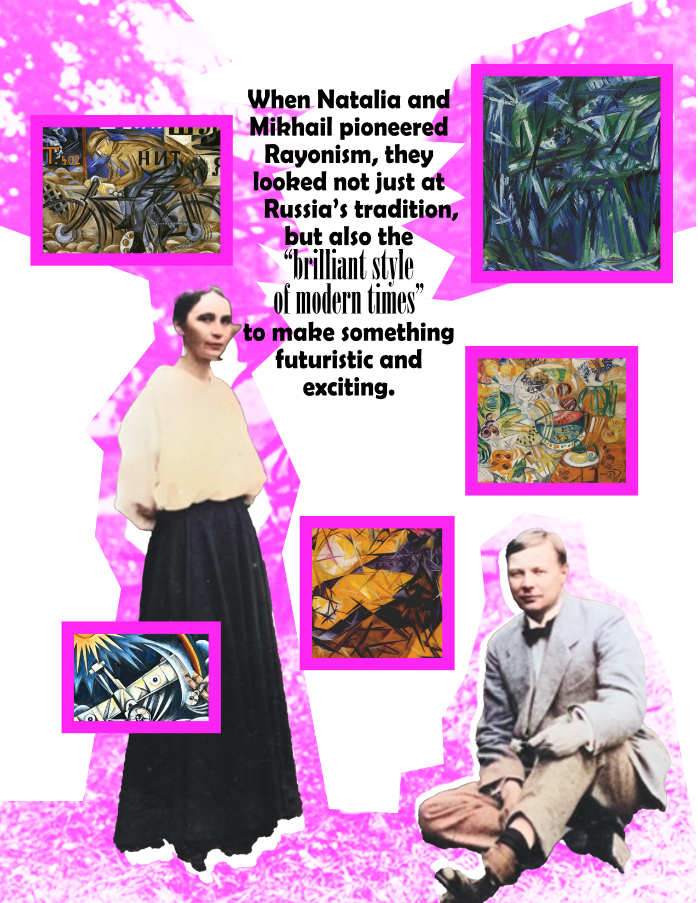
- Text in the middle of the page says "When Natalia and Mikhail pioneered Rayonism, they looked not just at Russia’s tradition, but also the "brilliant style of modern times" to make something futuristic and exciting." Beside it there is a colored photograph of Natalia Gontcharova and Mikhail Larionov and their paintings.
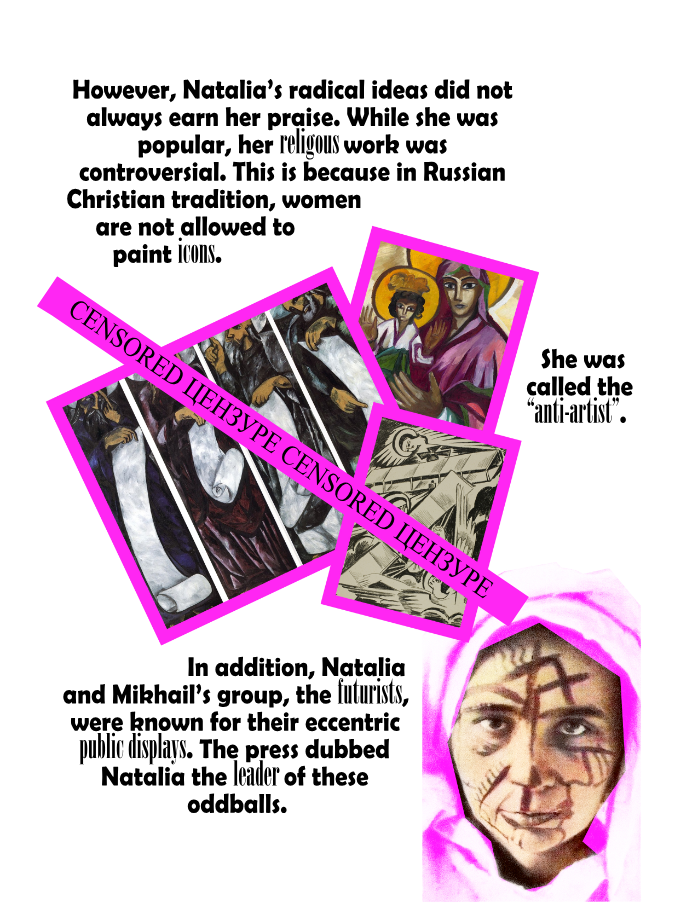
- Text around says "However, Natalia’s radical ideas did not always earn her praise. While she was popular, her iconography-inspired work was controversial. This is because in Russian Christian tradition, women are not allowed to paint this style of religious images. She was called the "anti-artist". In addition, Natalia and Mikhail’s group, the futurists, were known for their eccentric public displays. The press dubbed Natalia the leader of these oddballs." There is a colored photo of Natalia Gontcharova in face paint as well as pictures of her icon paintings, which have the word "CENSORED" in English and Russian across it.
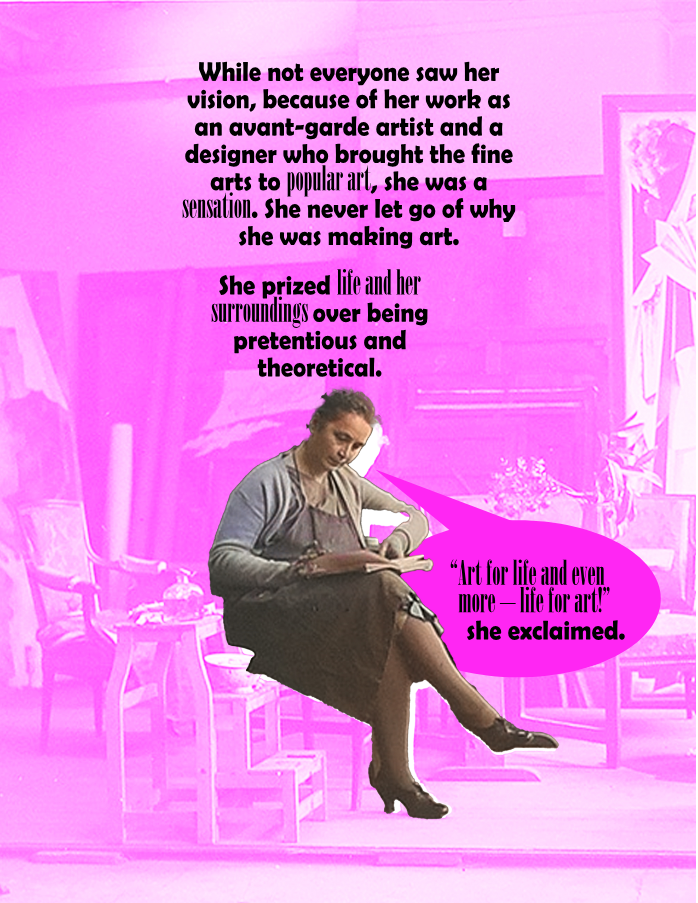
- There is a colored photograph of Natalia Gontcharova writing. Text around says, "While not everyone saw her vision, because of her work as an avant-garde artist and a designer who brought the fine arts to popular art, she was a sensation. She never let go of why she was making art. She prized life and her surroundings over being pretentious and theoretical." A speech bubble from Gontcharova reads, ""Art for life and even more – life for art!" she exclaimed."
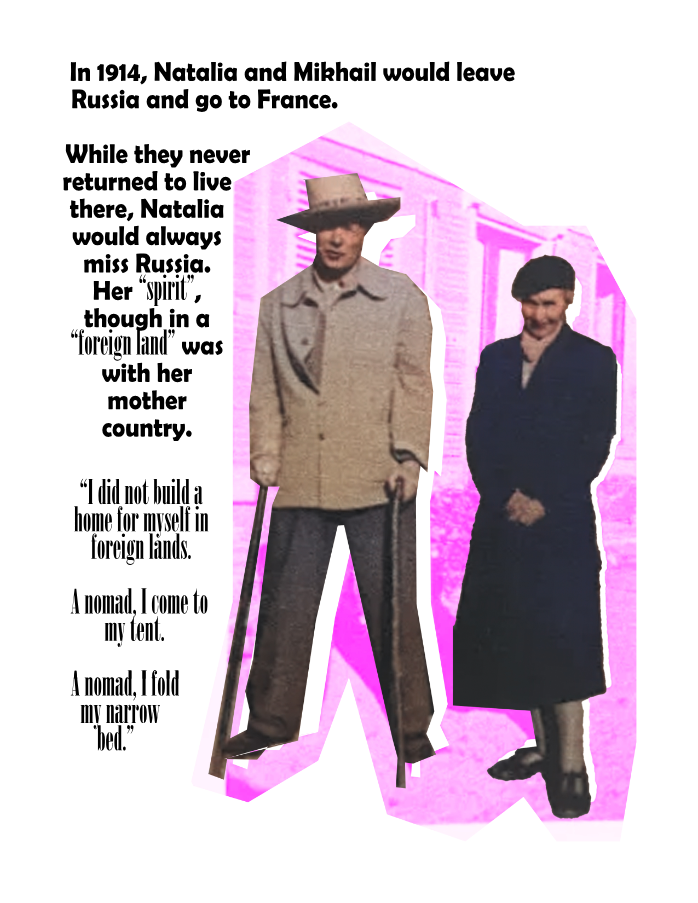
- There is a colored photo of Natalia Gontcharova and Mikhail Larionov in old age. Text on the side says, "In 1914, Natalia and Mikhail would leave Russia and go to France. While they never went back, Natalia would always miss Russia. Her "spirit", though in a "foreign land" was with her mother country. "I did not build a home for myself in foreign lands. A nomad, I come to my tent. A nomad, I fold my narrow bed.""
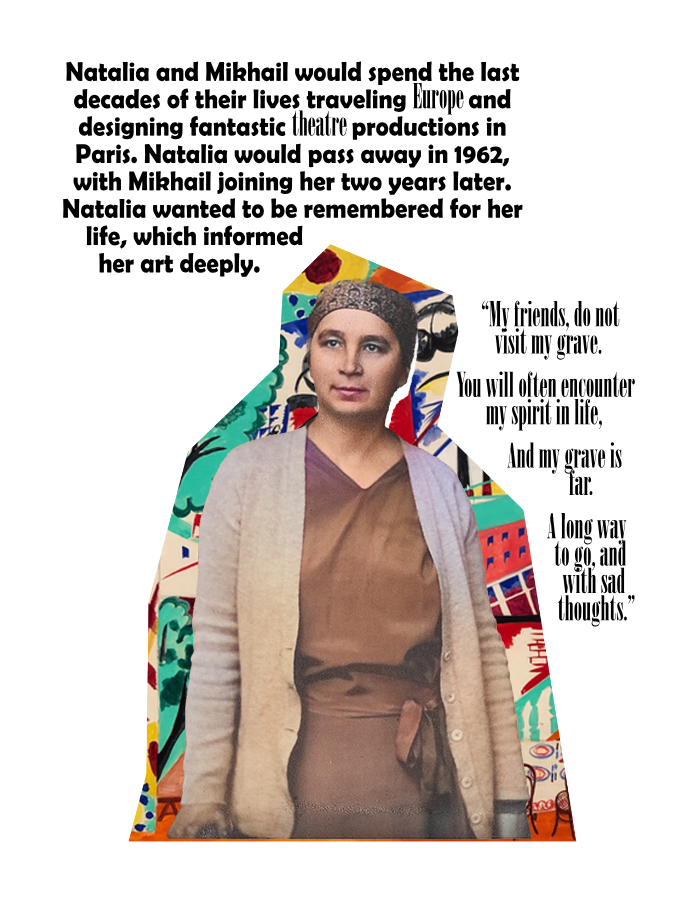
- There is a colored photo of Natalia Gontcharova at the bottom of the page. Text at the top says: "Natalia and Mikhail would spend the last decades of their lives traveling Europe and designing fantastic theatre productions in Paris. Natalia would pass away in 1962, with Mikhail joining her two years later. Natalia wanted to be remembered for her life, which informed her art deeply. "My friends, do not visit my grave. You will often encounter my spirit in life, And my grave is far. A long way to go, and with sad thoughts.""
"The Biography of Natalia Gontcharova"
November 2025
Digital medium
12 pages; 696x903 px each
I am minoring in art history and find that this knowledge has really enriched my creative and teaching practice. In my modern art history course, we have studied art movements from impressionism, to cubism, to surrealism, and beyond. This book, designed for younger readers, aged around ten, tells the life story of Russian futurist painter, Natalia Gontcharova. I also gave a presentation about Gontcharova prior to creating this book.
Detailed image description of zine here.
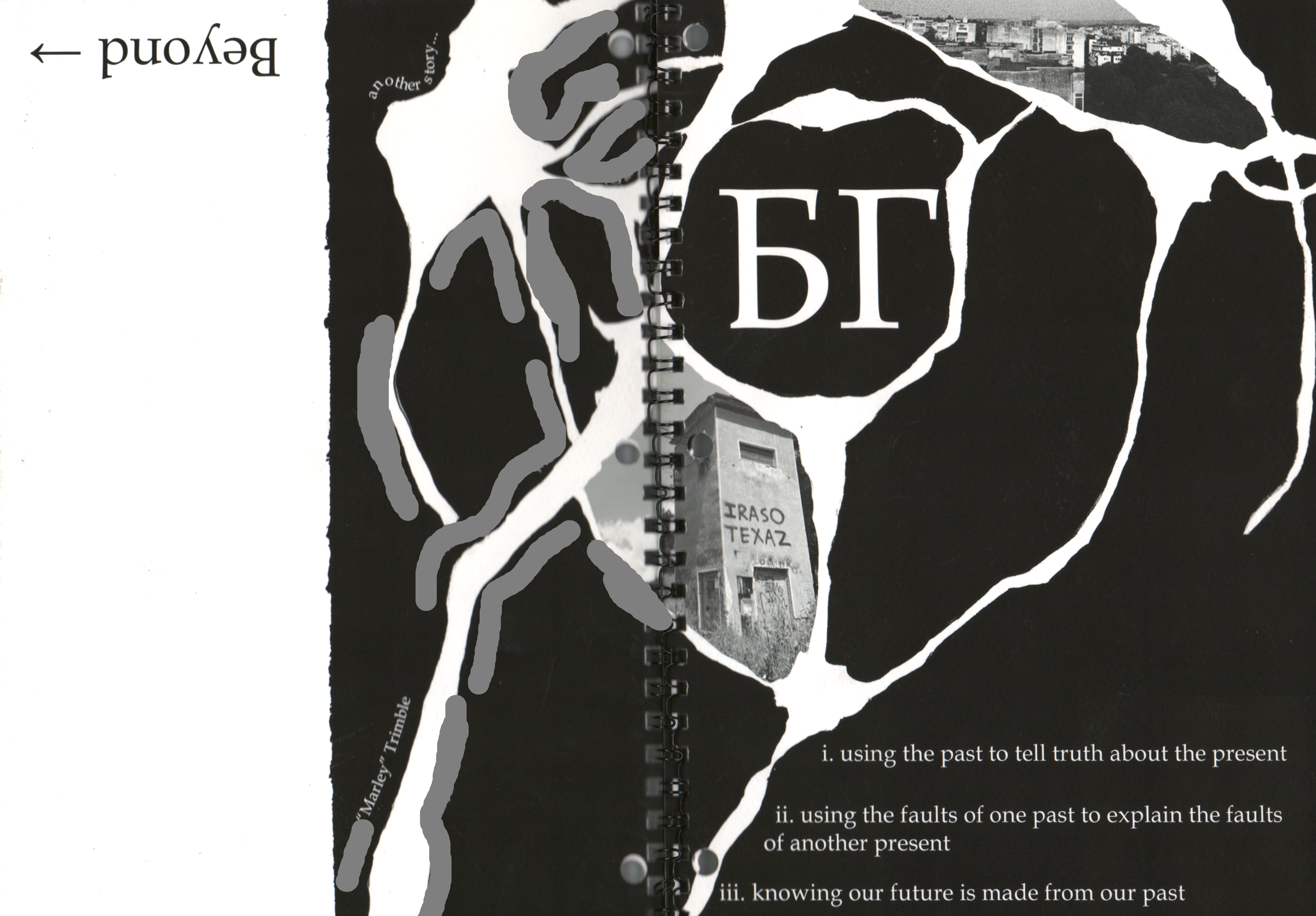
- There is a black and white spiral-esque graphic with the title "БГ" and monochromatic photographs of buildings throughout. Text on the right reads "i. using the past to tell truth about the present. ii. using the faults of one past to explain the faults of another present. iii. knowing our future is made from our past." Upside-down text on the left says "Beyond" with an arrow.
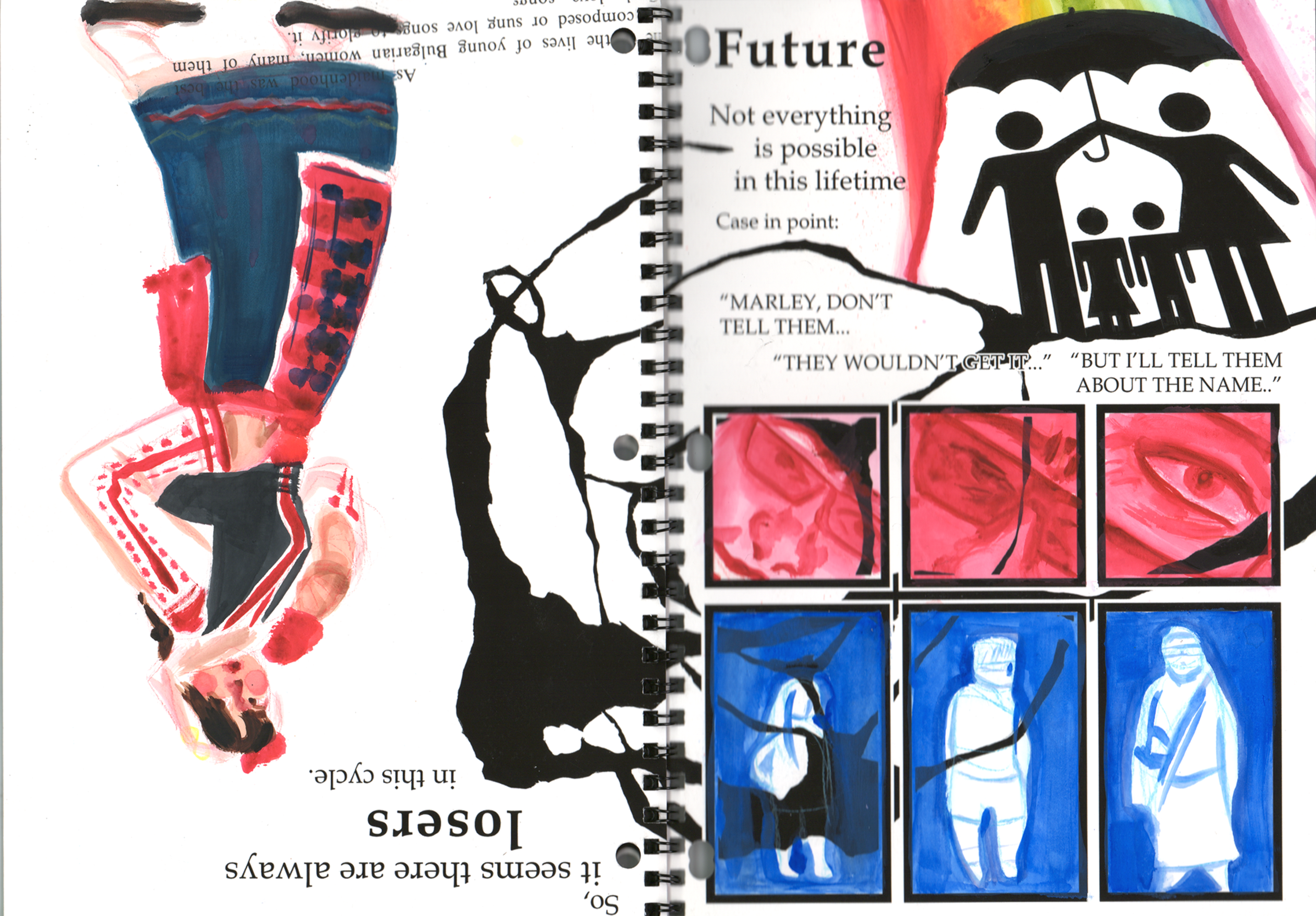
- On the right there are colorful watercolor illustrations; a stick figure family using an umbrella to block a rainbow, and a set of comic panels increasing in proximity to a face and showing the growth of a child. Text says, "Future. Not everything is possible in this lifetime. Case in point: "MARLEY DON'T TELL THEM… THEY WOULDN'T GET IT… BUT I'LL TELL THEM ABOUT THE NAME." The left page is upside down, with a watercolor of a girl in traditional Bulgarian wear. Text reads, "So it seems there are always losers in this cycle." Collaged text says, "As maidenhood was the best time in the lives of young Bulgarian women, many of them composed or wrote love songs to glorify it."
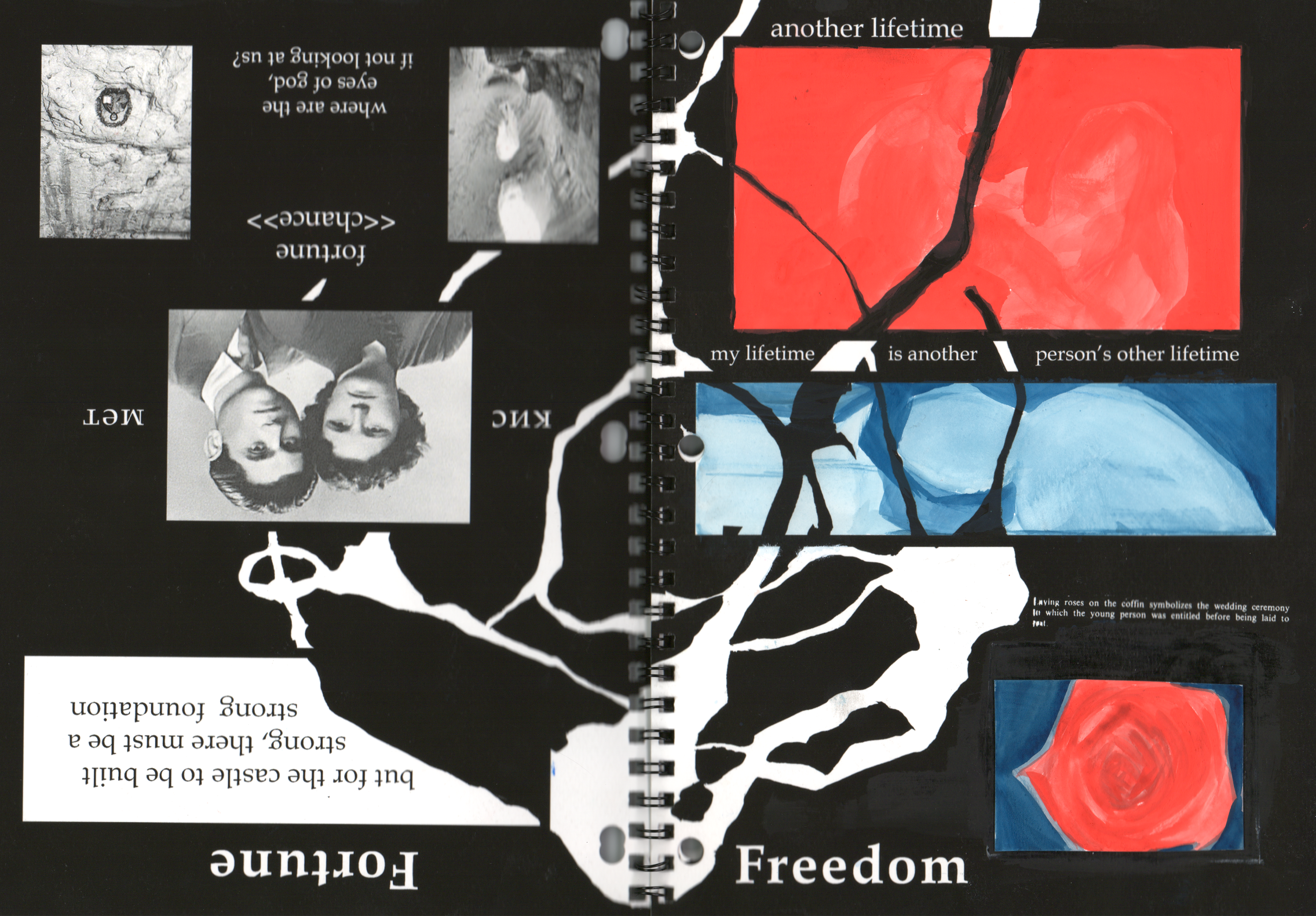
- Panels on the right side of the page show watercolor drawings of a mother and child, someone kneeling beside a coffin, and a rose. Text beside the drawings says "another lifetime. my lifetime is another person's other lifetime. Laying roses on the coffin symbolizes the wedding ceremony to which a young person was entitled before being laid to rest. Freedom." The left page is upside-down and black and white. There are photos of a couple and Bulgarian sites. Text reads, "Fortune. but for a castle to be built strong, there must be a strong foundation. късмет. fortune. «chance». where are the eyes of god, if not looking at us?"
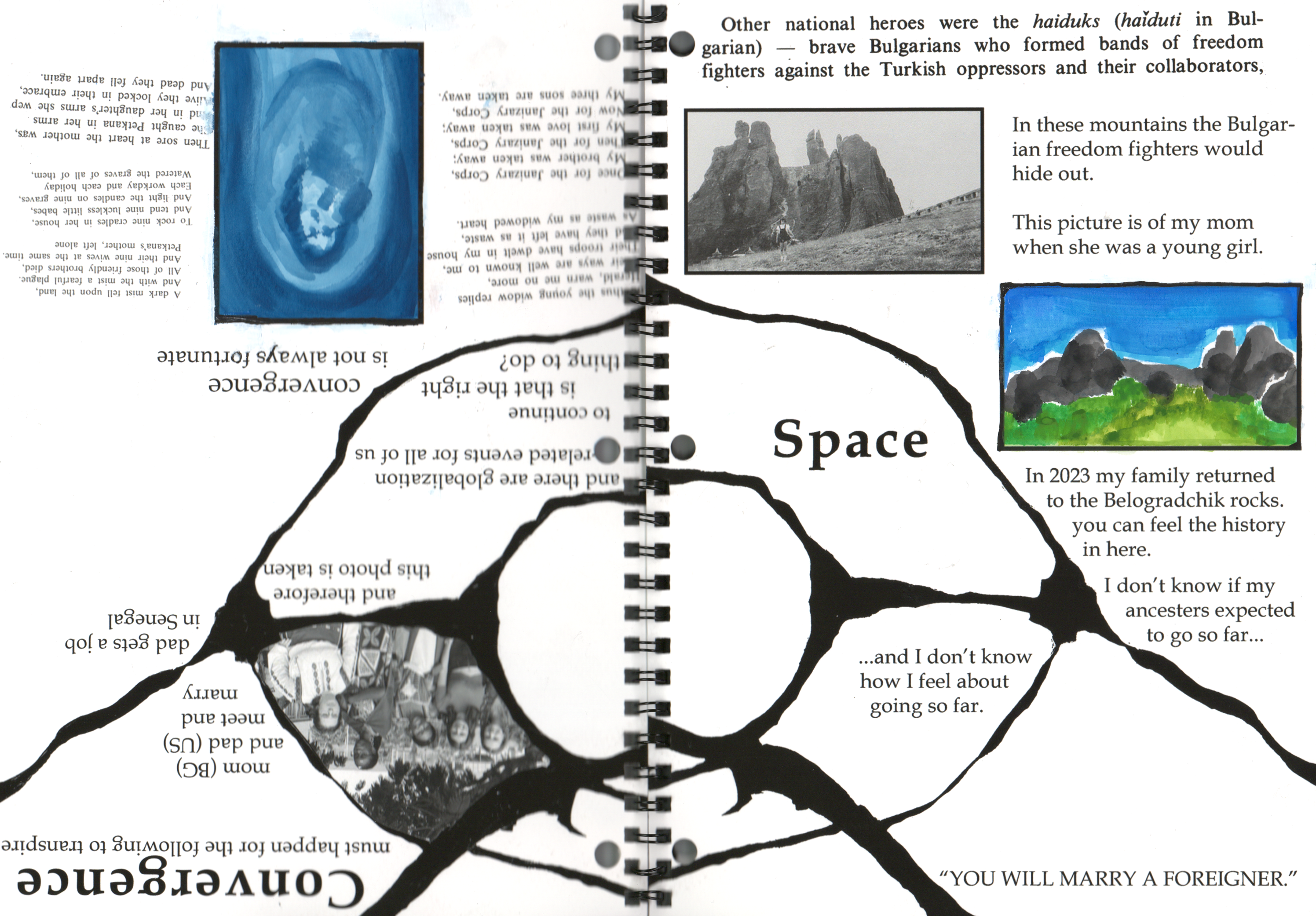
- On the right, there is a black and white photograph of a natural landmark as well as a watercolor painting of the same place and text which reads, "Space. Other national heroes where the haiduks (haǐduti in Bulgarian)—brave Bulgarians who formed bands of freedom fighters against the Turkish oppressors and their collaborators. In these mountains the Bulgarian freedom fighters would hide out. This photo is of my mom when she was a small girl. In 2023, my family returned to the Belogradchik rocks. you can feel the history in here. I don't know if my ancestors expected to go so far… and I don't know how I feel about going so far. "YOU WILL MARRY A FOREIGNER."" The left page is upside down, with a modern black and white photograph of young people in cultural wear and a blue watercolor of an icon. Text reads, "Convergence. must happen for the following to transpire. mom (BG) and dad (US) meet and marry. dad gets a job in Senegal and therefore this photo is taken. and there are globalization related events for all of us. to continue is that the right thing to do? convergence is not always fortunate." There is small collaged text beneath this with folksongs verses.
"БГ (BG)"
November 2024
Zine; watercolor and printer ink on cardstock
8 pages; 7x9.75"
Our assignment was to create a zine utilizing any mediums but while including a past sculpture and on the subject of memories. A zine is a self-published booklet that is not proliferated on a large scale. In this project, I play with the medium of the zine as a cyclical artwork. This informed my choices to compose the images in both directions to create a new reading order, as well as to spiral bind it. Cyclicality ties in to the theme of my zine. Family and history is a determiner of the present and means to understand injustice. My identity as Bulgarian American informed the subject matter and color palette. White, red, and blue are a part of the national costume of Bulgaria and typical American patriotism. The process of creation involved digital collage, including: a publication on Bulgarian folklore by Assen Nicoloff, my prose, artwork, photographs of Bulgaria, and family portraits. My study of typography continued to be relevant when it came to my collage and writing. Typography and writing provided structure that would be expanded upon and come into conflict with my visual artwork. When printed, I used watercolor to add texture and emphasis because of the physicality attached to this medium. Additionally, this object is unique, as only one edition exists. Note that this zine incorporates my painting "Inside". The psyche and trauma of one's ancestors and culture remaining relevant to oneself was a concept I represented using this motif lifted from a self-portrait of my skull.
Access a video desciption here.
A person flips through a spiral-bound comic from a birds-eye view. The pages have printed ink and text with watercolor, marker, and colored pencil additions.
"Planet Halo (Star Trek: Gemini System)"
December 2024
Zine; Watercolor, alcohol markers, and printer ink on cardstock
24 pages; 6.5x9"
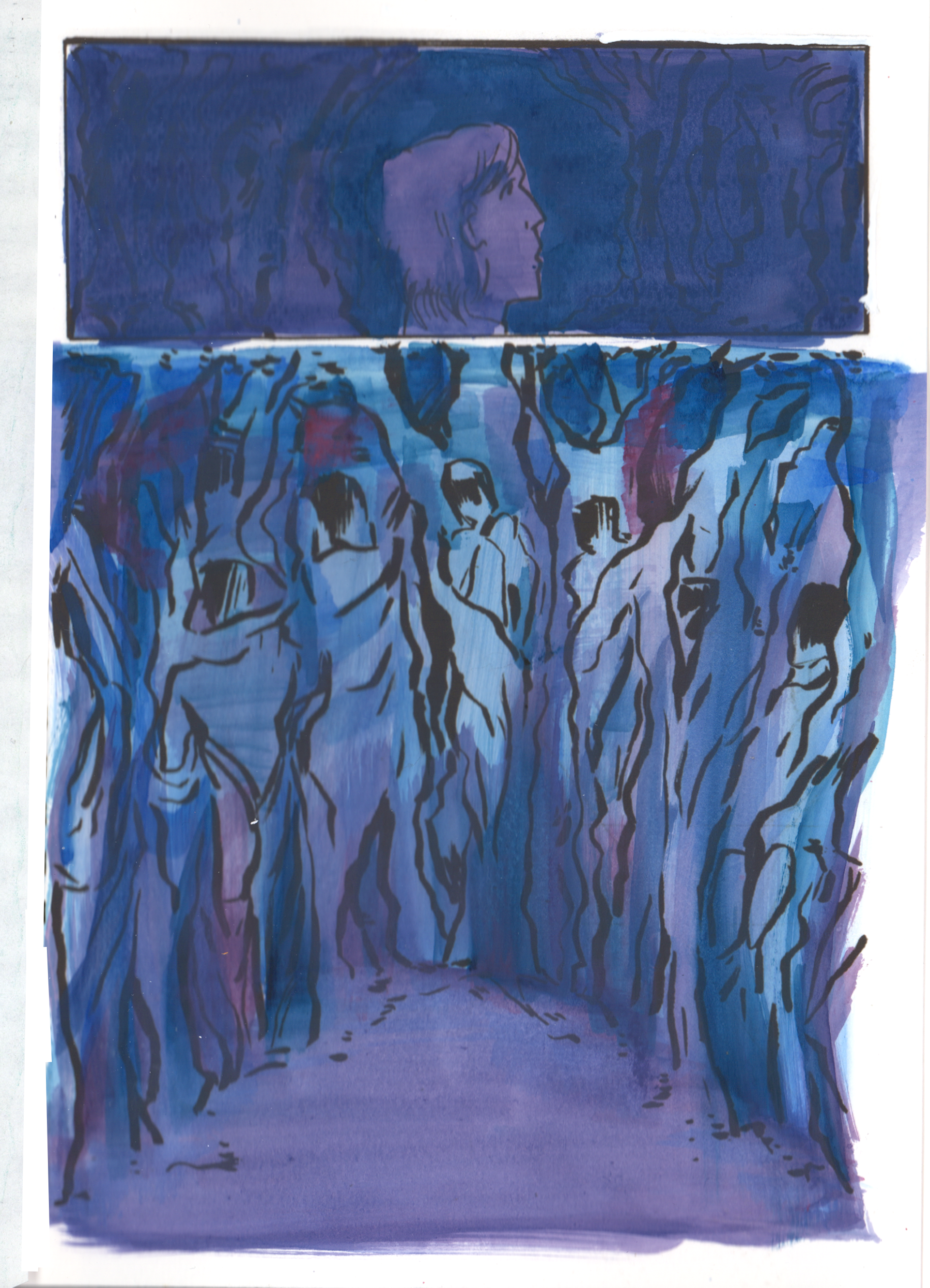
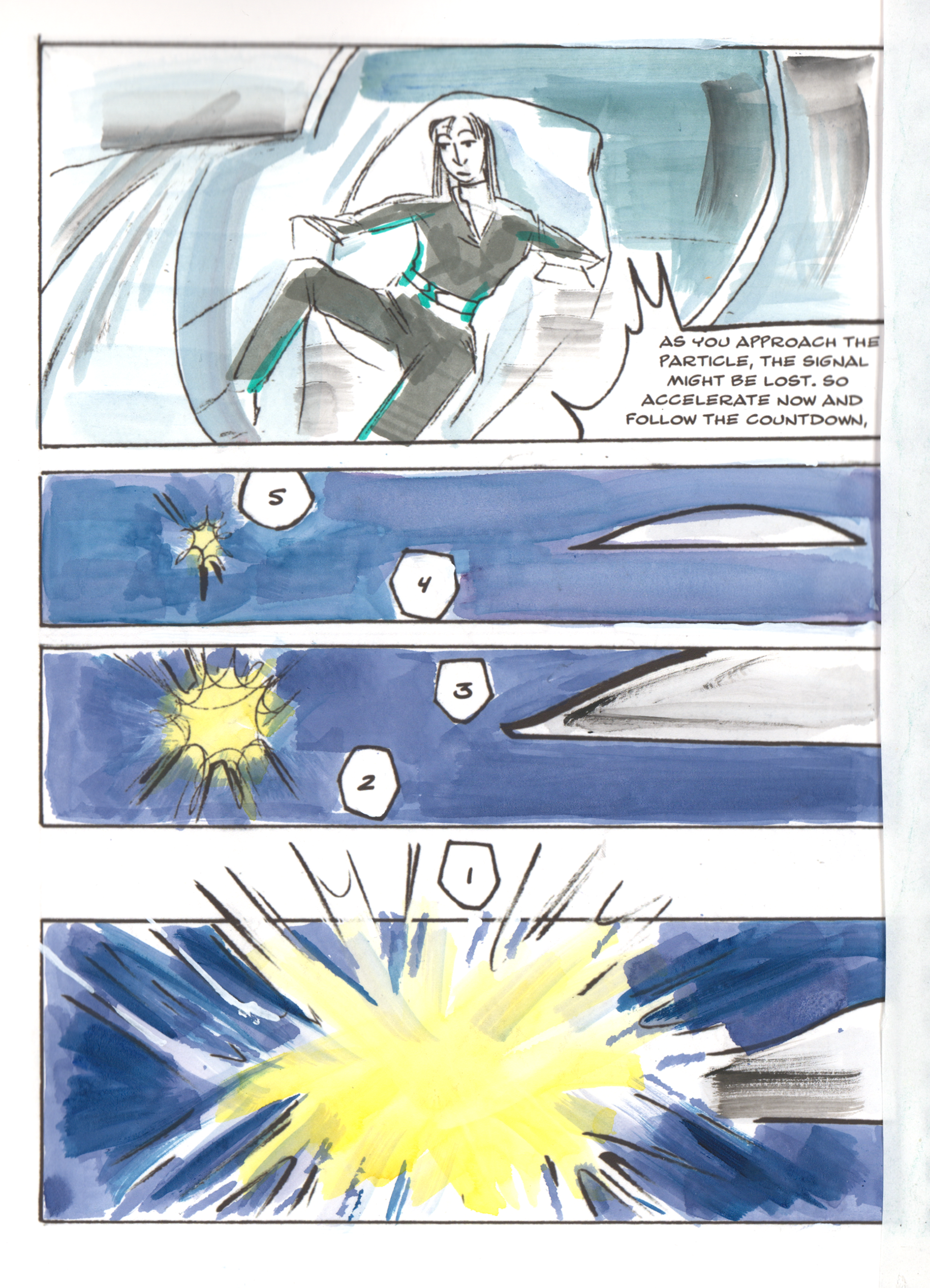
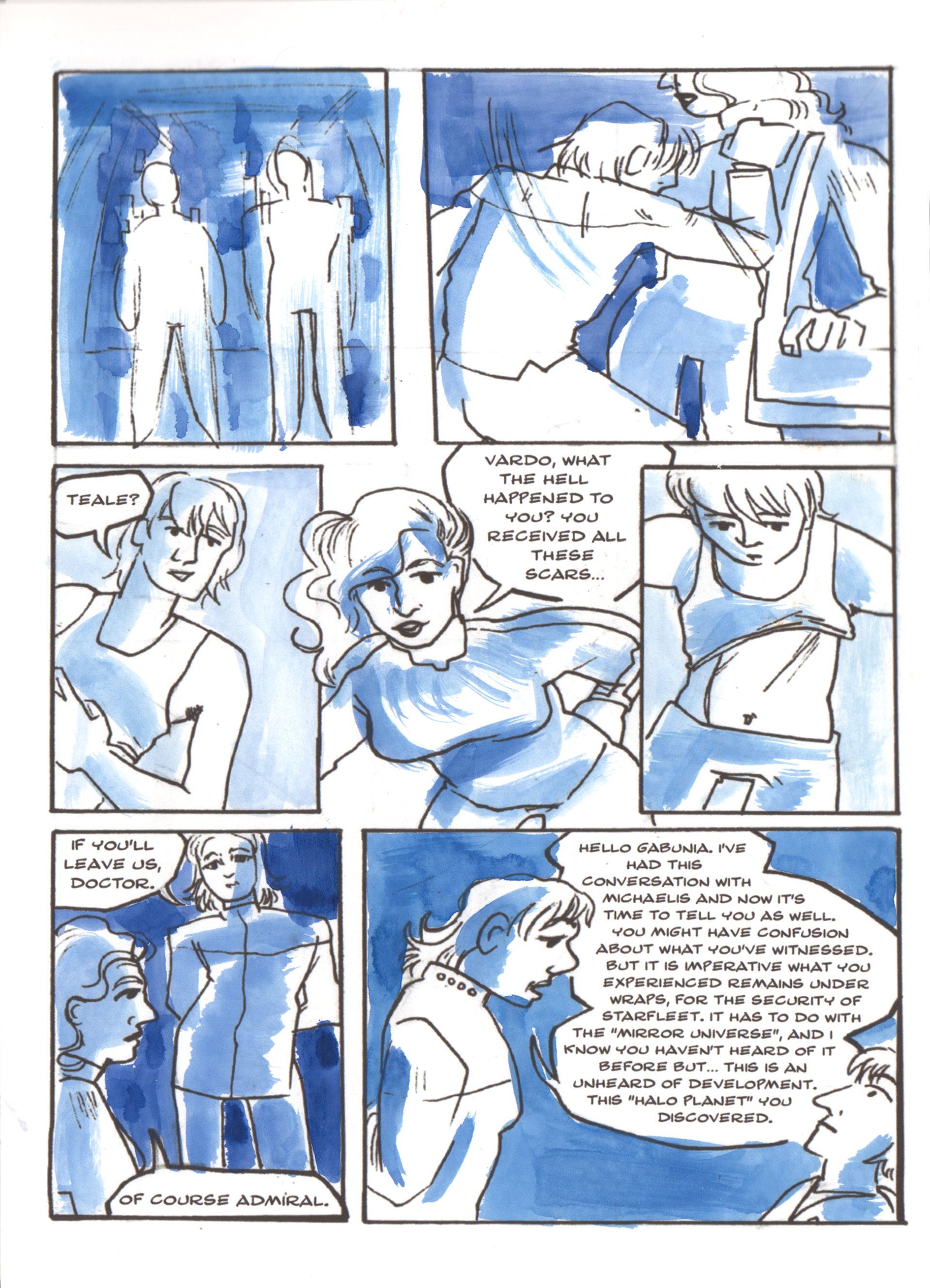
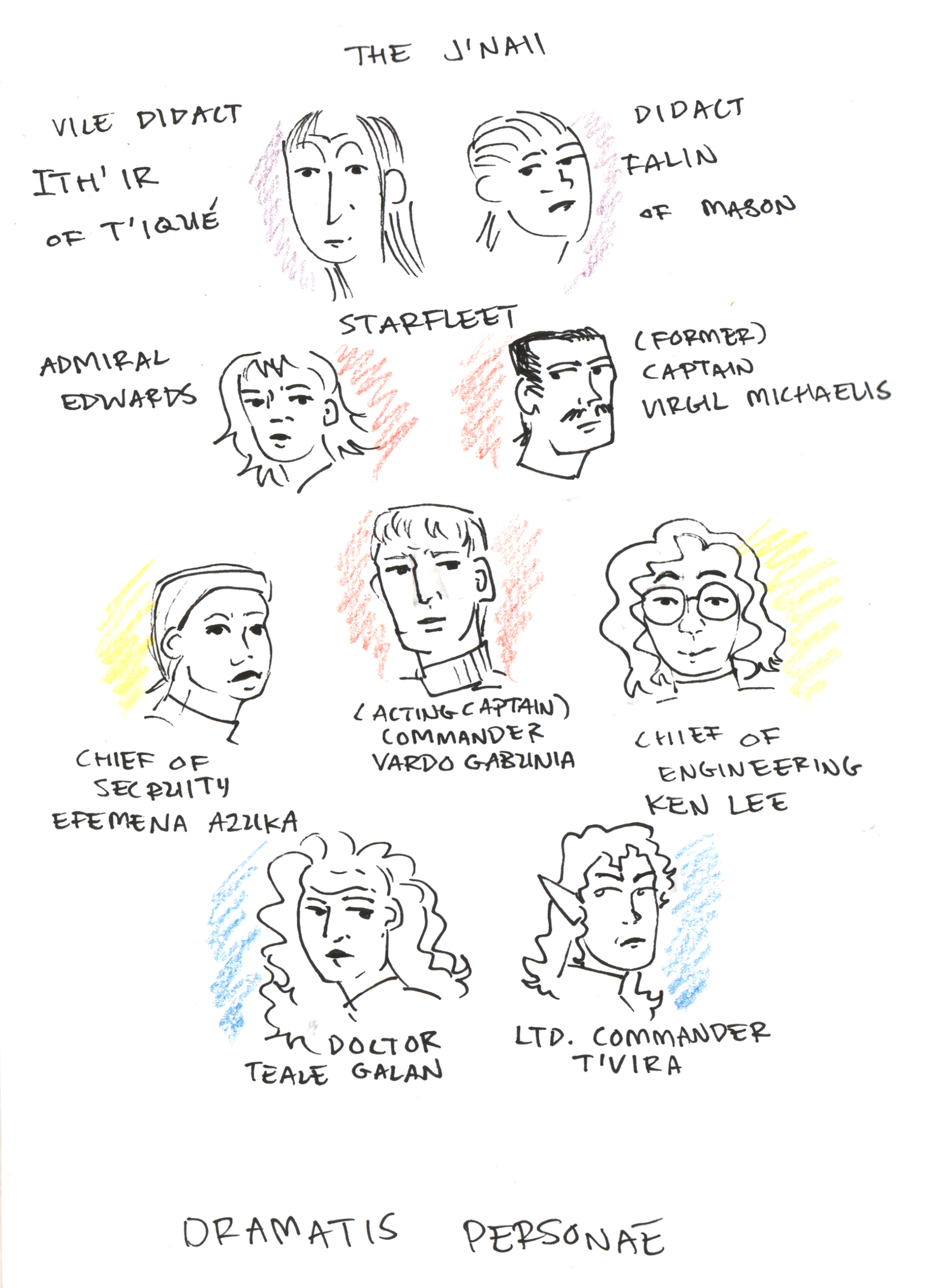
This comic zine was created for my final project. The story utilizes the world of Star Trek but is my own creation. Within one week I had completed my outline, script, and thumbnails. It took another week to draw my comic onto the full-size paper, and in the days following that I inked my comic, scanned it, and added text via photoshop. From there, I printed it out, painted select areas using watercolor and alcohol markers and bound the zine. My multimedia process and intense planning produced a high standard of work that developed my ideas completely, especially considering the time frame. Relevant artistic choices include an atmospheric and emotional use of color, impressionist brushstrokes, and a visual connection to DIY media culture. Below are some assorted pages from this comic that I feel best represent this work.
Two-dimensional Artwork
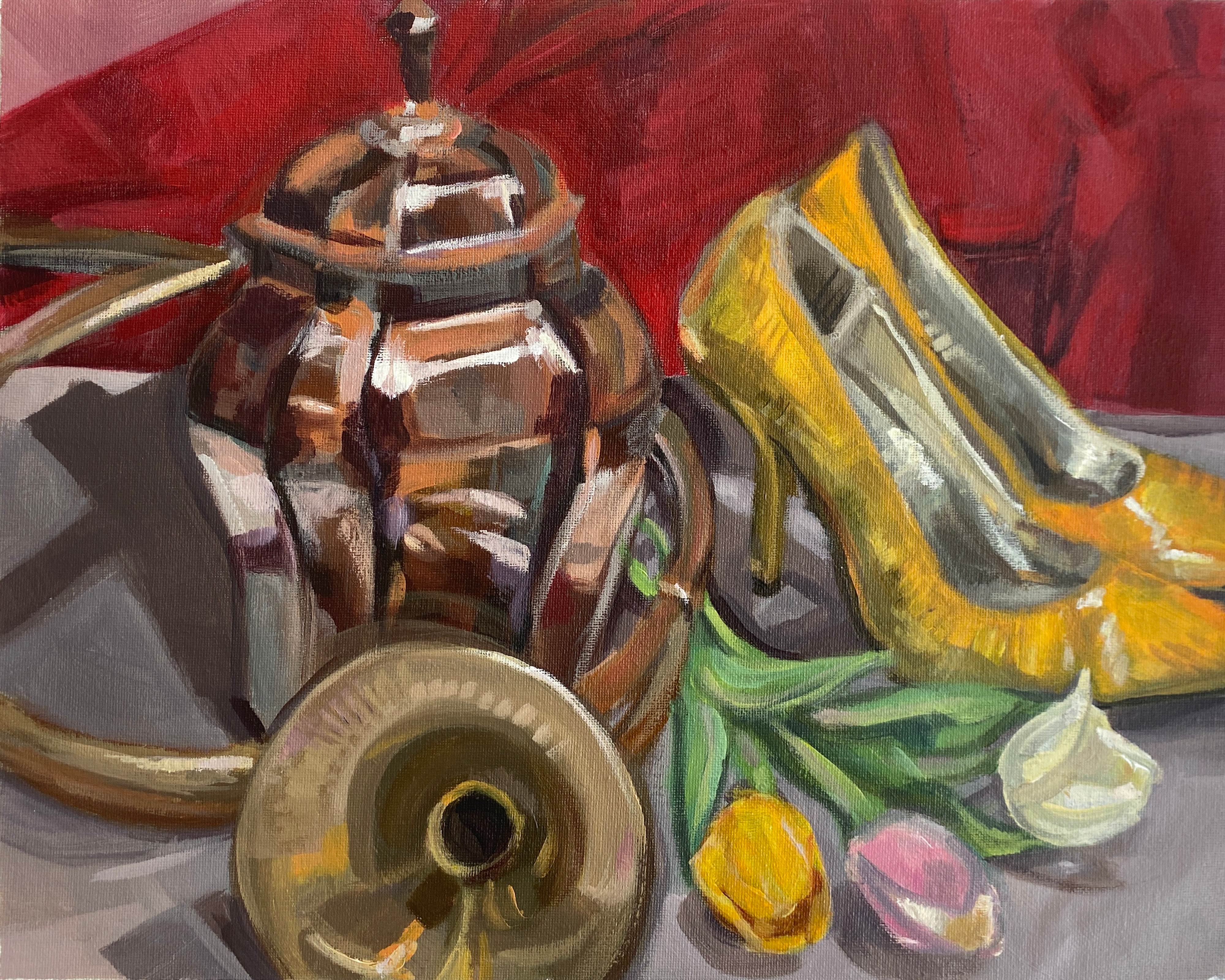
"Still life á la Leyendecker"
October 2025
Acrylic paint on canvas
18x12"
Prompted to paint a still life in the style of a famous painter, I chose American illustrator J.C. Leyendecker. Prior to painting, I accumulated references to assist in my understanding of Leyendecker's style. I additionally chose subject matter for this still life in line with the content of Leyendecker's paintings.
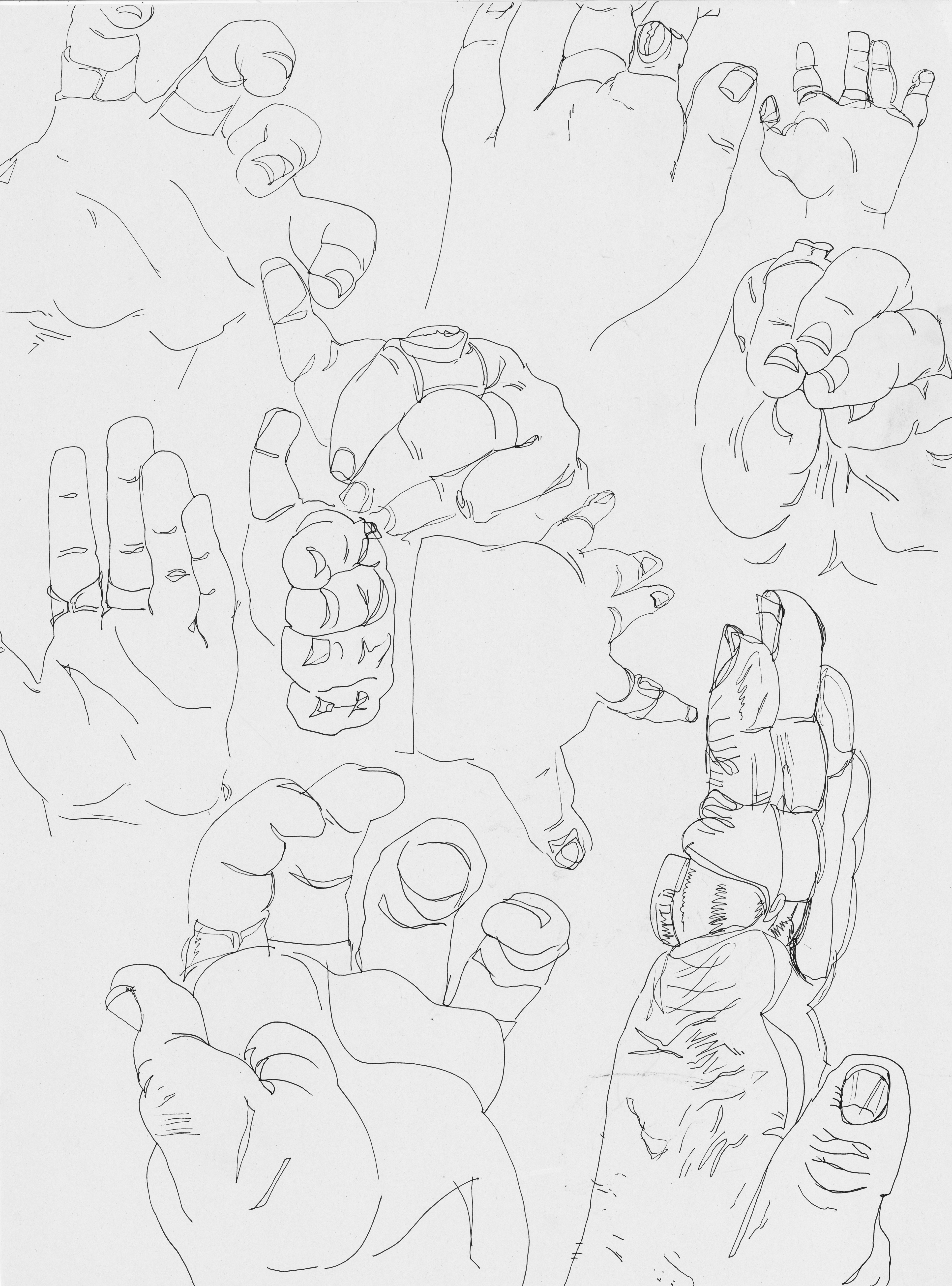
"Study of the Hand"
Janruary 2025
Inking markers on newsprint
18x24"
In this study, I drew my own hand from observation using contour lines. Using techniques related to line, I portrayed texture as well as the form of the hand. I additionally explored the technique of having a continuous line as a means of observing reality.
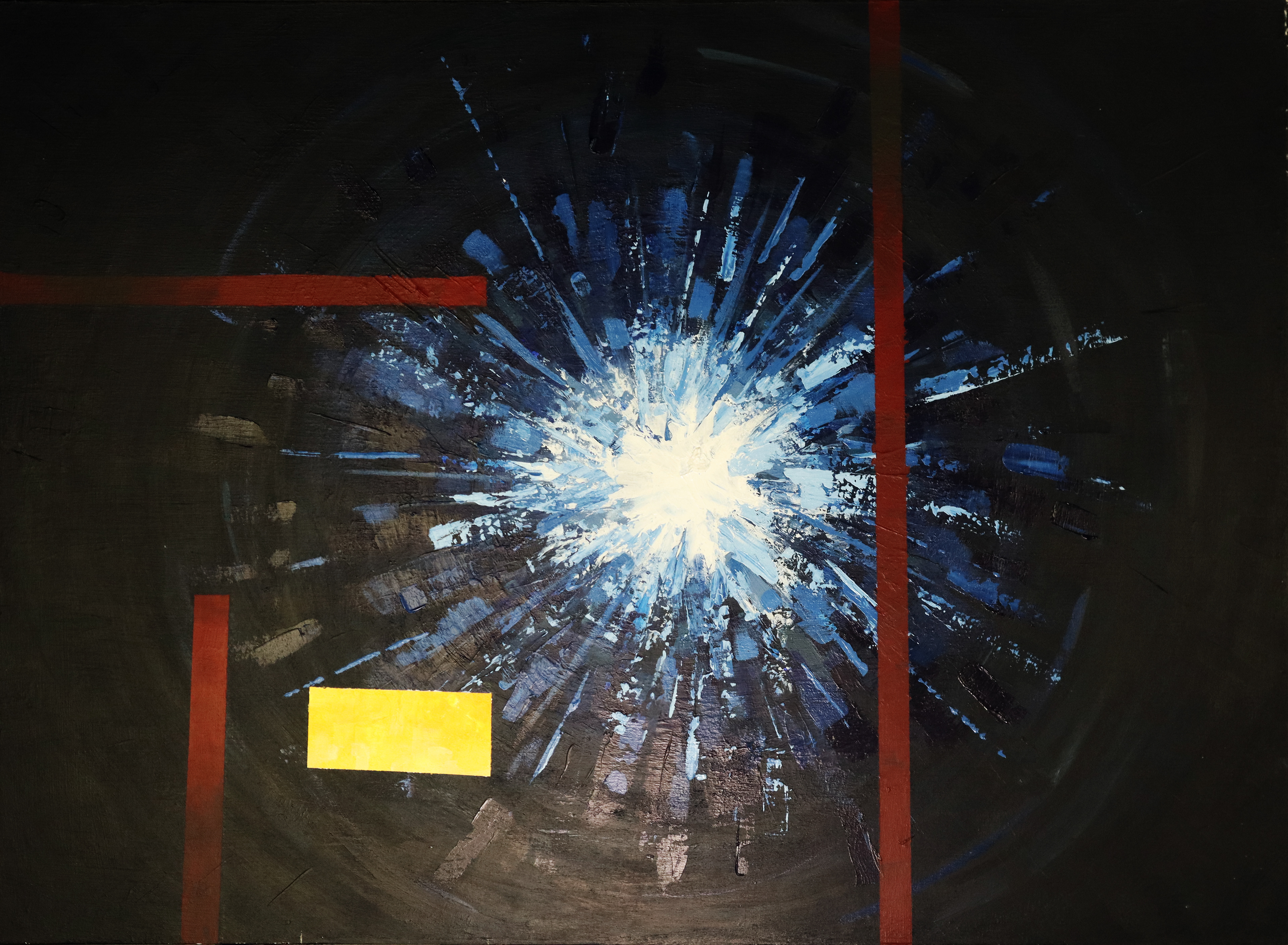
"Rules"
October 2024
Acrylic on panel
30x22"
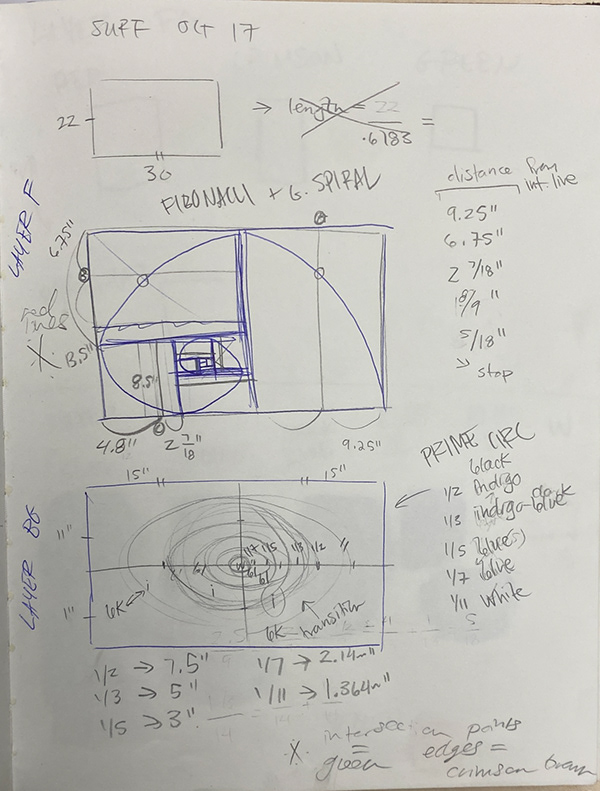
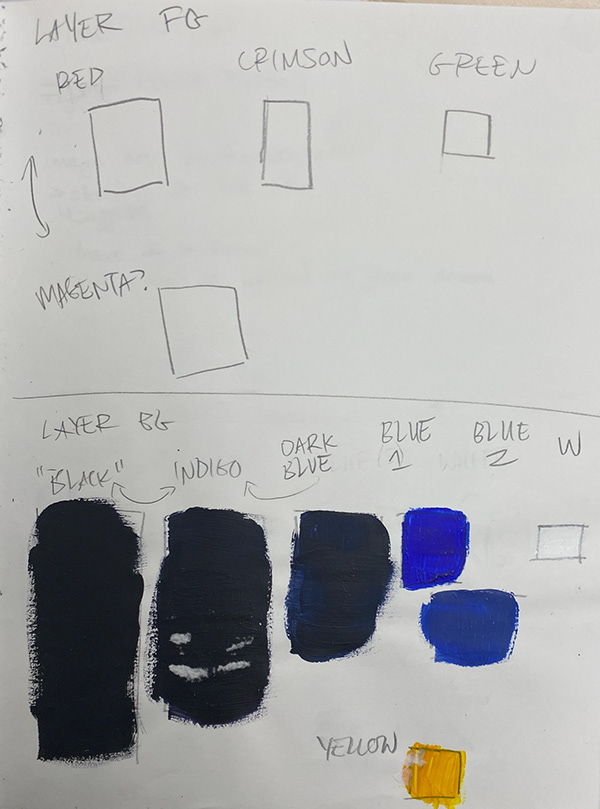
The creation of this painting involved a lot of plotting, as can be seen in my sketches. The fibonacci sequence and fractions were applied to the increments of the circular blue gradient in the center of the piece. Likewise, the red-green strips of paint are based upon the golden ratio and how the golden spiral would intersect with the aforementioned sections. Though color is very emotive, I integrate a rational focus based on math, as well as a visual allusion to space exploration.
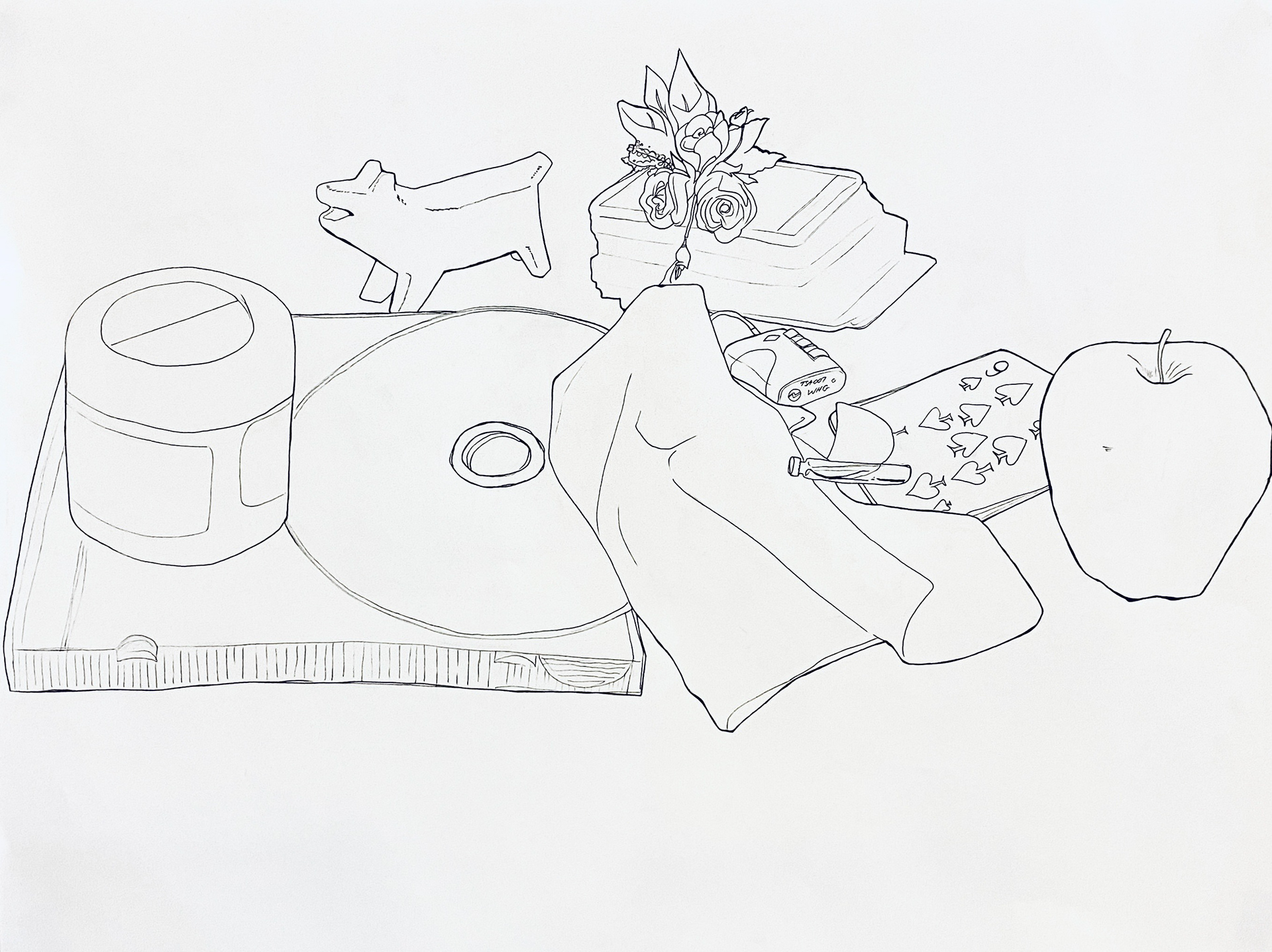
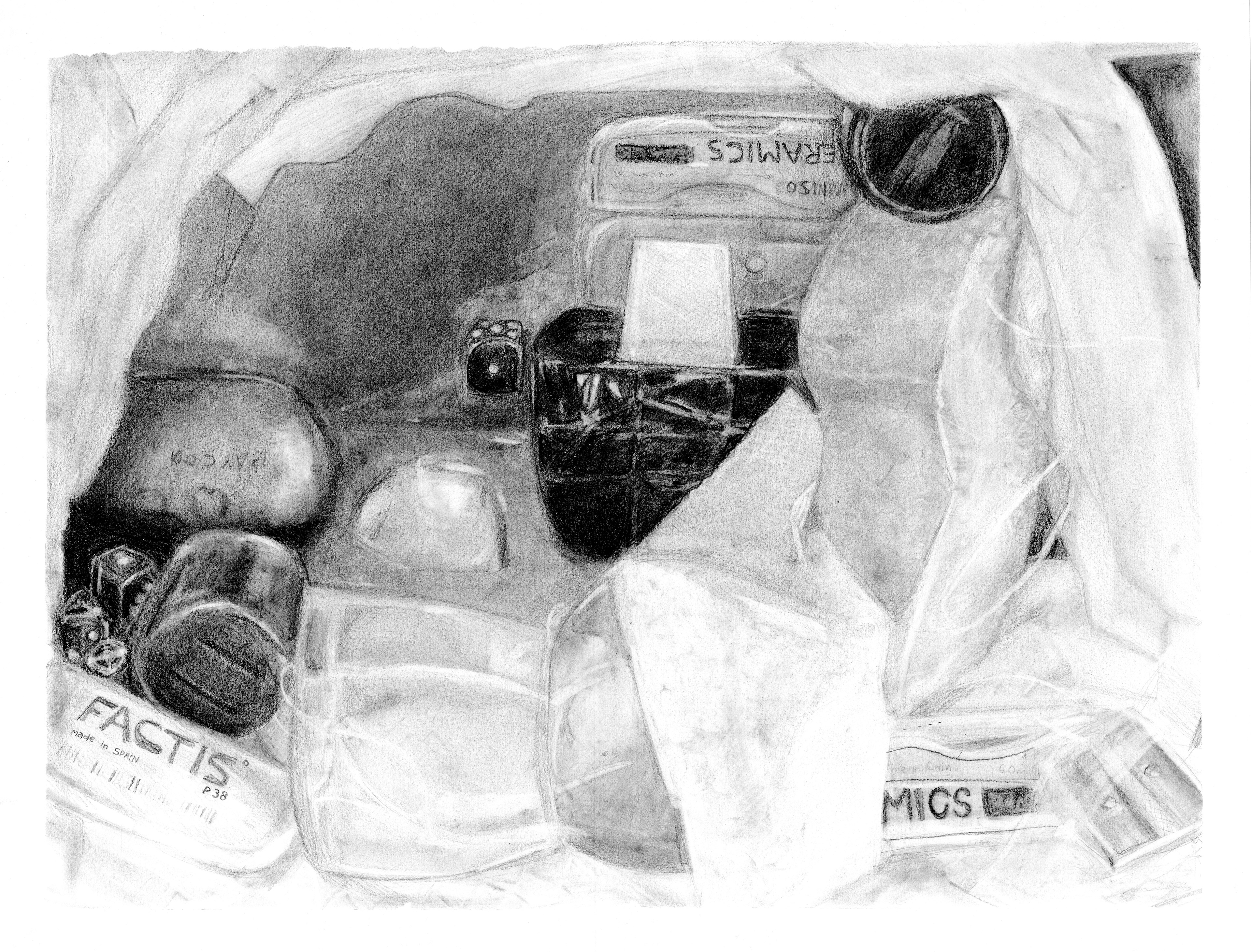
"Contour Drawing of Desk"
"View of Desk"
January 2025
Inking markers on paper
18x24"
Thinking about line as a principle of design, I used it to portray tight and detailed forms accurately as well as to suggest shapes by what bounds them or by lines broken up by negative space. The objects chosen have significance to my culture and life experiences.
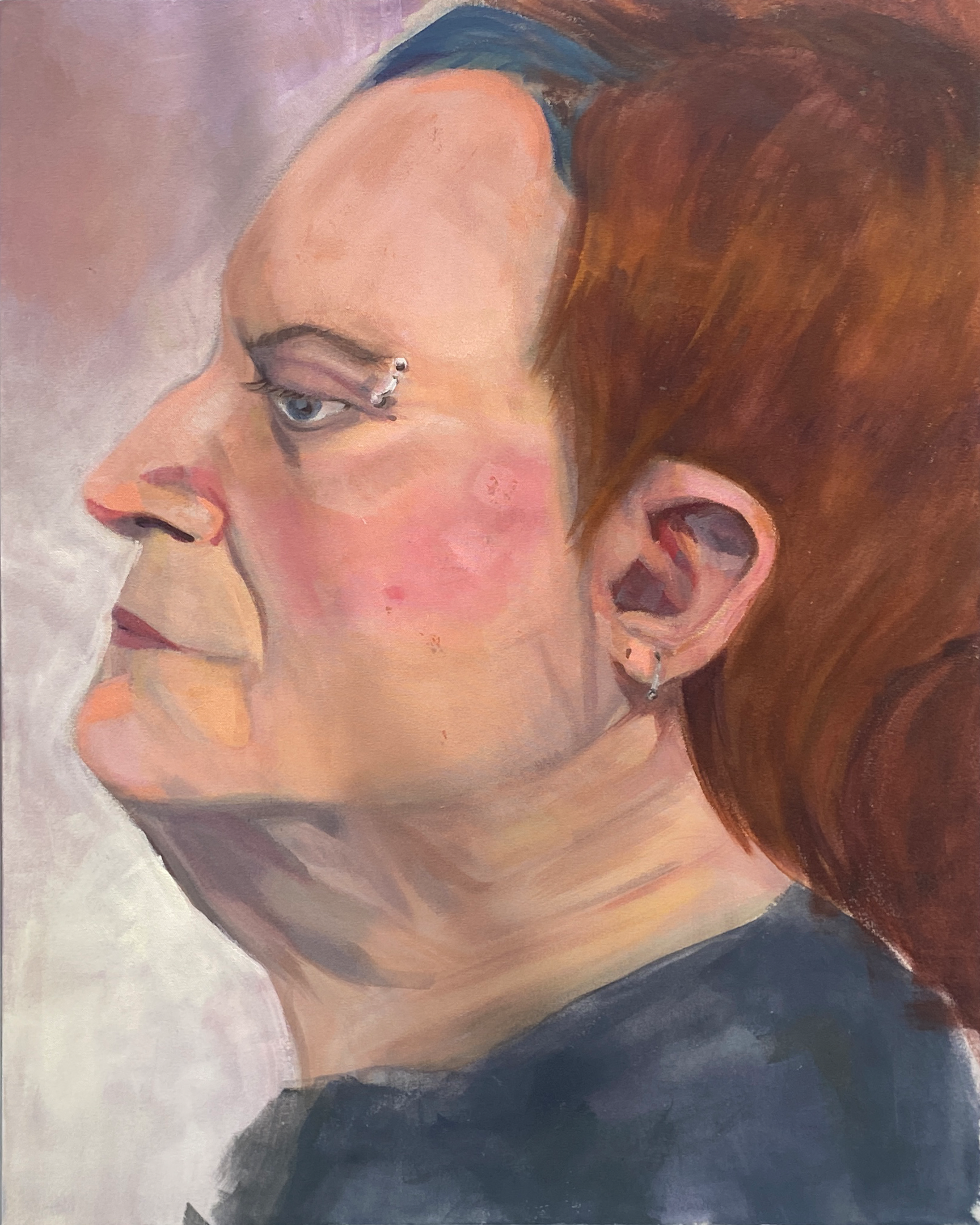
"Profile"
November 2025
Acrylic paint on canvas
24x30"
The painting's likeness is a model who sat for multiple sessions and was painted from observation.
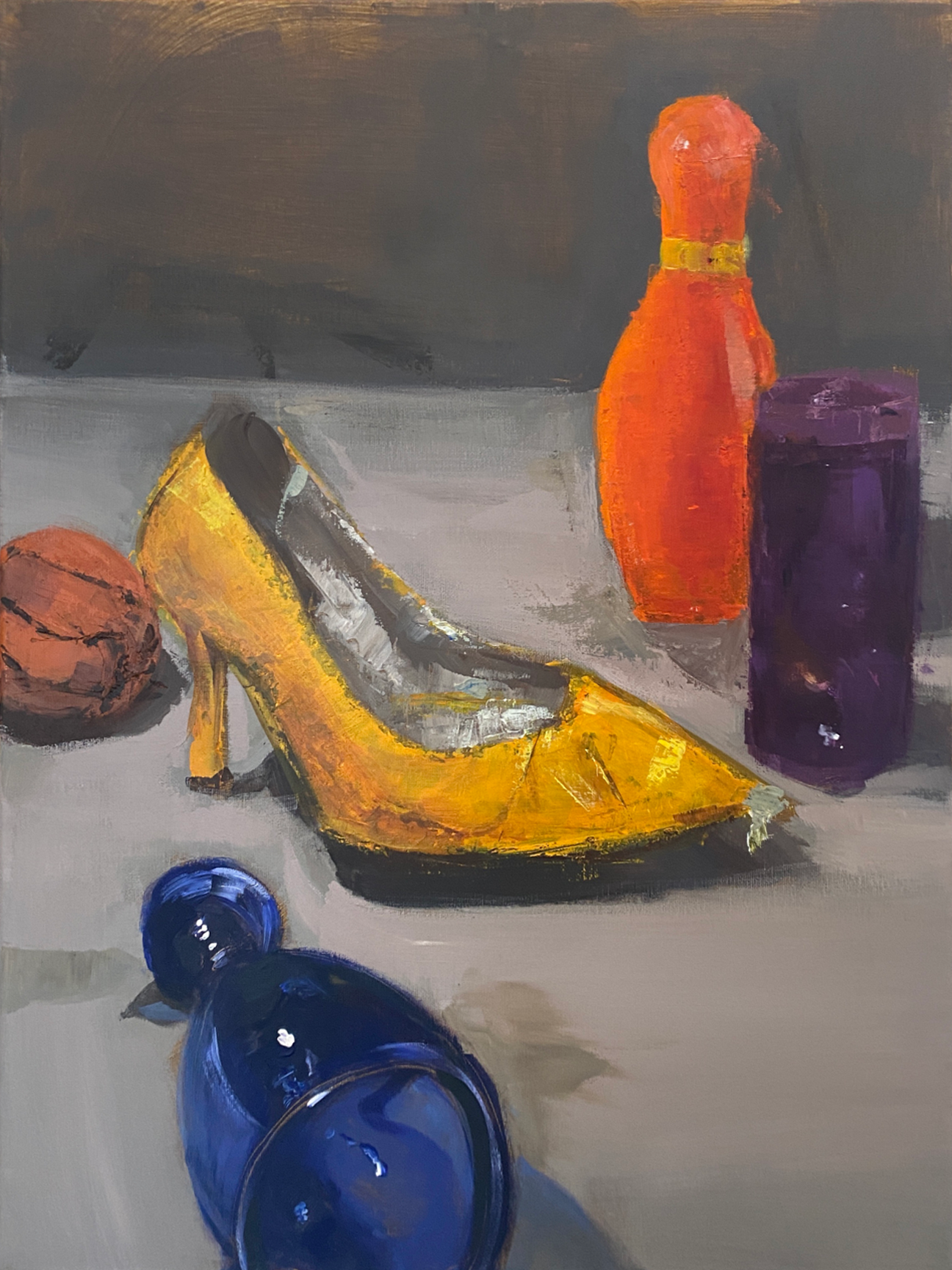
"Still Life of Five Objects"
September 2025
Acrylic paint on canvas
18x24"
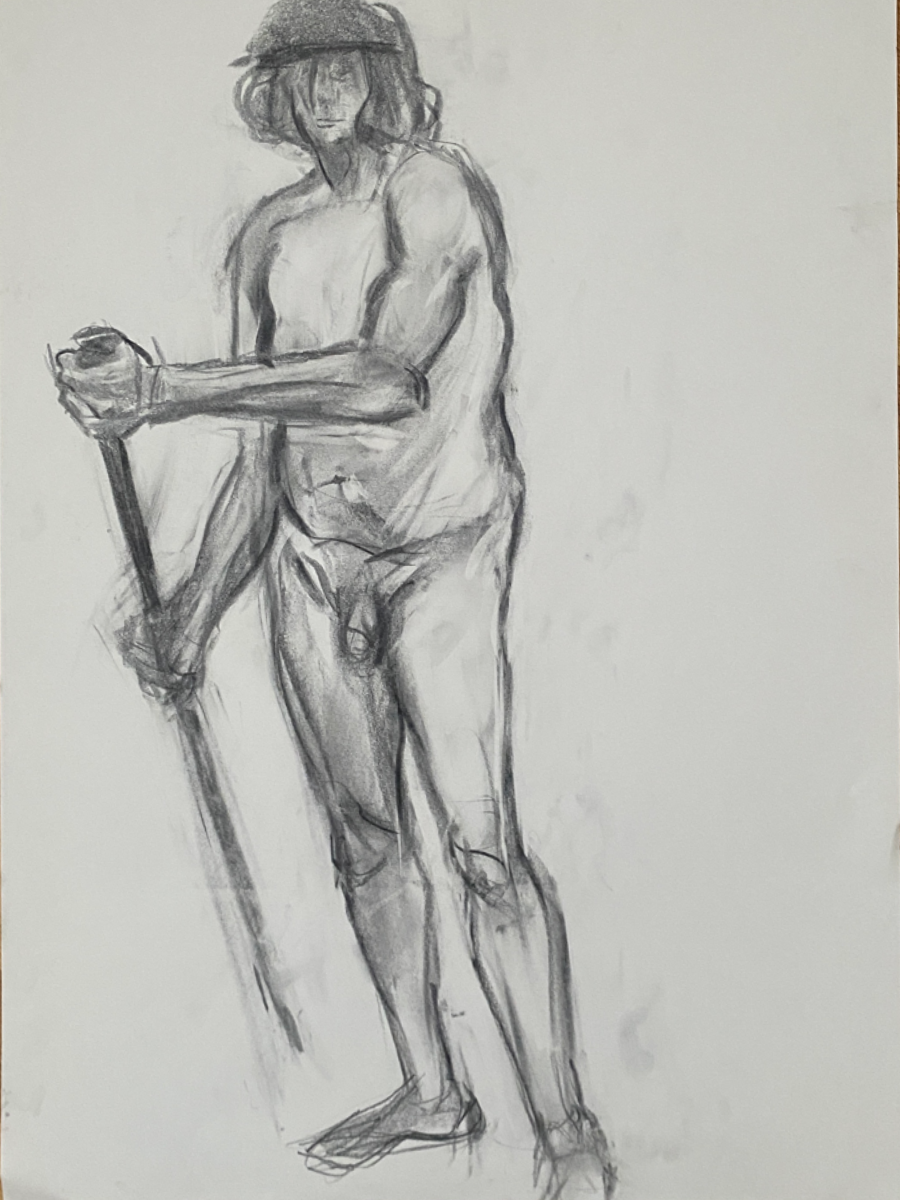
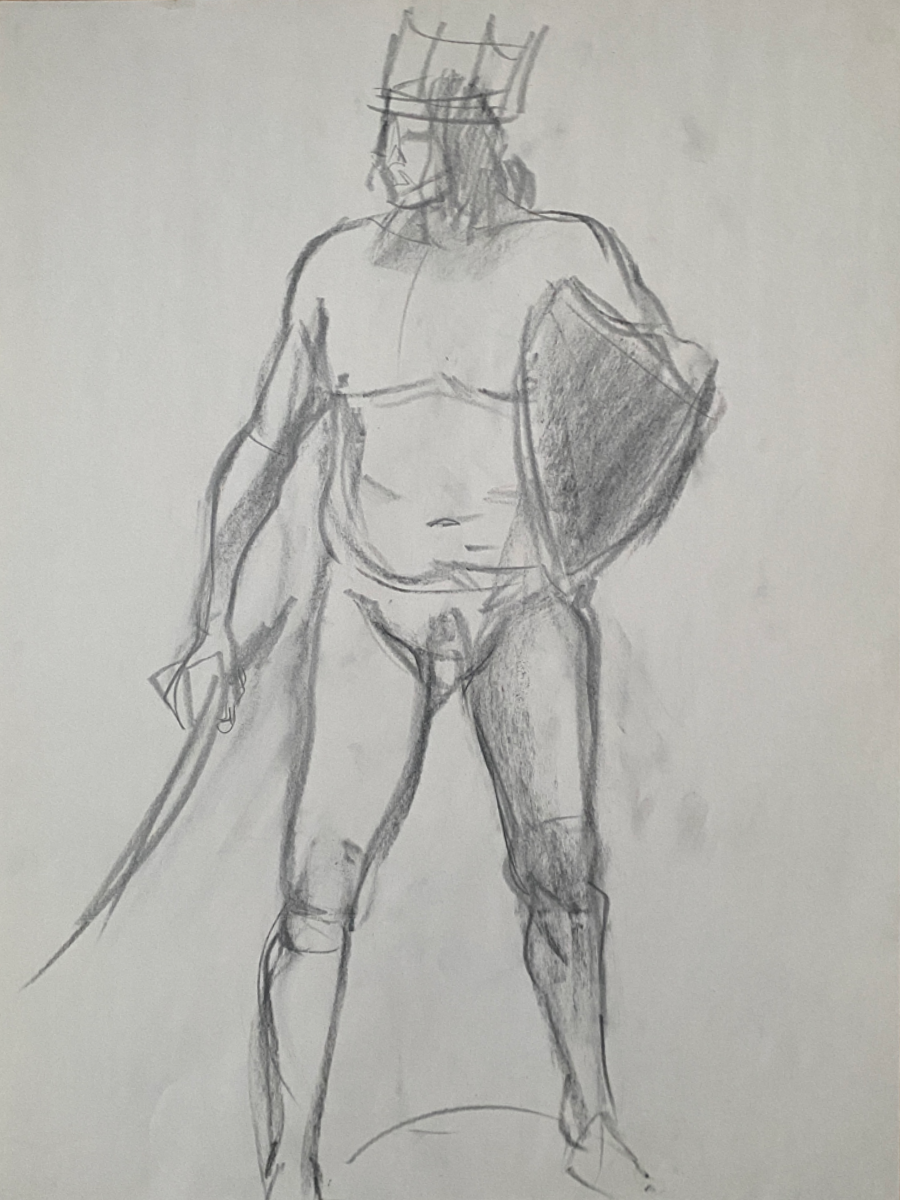
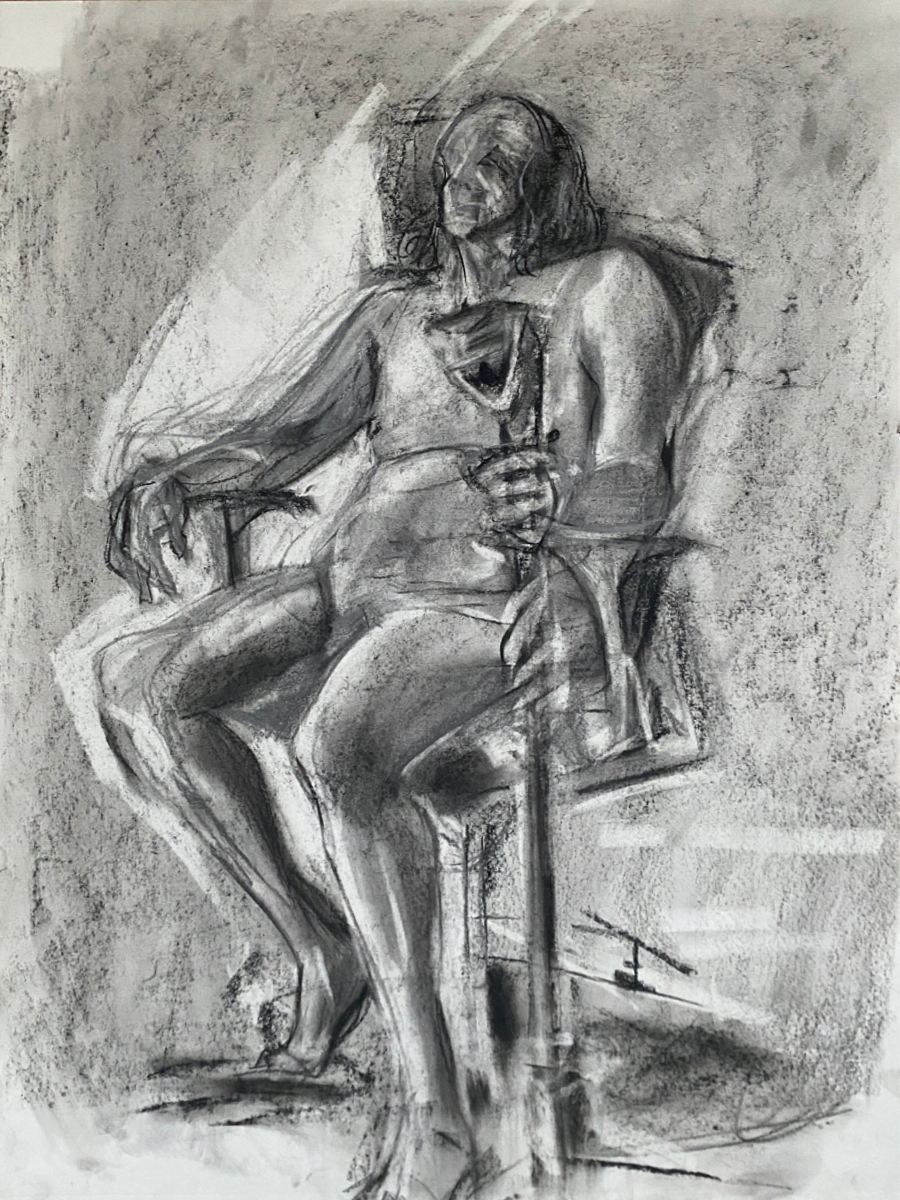
"Full figures"
May 2025
Charcoal on paper
18x24"; each
These figures are based off a live model, who posed in sessions close to 30 minutes in length. Capturing both the anatomy and weight of the pose were goals of mine for these sessions.
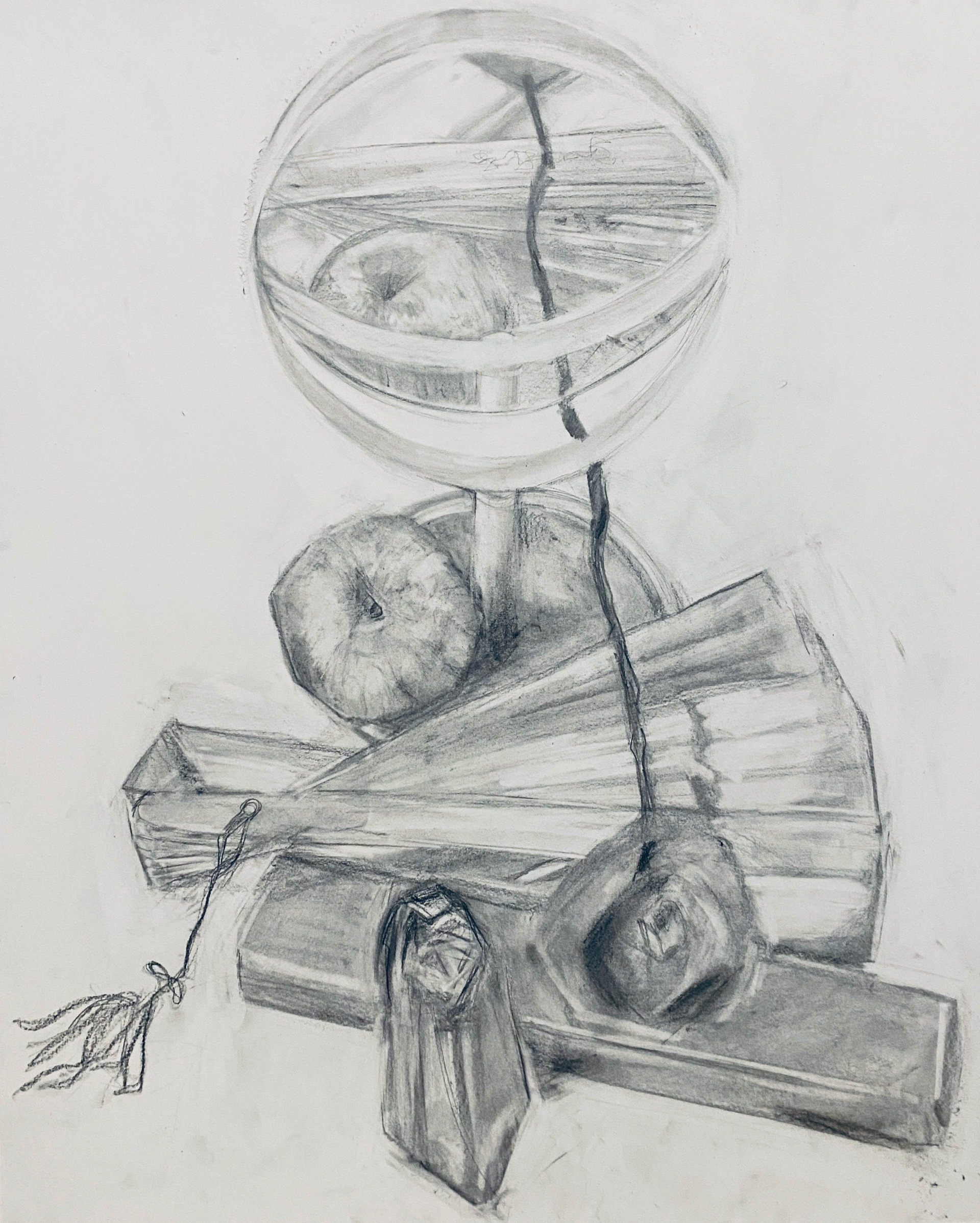
"Still life with Apple"
January 2025
Graphite on paper
18x24"
When it came to the light and interactions between these objects, I decided to use some impressionist techniques. For example, visible marksmanship allowed me to communicate details such as texture. Additionally, I blurred some parts of the drawing to bring attention to other areas and elicit the viewer’s focus.
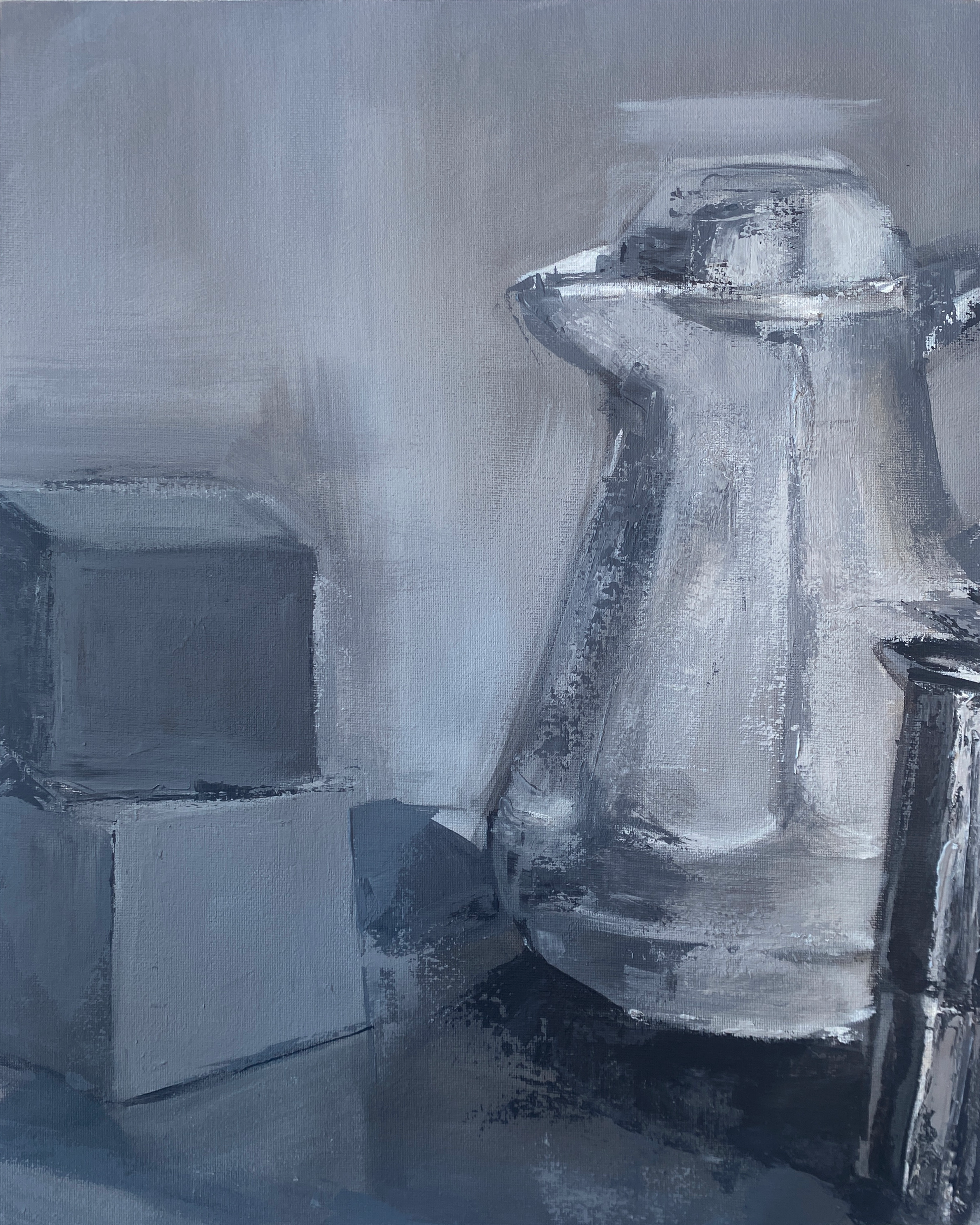
"Monochromatic Still Life"
September 2025
Acrylic paint on canvas
12x18"
"The Summering"
February 2025
Graphite on paper
18x24"
My artwork is an interpretation of the similarly titled painting by Đoko Mazalić. Objectives in this piece included a realistic depiction of the foreground/background relationship as well as the portrayal of light falling across the diagonal composition. I accomplished this by meticulously studying from my reference and ideating multiple times to get my drawing as close as possible to reality. Technical skills I applied included the use of my eraser to create contrast within dark objects as well as to blend. I also used my chamois to create consistent value within shapes.
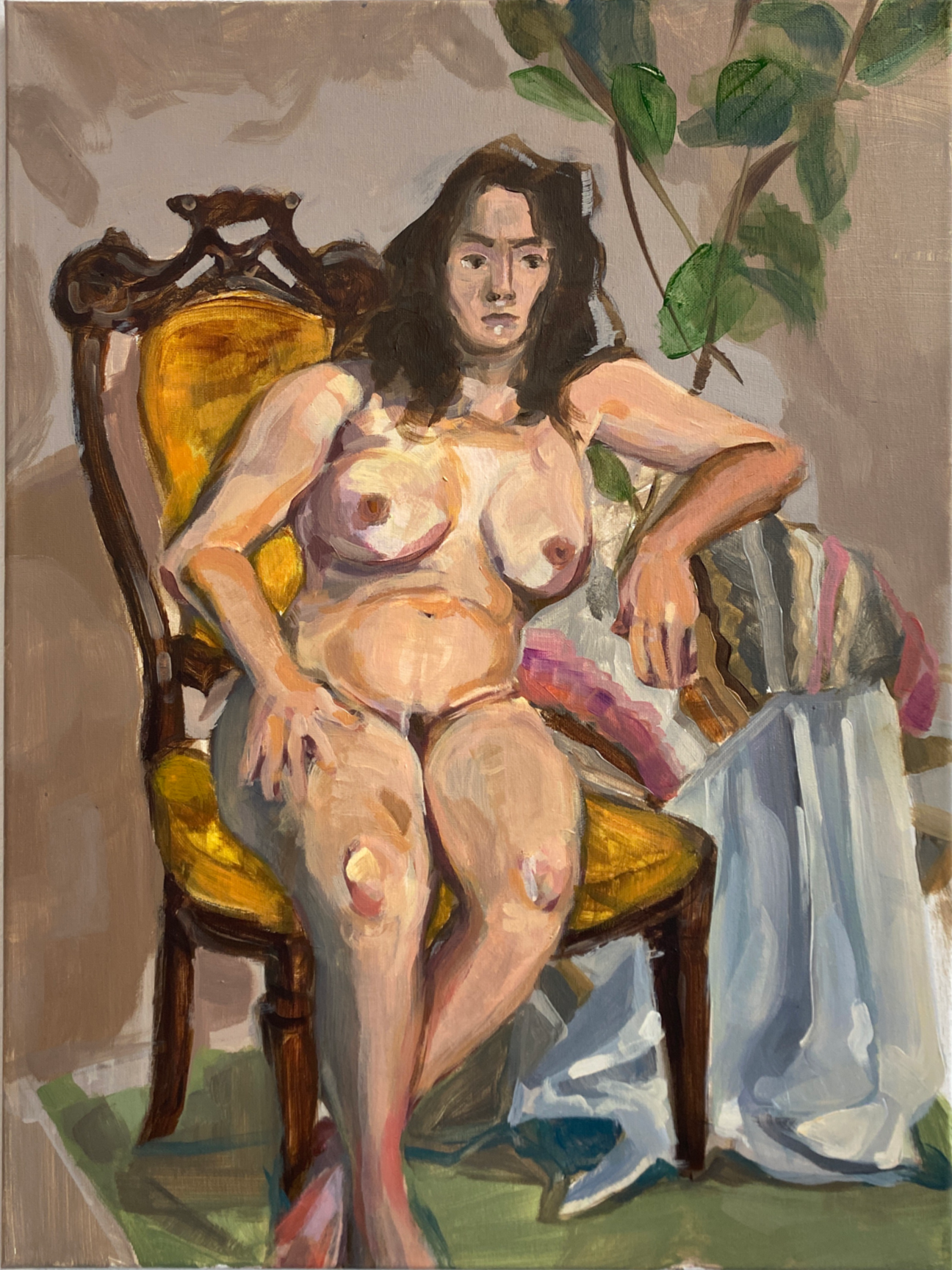
"Figure on chair"
November 2025
Acrylic paint on canvas
18x24"
This was painted from observation of a model across multiple sessions.
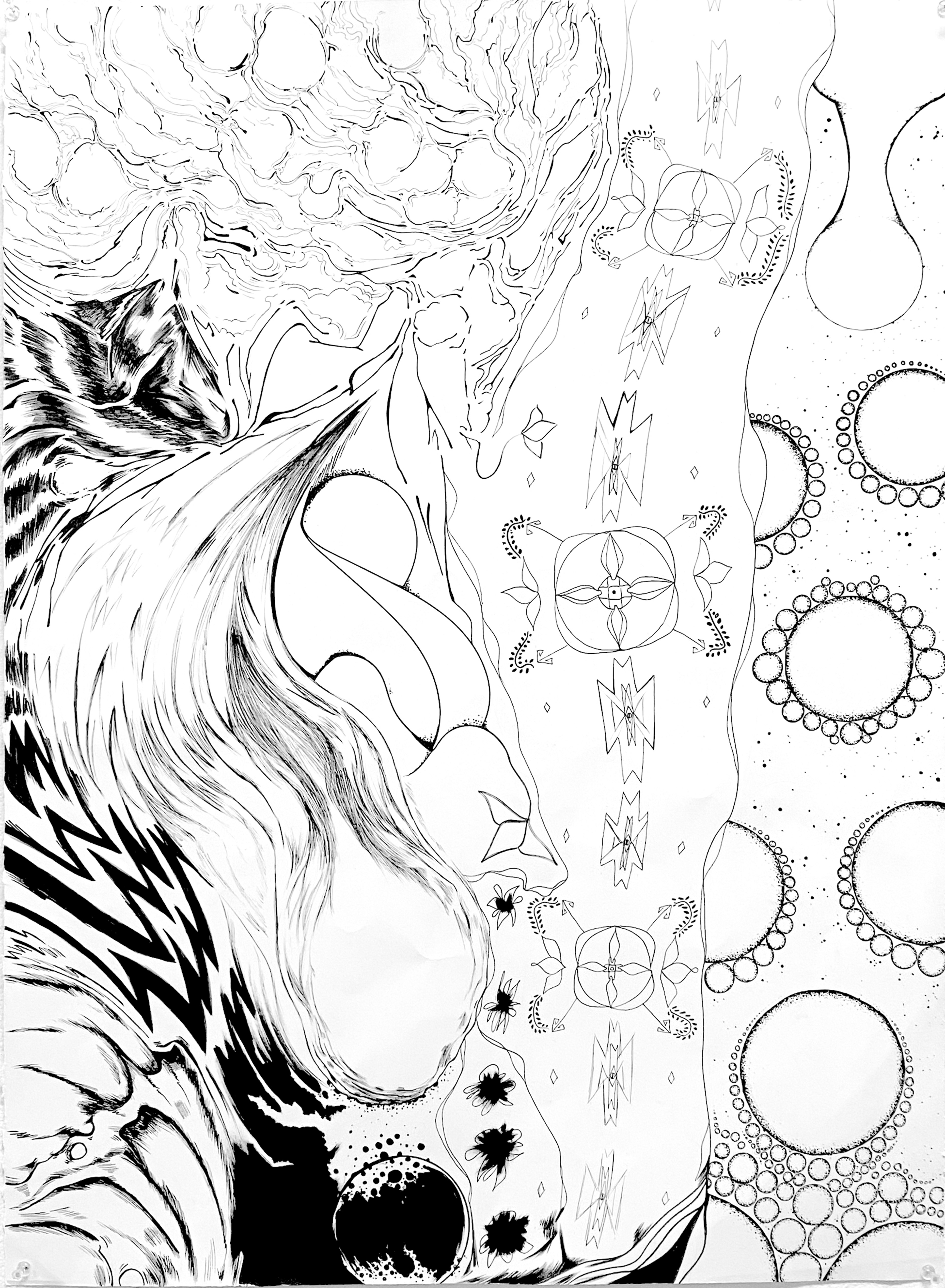
"The Plummet"
September 2024
Ink on paper
22x30"
My objective when investigating line was to portray precision and gravity. These two are portrayed through the contrast and placement of light and shadow. The concentration of lines within smaller areas as well as the use of patterns, both of which I explored in my sketchbook, aided in the creation of my dynamic composition.
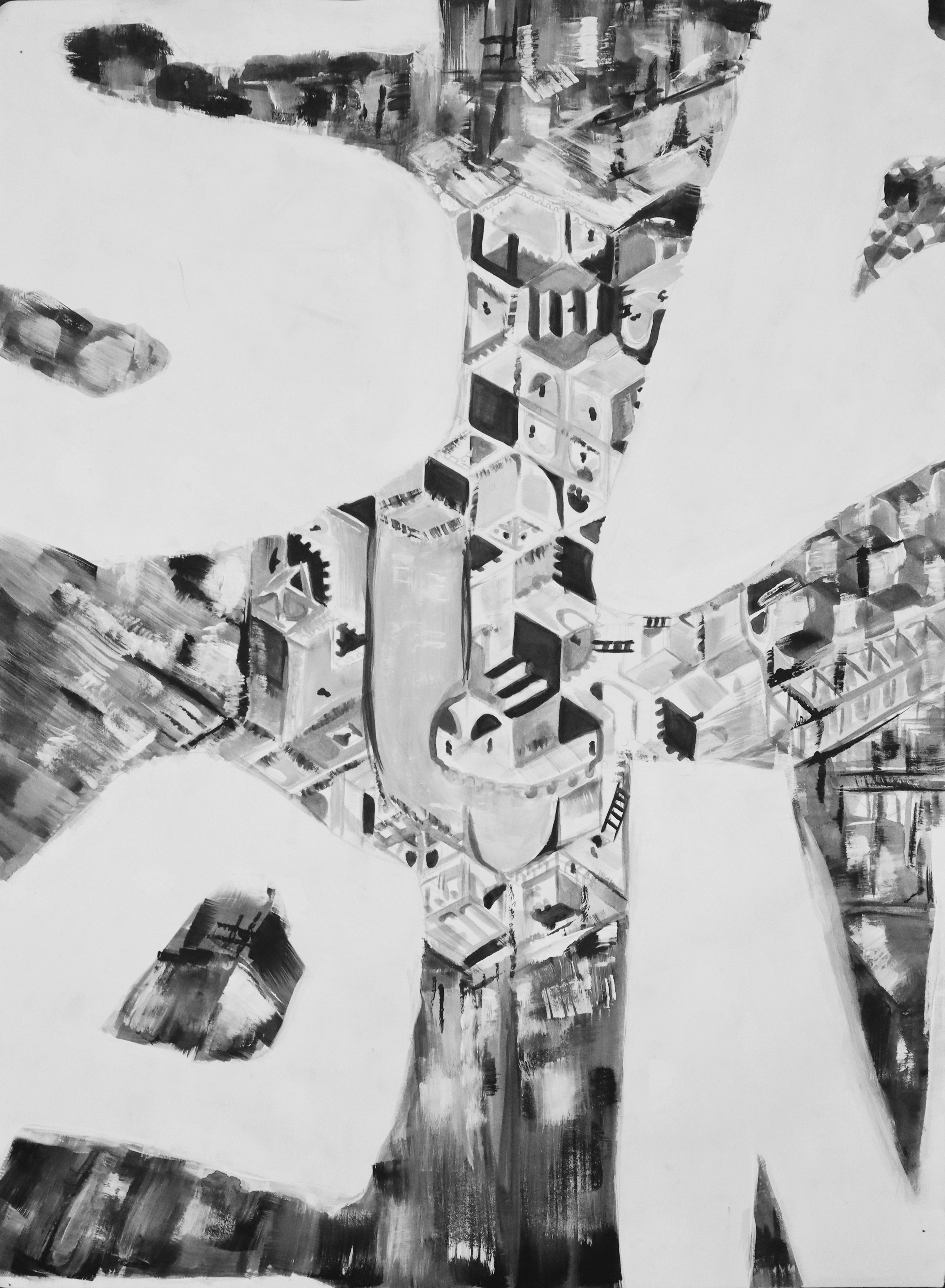
"Seen (But Not)"
October 2024
Gouache and acrylic on paper
22x30"
On the basis of the title word (“Seen”) I use typography as a communication tool that still signifies meaning even when not shown completely. My abstract portrayal of architecture on the outside of the composition and creation of infinite, irrational, yet recognizable isometric perspective are choices I pursued to unsettle the viewer when they aren’t given the full picture.
"Still Life with Flower and Eggs"
February 2025
Graphite on paper
12x16"
The still life that served as the subject of this drawing contained dramatic shadows and lighting. When it came to portraying these tenebristic values through graphite, I used technical methods to cover large swaths of the canvas. For example, using tight circles to create smooth gradients and applying multiple layers of pencil. I additionally used soft and visible pencil lines as a technique to render texture and quality of light, as well as mood.
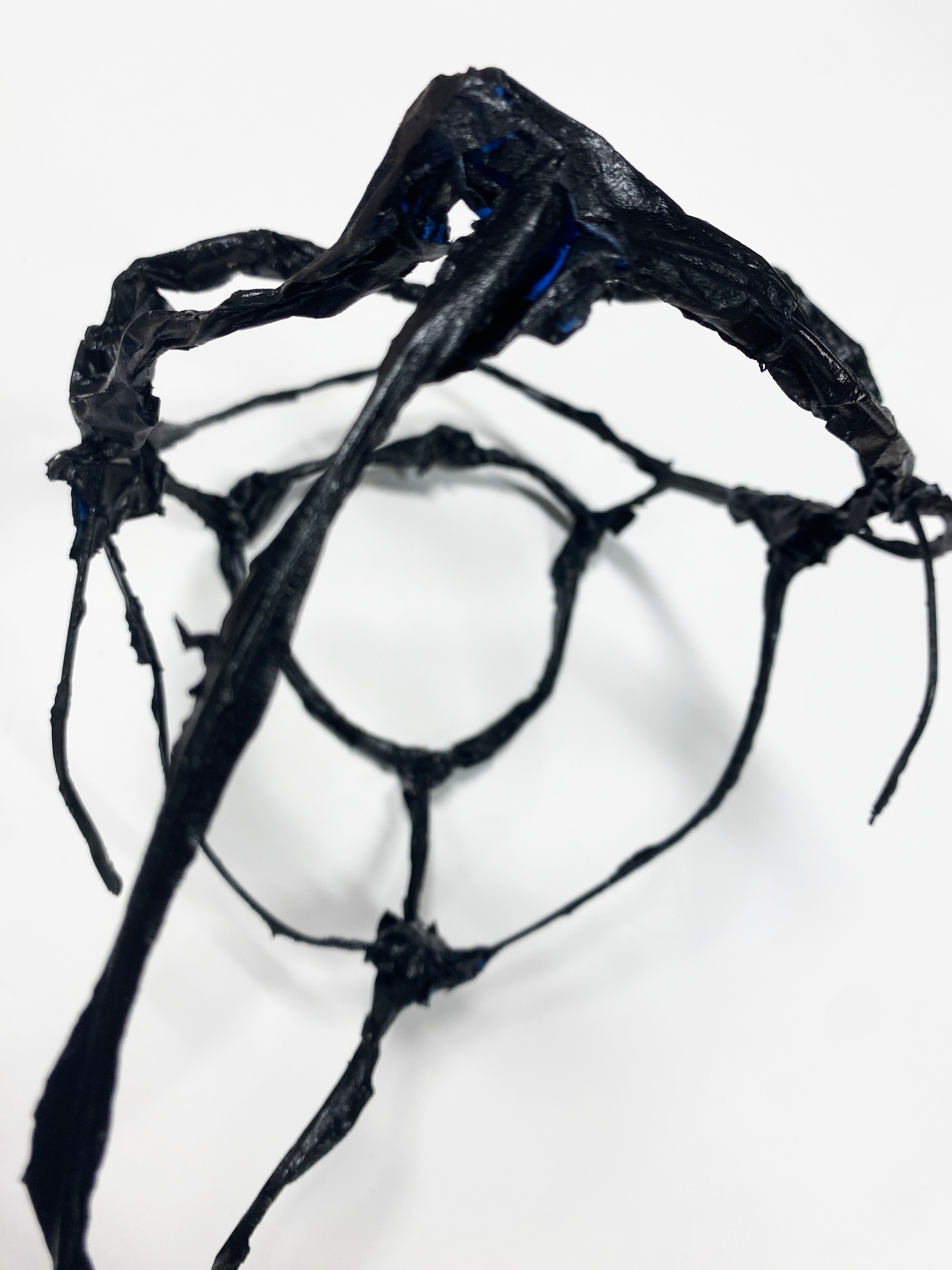
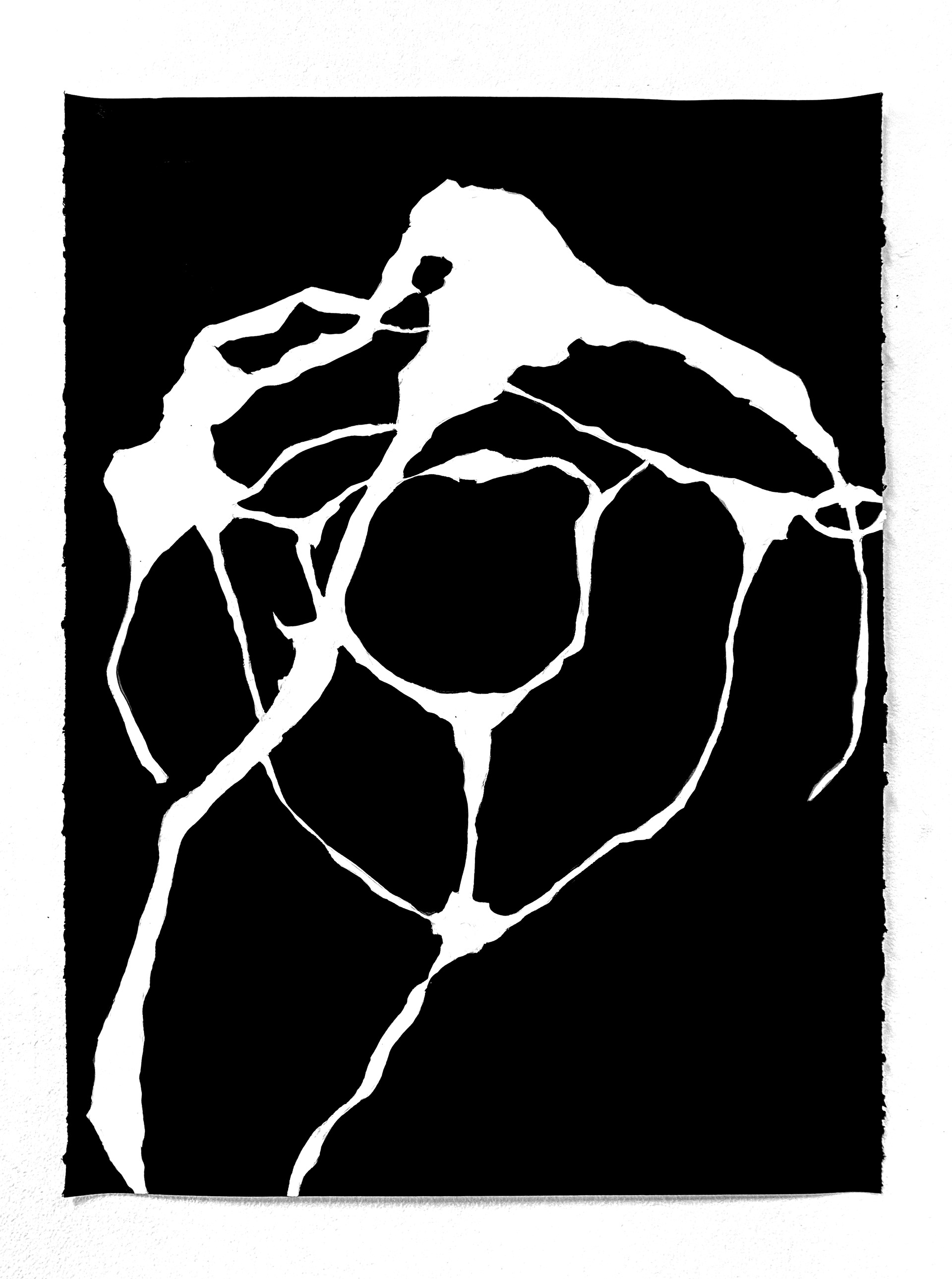
"Inside"
September 2024
Ink on paper
22x30”
Contrast and perspective were techniques I utilized to abstract the human form further. This painting is based off of a wire sculpture I created off my likeness. Specifically, this is a top-down view of the “skull” of the sculpture created from wire, masking tape, and painted over in black. Photographs of the aforementioned sculpture can be seen below. My desire to remove recognizable human features from this artwork stemmed from my exploration of the psyche as an eye into ourselves.
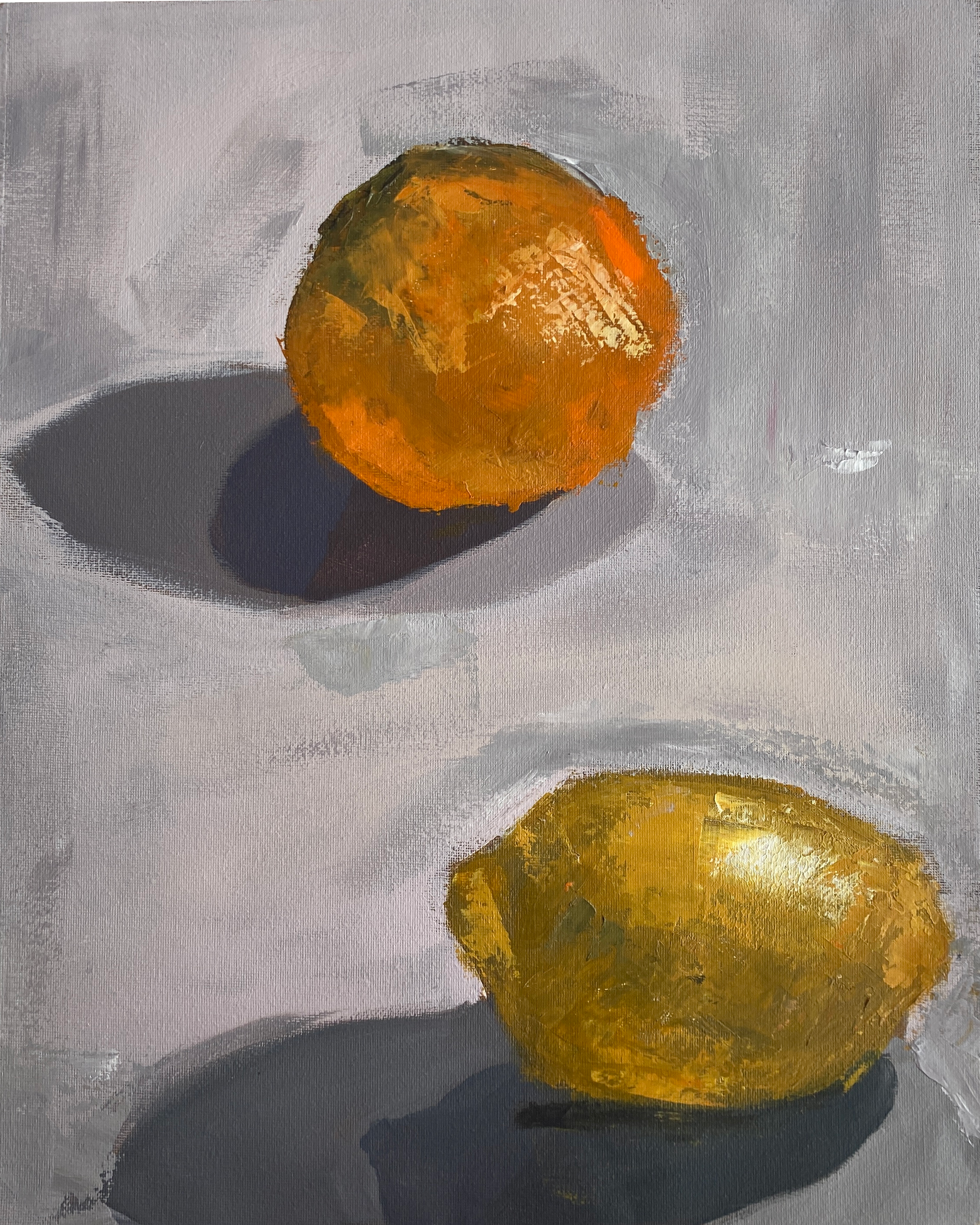
"Still life of Fruit"
August 2025
Acrylic paint on canvas
12x18"
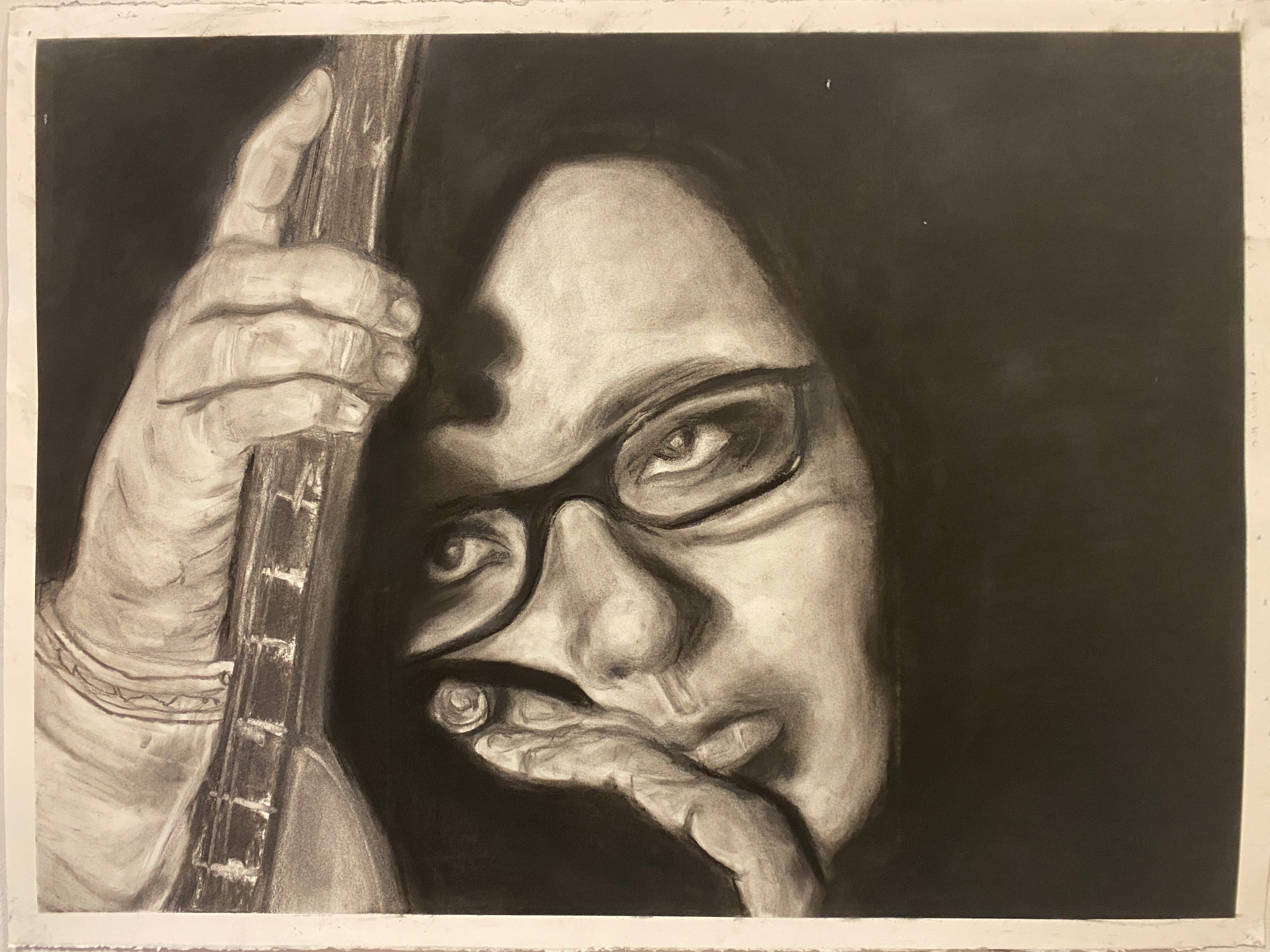
"Self-portrait"
April 2025
Charcoal on paper
30x22"
I created this self-portrait based on a photo I staged. I incorporate details from my Bulgarian culture and pose with a guitar, representing my creative aspirations.
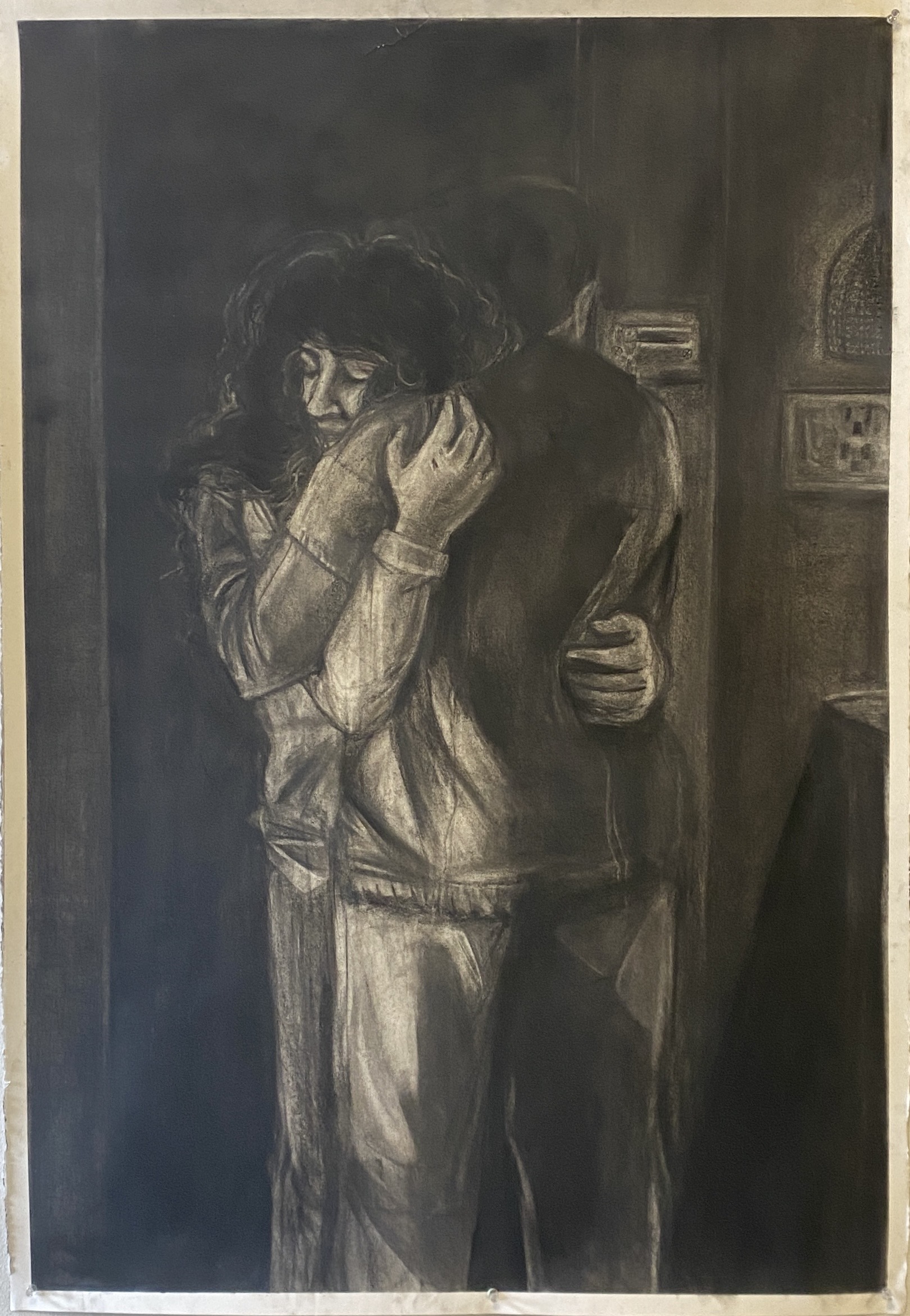
"3:39am, Akifa’s Lawn Was Still Smothered with Dew"
May 2025
Charcoal on paper
30x45"
In this drawing I convey a feeling of closure and longing by utilizing impressionistic and visible mark making. The scene itself is an unexpected and tender reunion on one figure’s doorstep at night, visible by the light of the rear figure’s (Akifa’s) home. My inspirations included the style of candid photography/videography as well as the elevation of mundane scenes to fine art; this influenced the content of my piece and its dramatic yet grounded aesthetics. The composition uses tenebrism and frames the embrace and points of contact between the two women. The gauzy quality of the illuminated face (Marjami’s face) indicates the bond between the figures. The two characters are close but have a tumultuous relationship. The title references how malleable the hours before dawn are, when the feelings of night have not yet evaporated. This metaphor and visual darkness serve as the backdrop and reflection of Marjami and Akifa’s relationship.
Three-dimensional Artwork
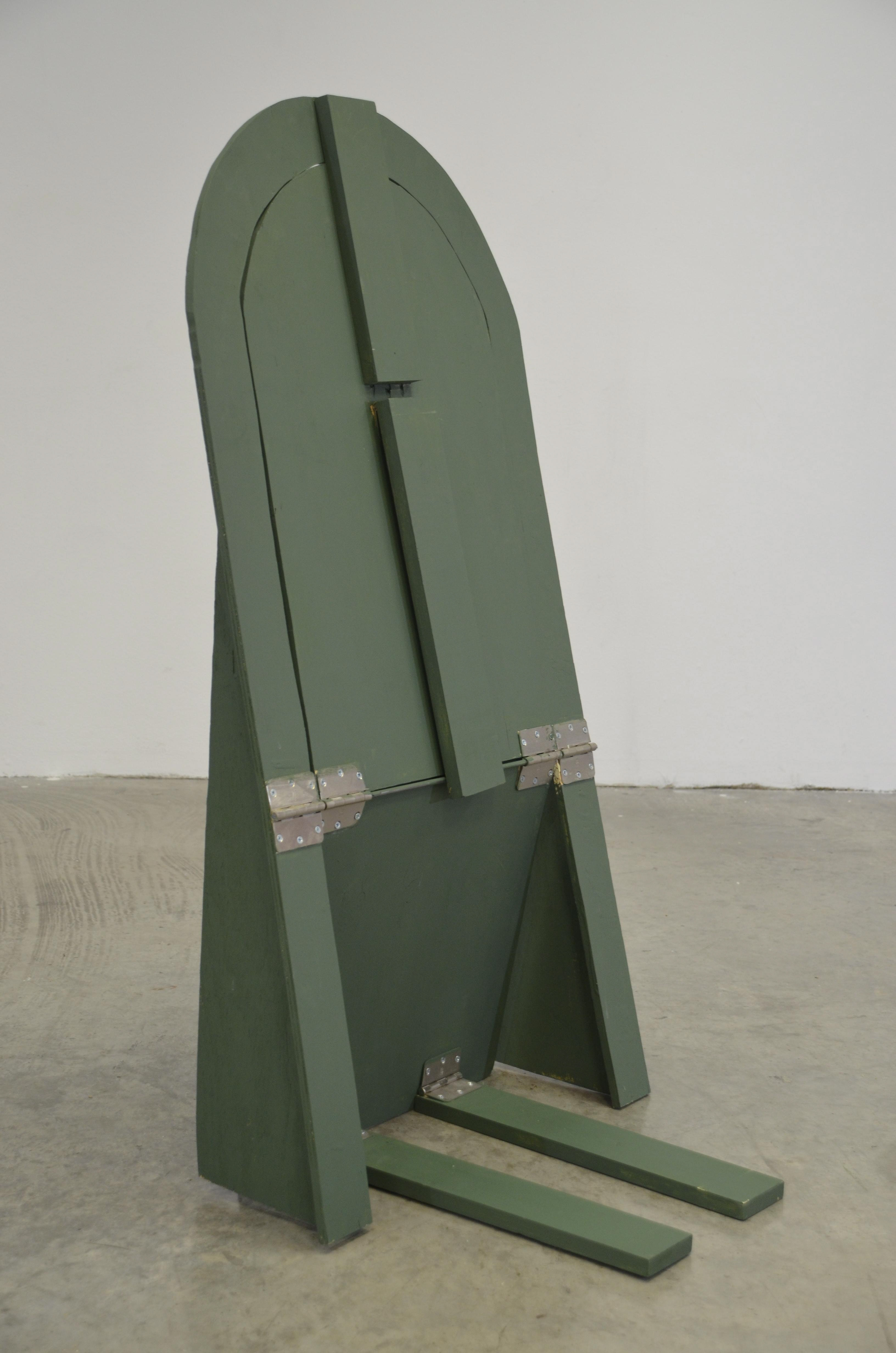
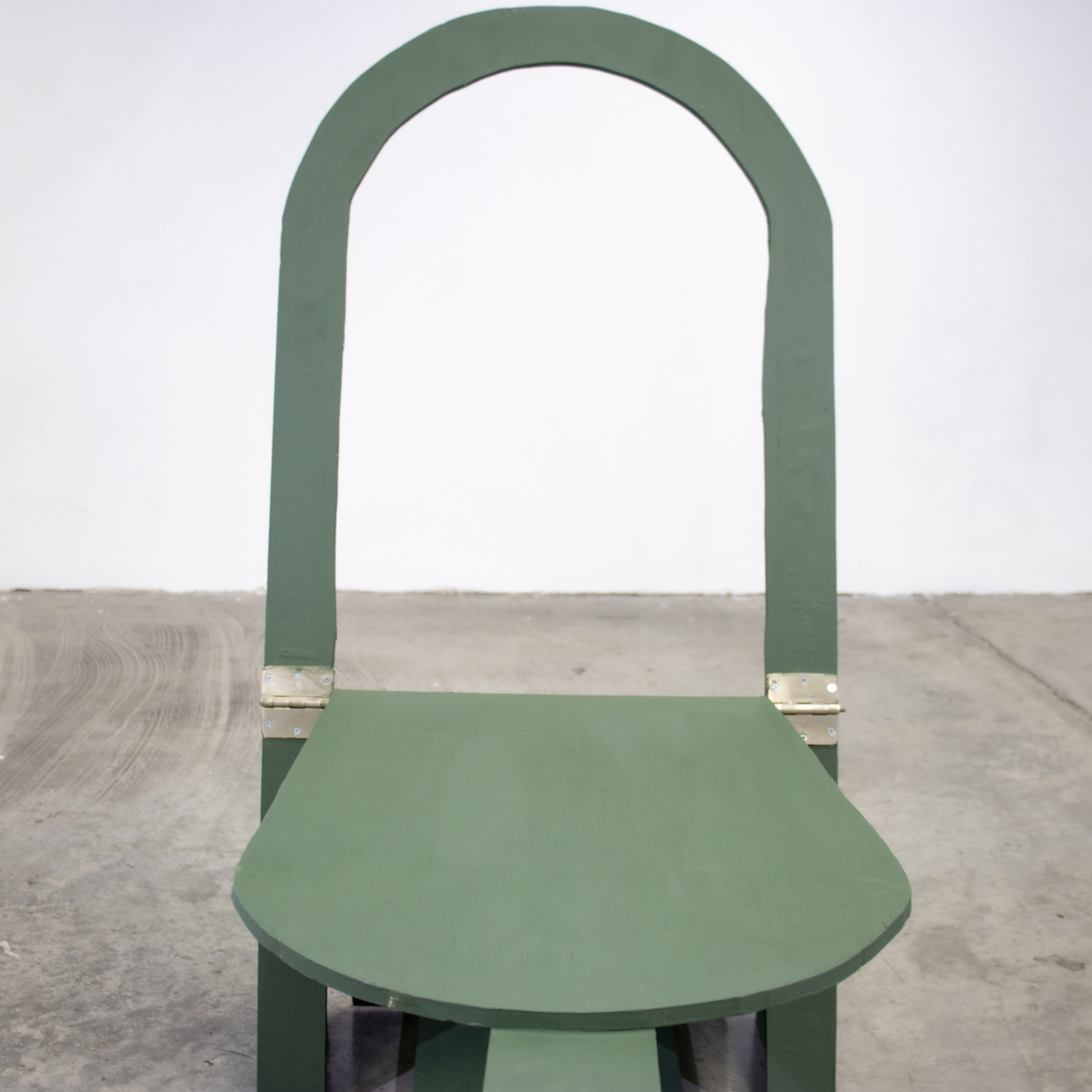
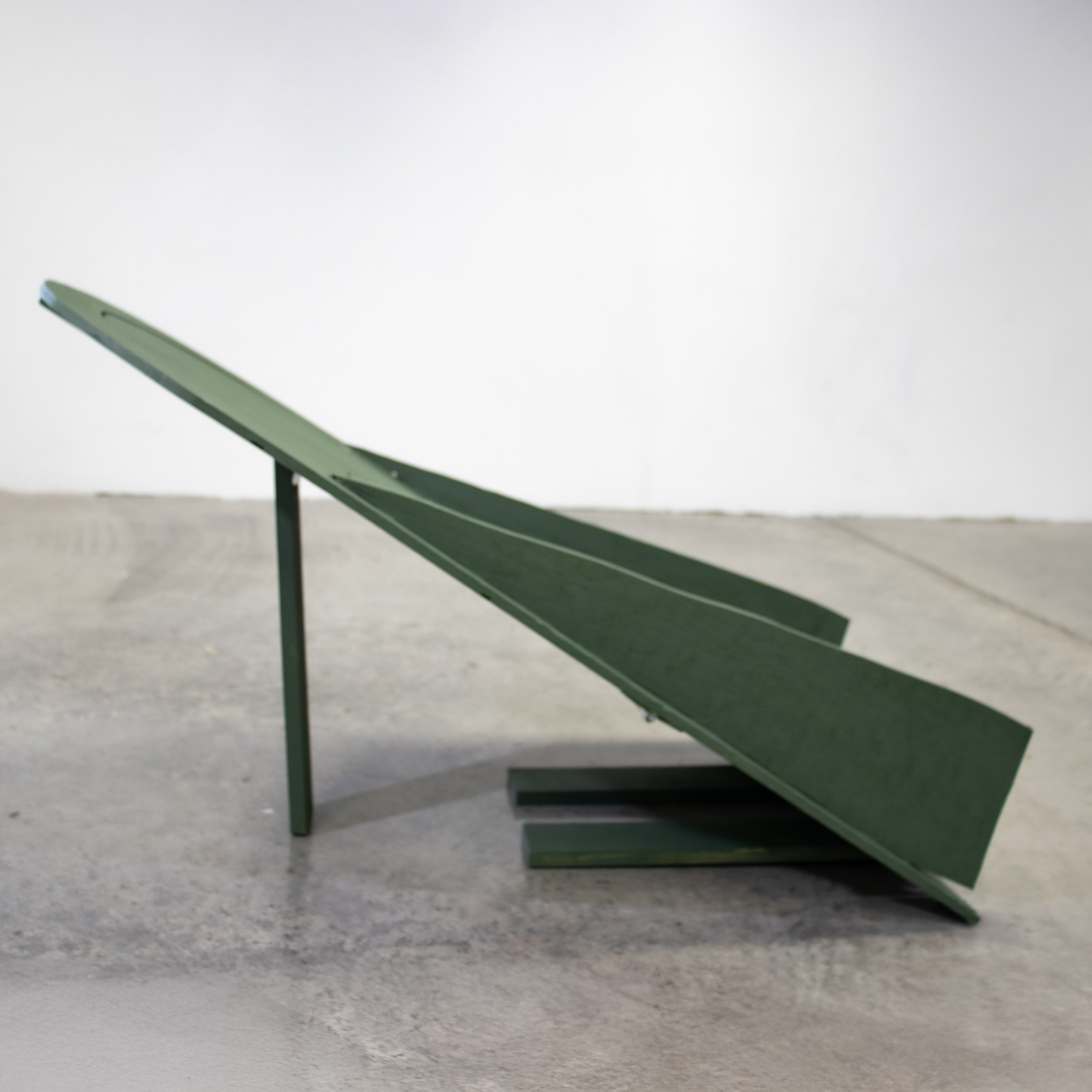
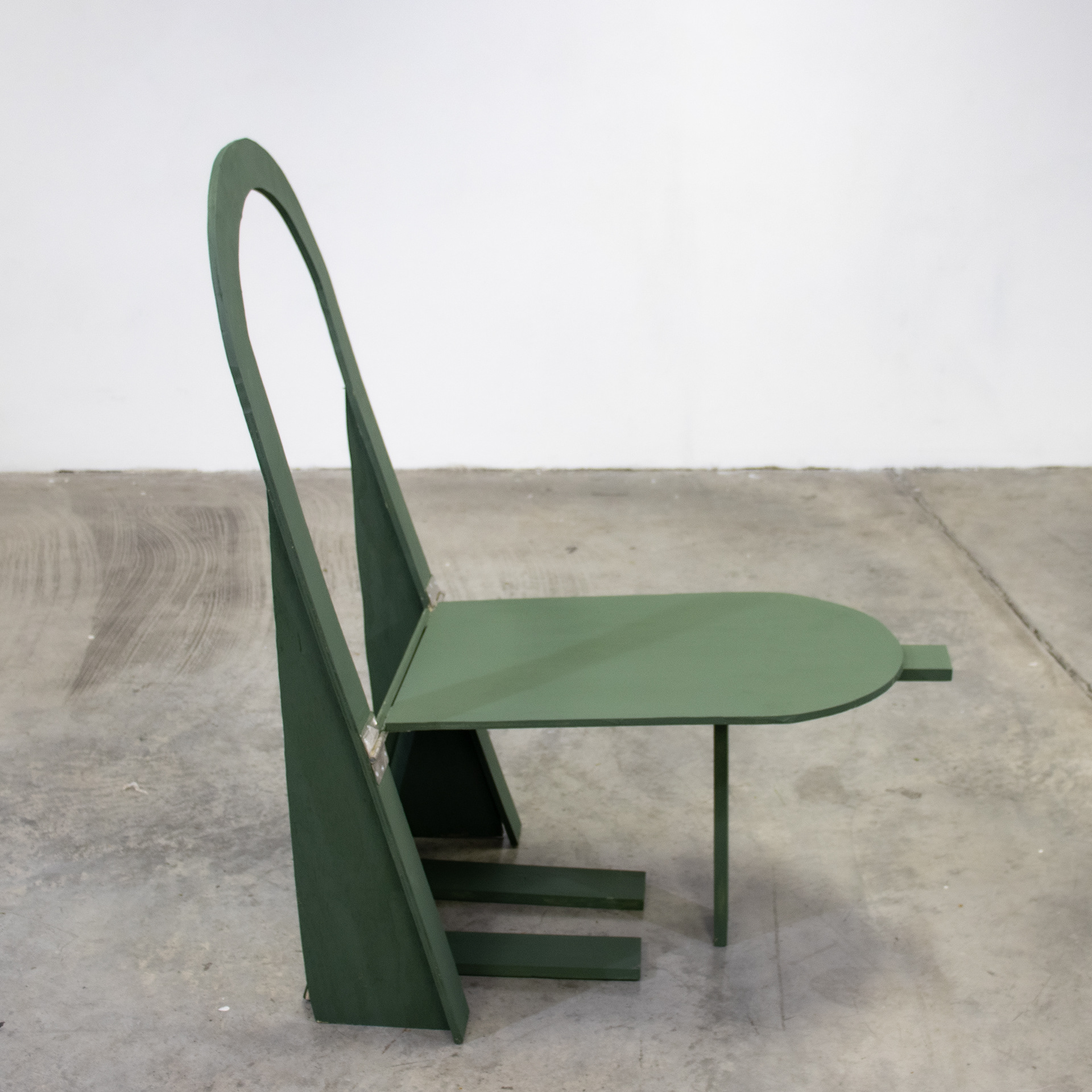
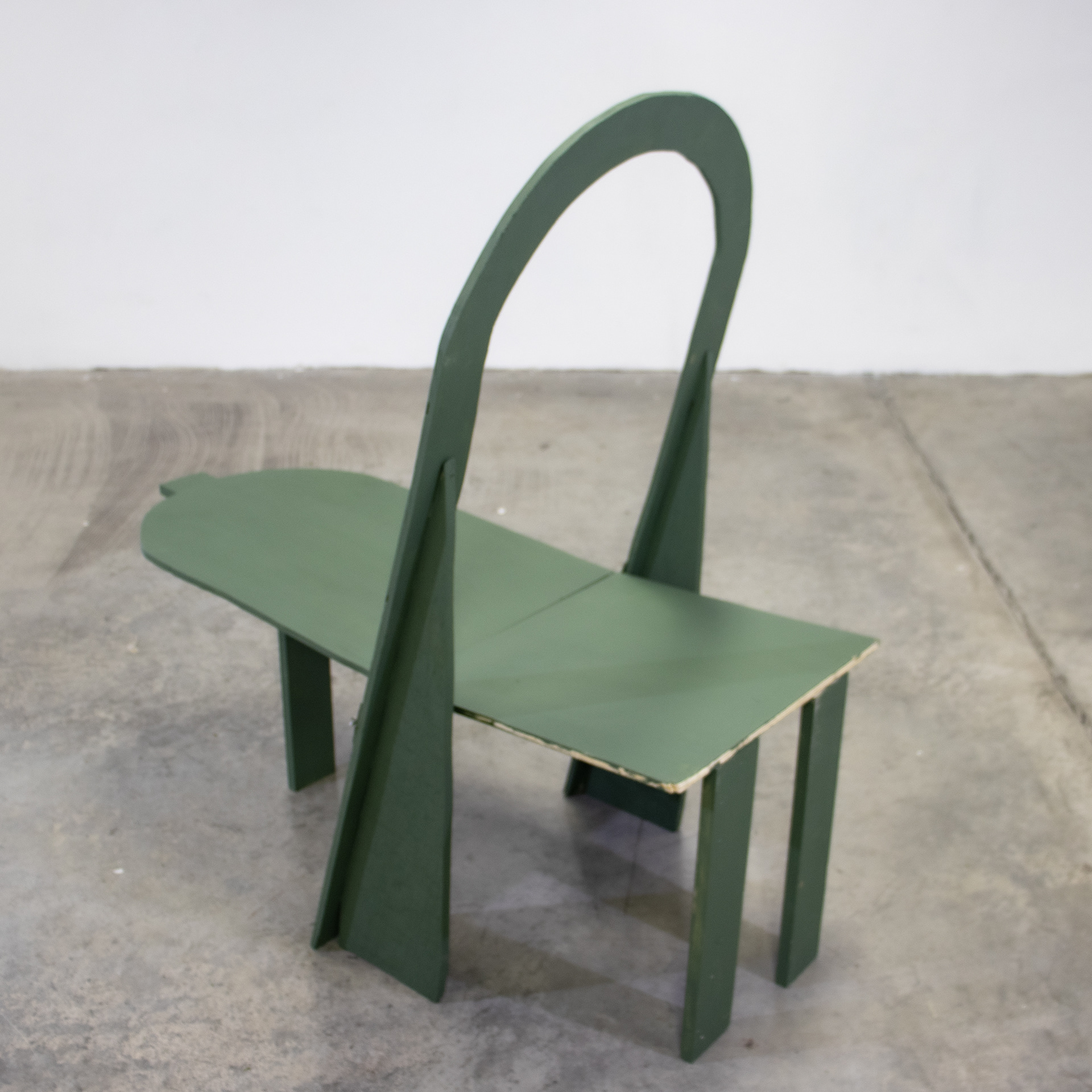
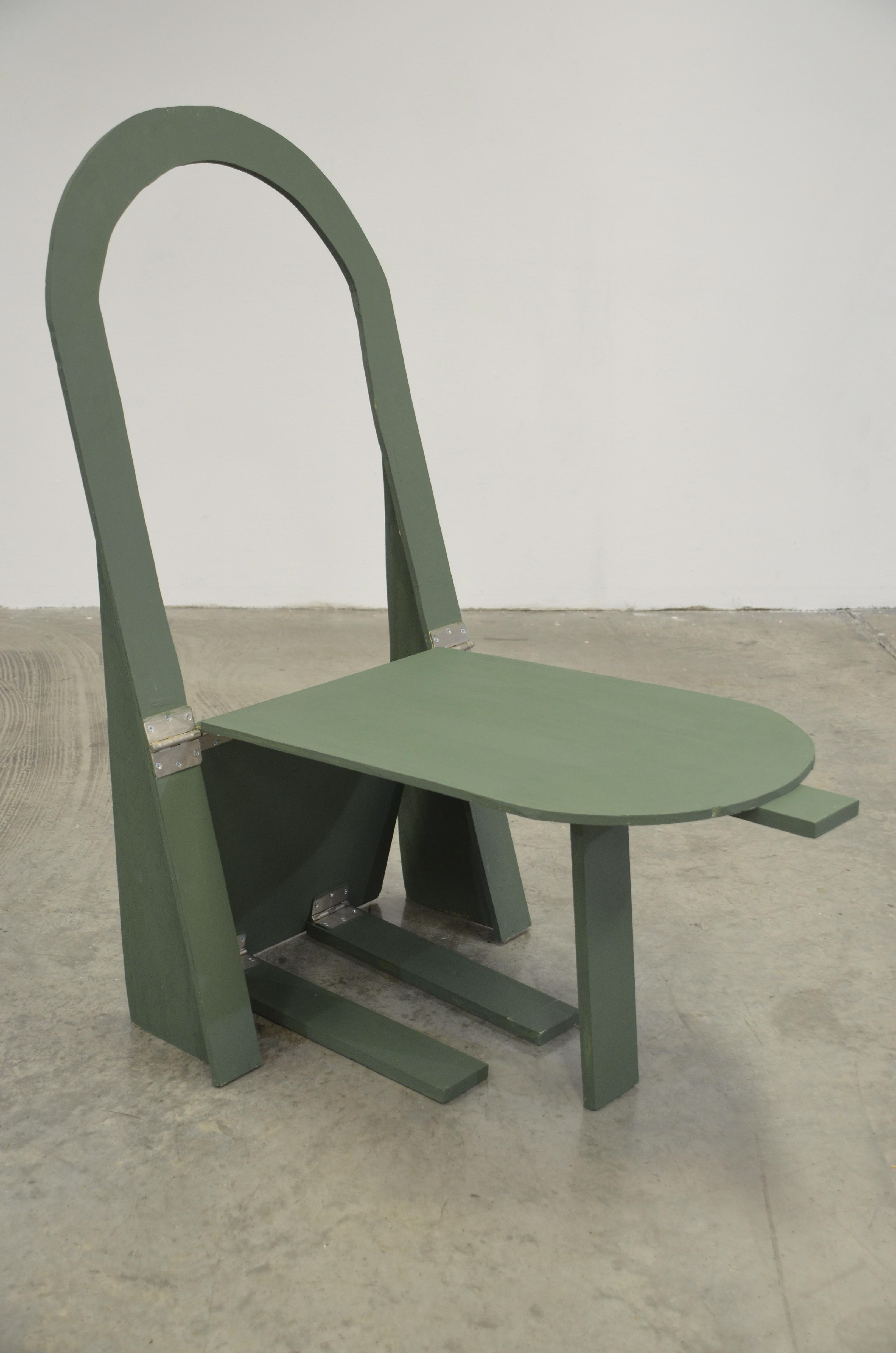
"Chair in Olive"
February 2025
Wood, metal, and acrylic paint
38x24x21"
From the inception of this idea to its progression and later finishing touches, several ideas stayed on my mind. These concepts included transformability as well as simplicity. These ideas harken back to militaristic furniture, which I reference by using color. I accomplished this design concept by beginning with a strong plan and keeping true to my concepts during the process. As I elaborate on in the ten book pages found here, I made several crucial decisions when creating this chair.
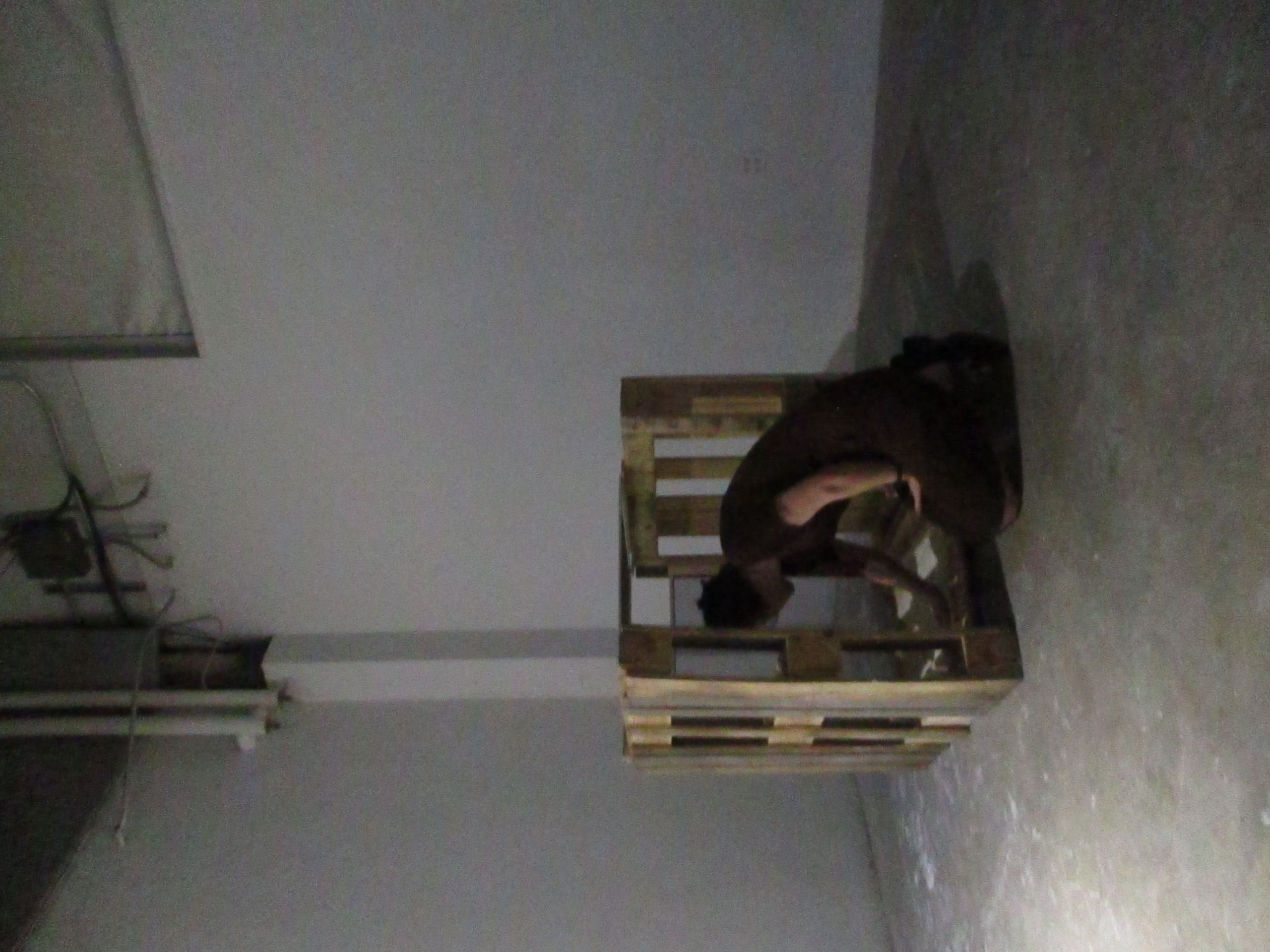
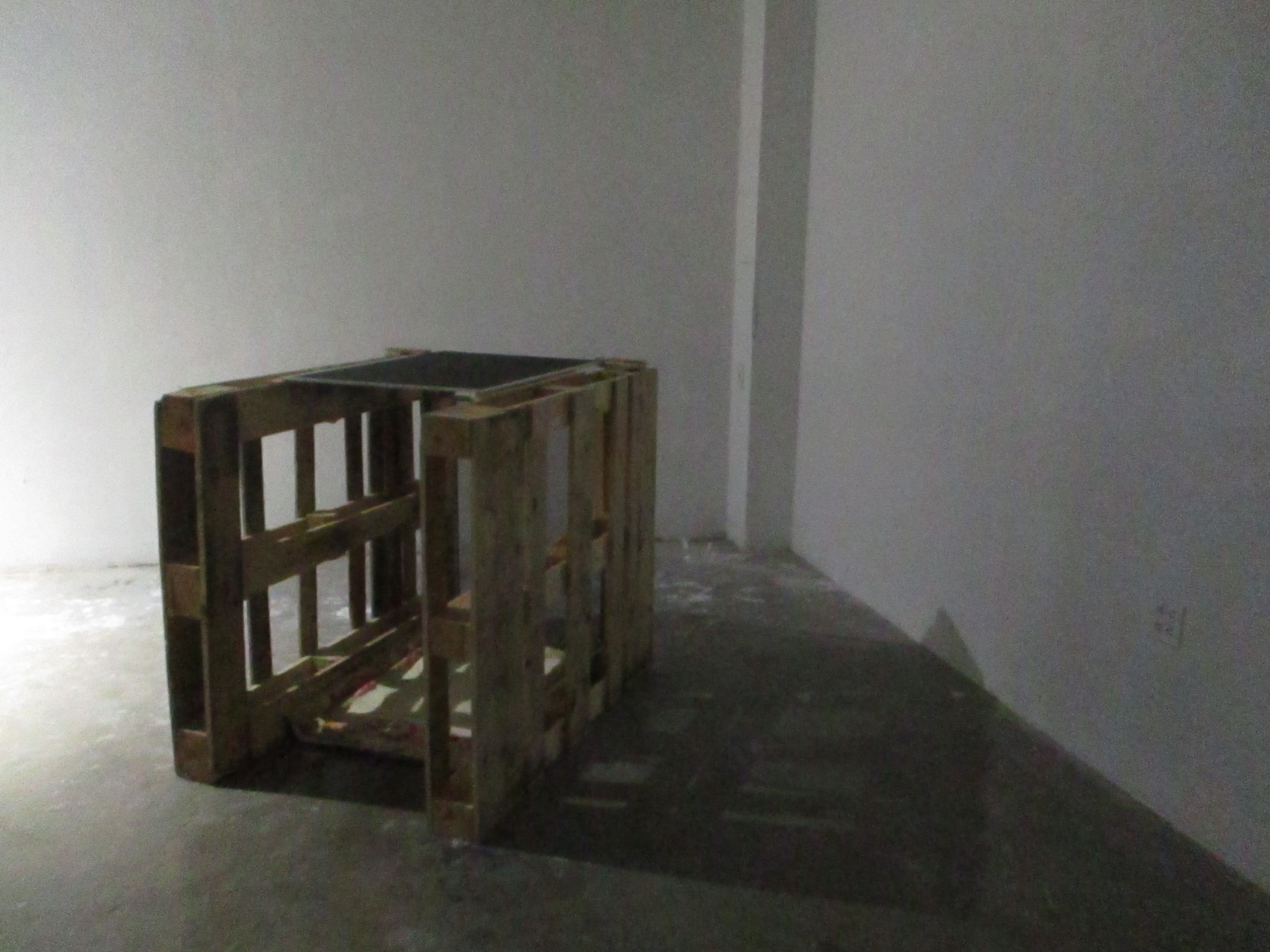
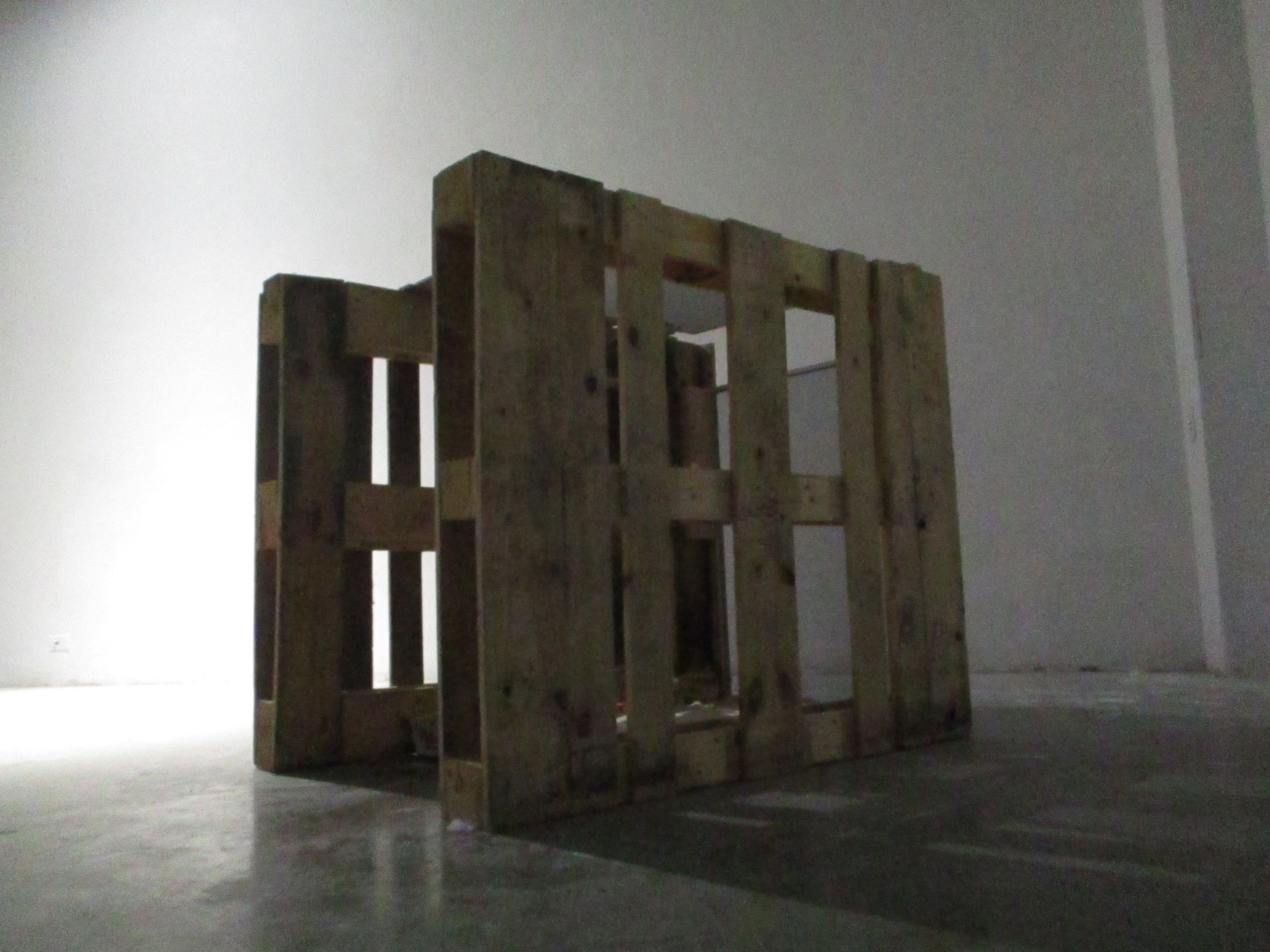
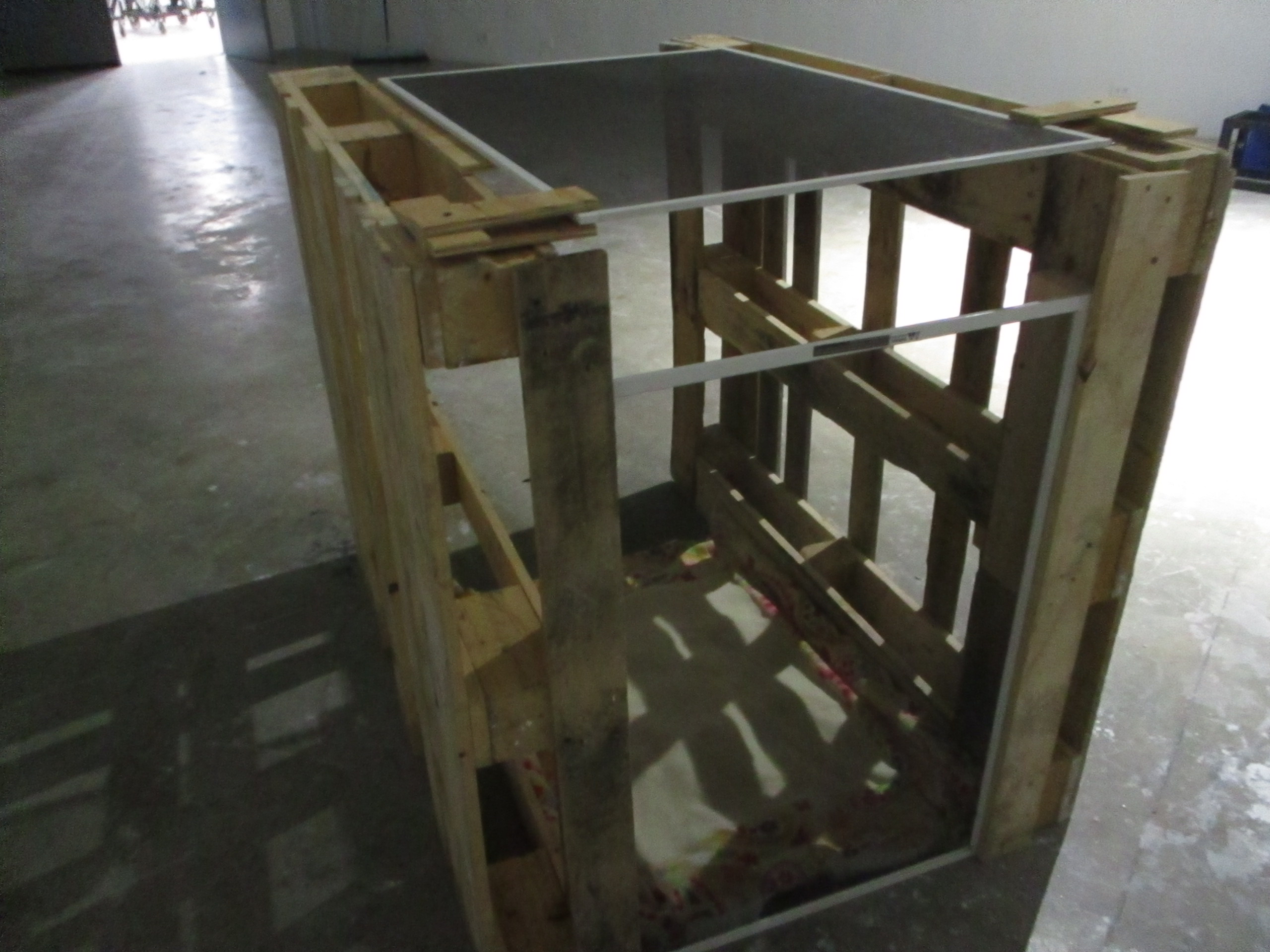
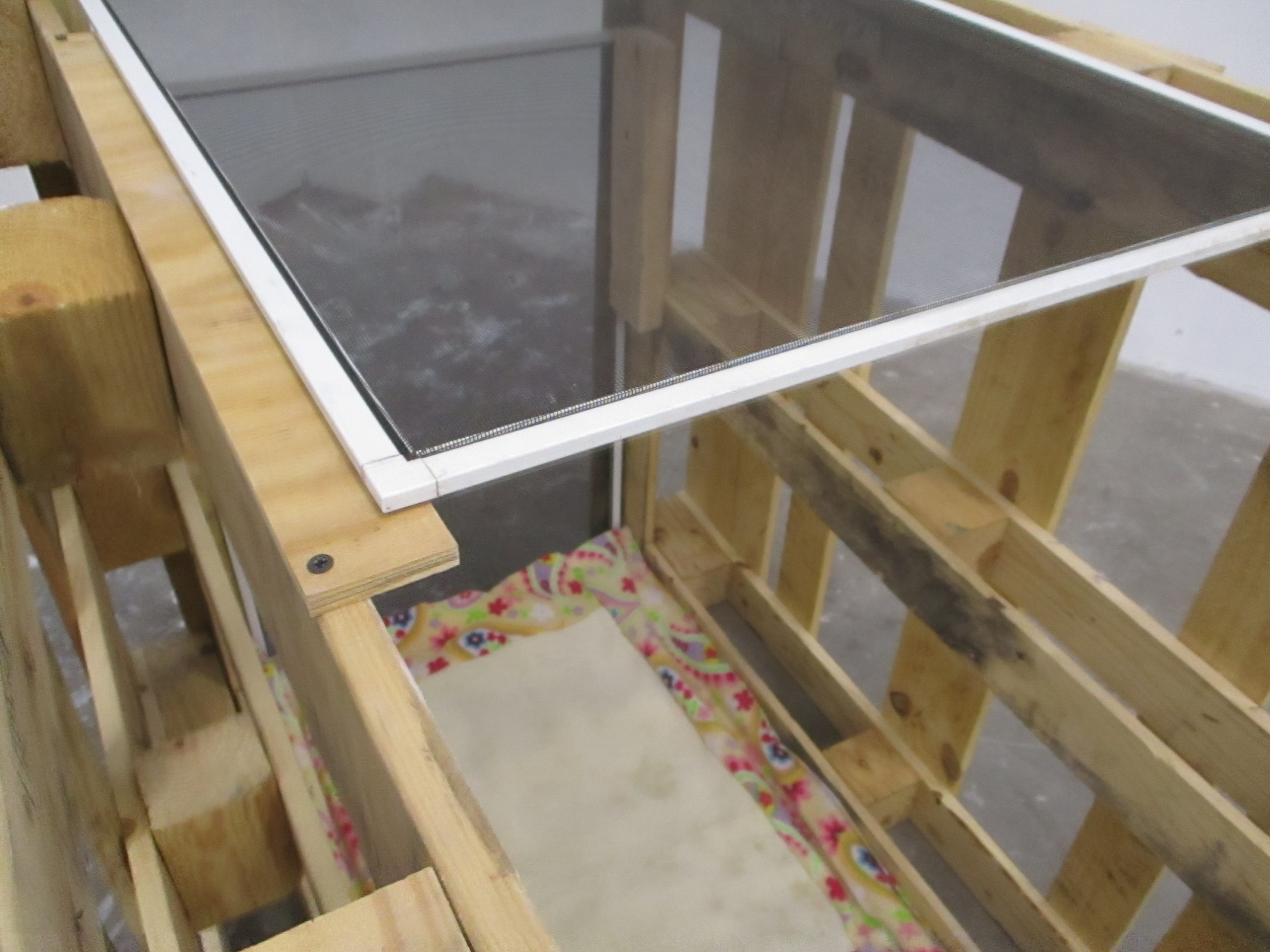
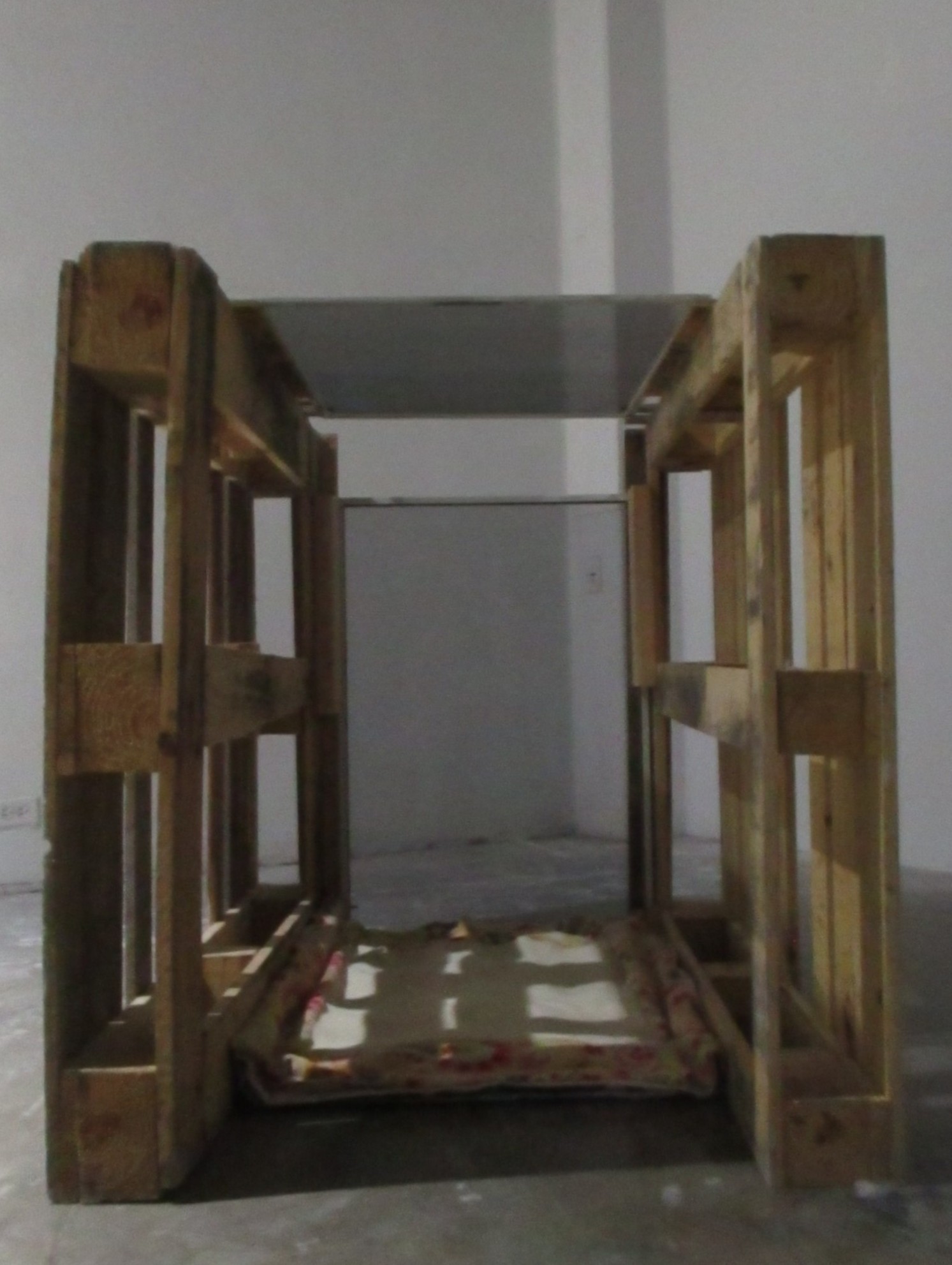
"Cave"
April 2026
Single-installation, Wood, fabric, agar composite, mold, plastic screen
4' x 2 ' x 39' ⅜"
My interactive sculpture occupies the locus between meditative spaces, cages, and the womb. As the site is breached by the viewer—either through their physical intervention or voyeurism—textural, visual, and olfactory play is initiated. Elements of the experience are darkness and wetness; both tie into the senses activated in a moment of staying up late to cry. Throughout the process of creation, Cave shifted in its ability as a tool, becoming a jig that guides the body.
A dichotomy of dis/comfort, are present in Cave in the form of both sweet cinnamon-sugar smells and soft duvets as well as brutalist, industrial slats of wood, moist cushions beneath a blanket, the stench of vinegar, and mold. Because of such elements, the sculpture could only exist for a limited, single moment to engage participants.
Cave is a tool that secures the person it envelops, blurring lines of dis/comfort. The implication of such a jig raises questions of danger, authority, and agency. What instruments facilitate submission, whether self-induced or coerced? My interest in the object follows my investigation into paraphilic relations between safe spaces and privacy. Cave is a site considering how childhood play explores the contradiction between shame and safety.
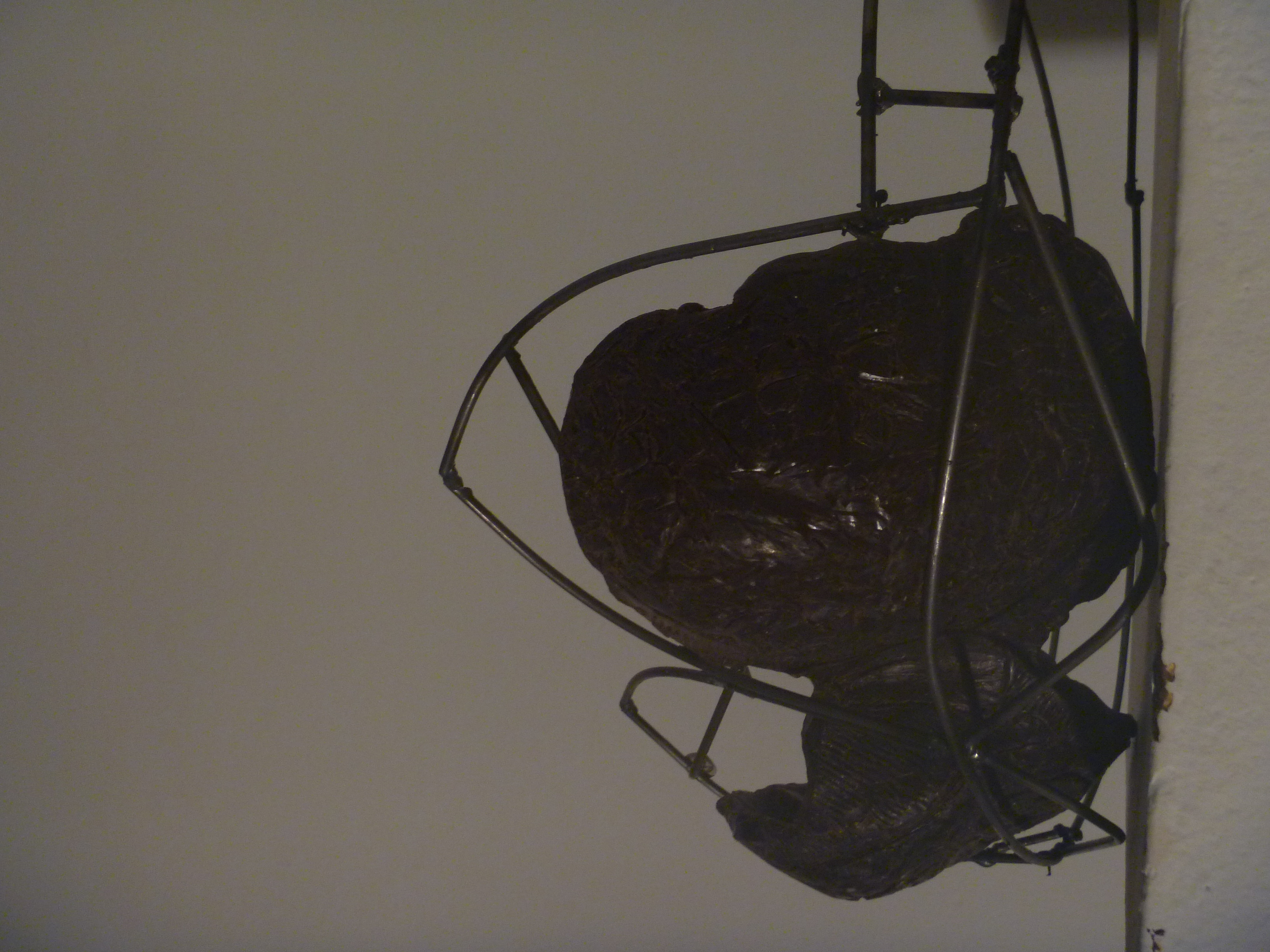
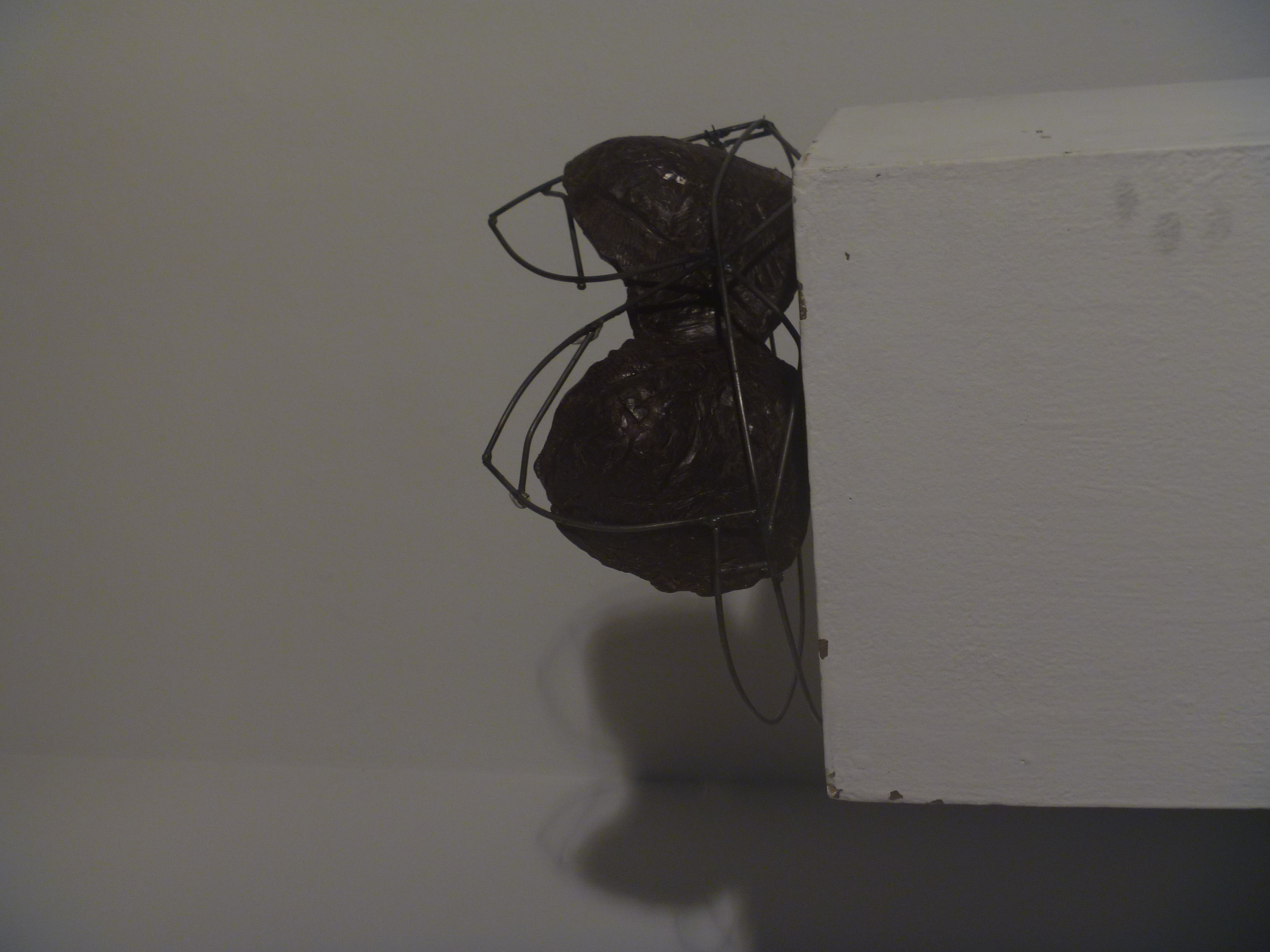
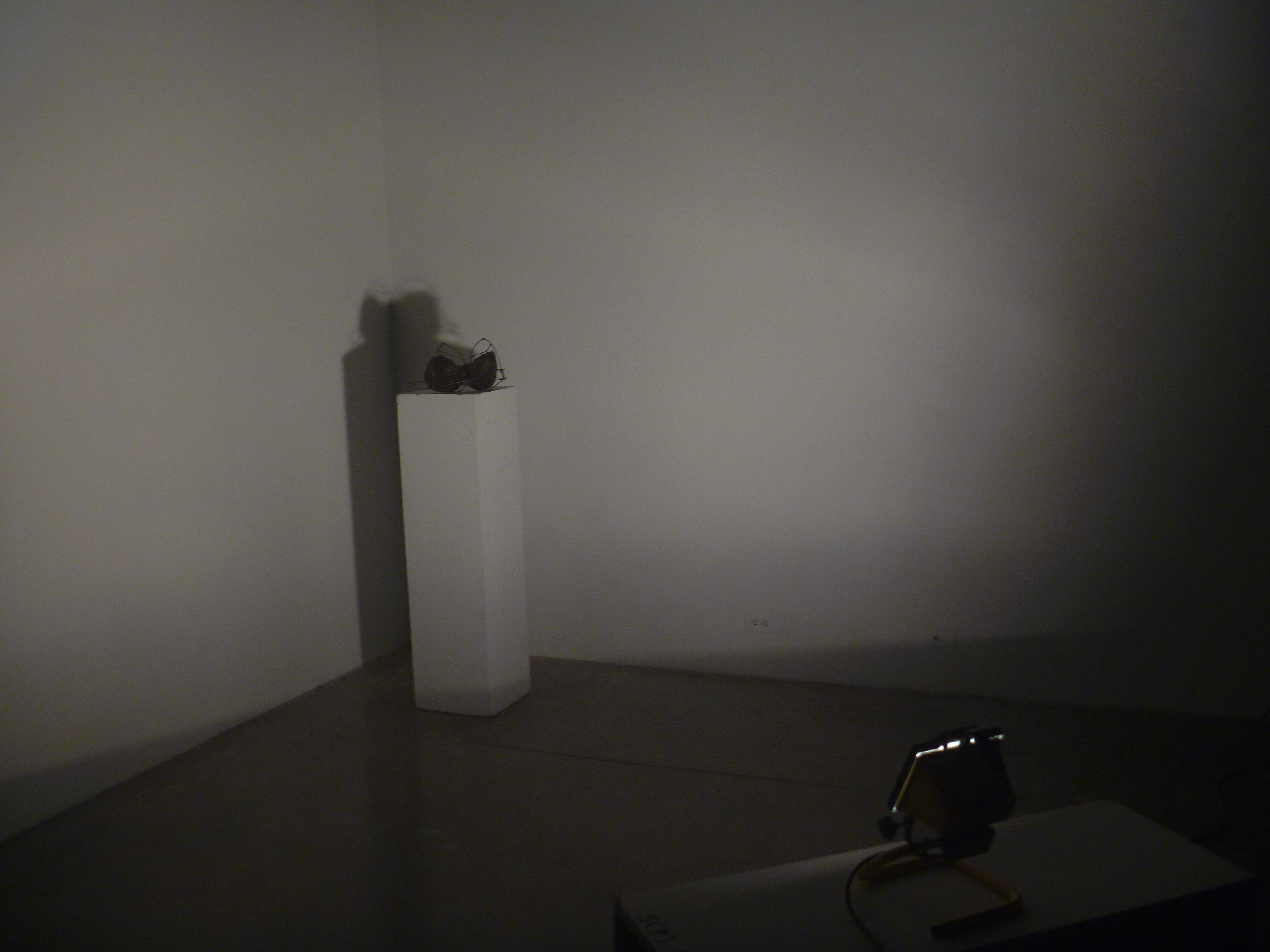
"Codpiece"
March 2026
Stainless steel rod, wax
14 x 10 x 6 "
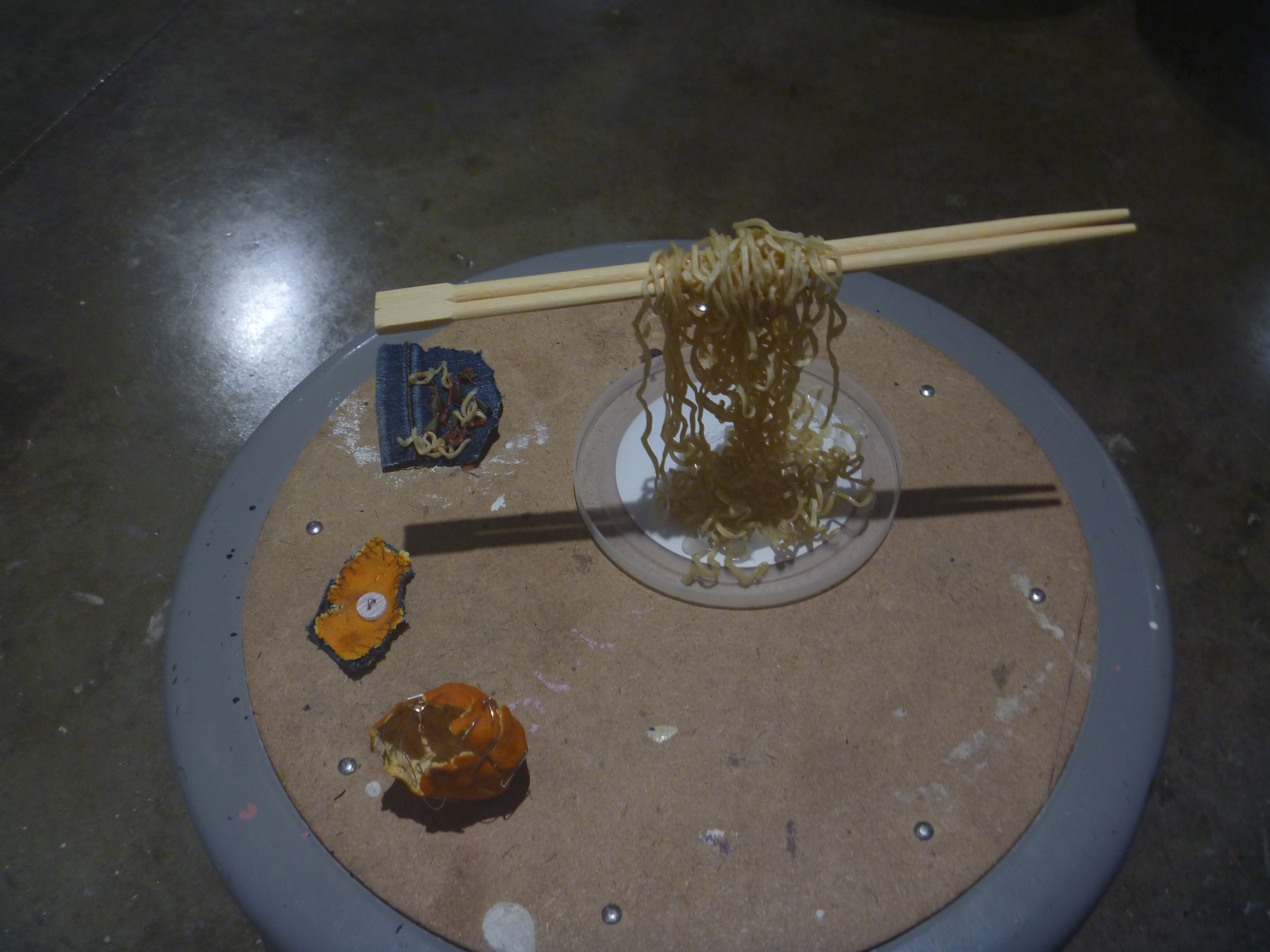
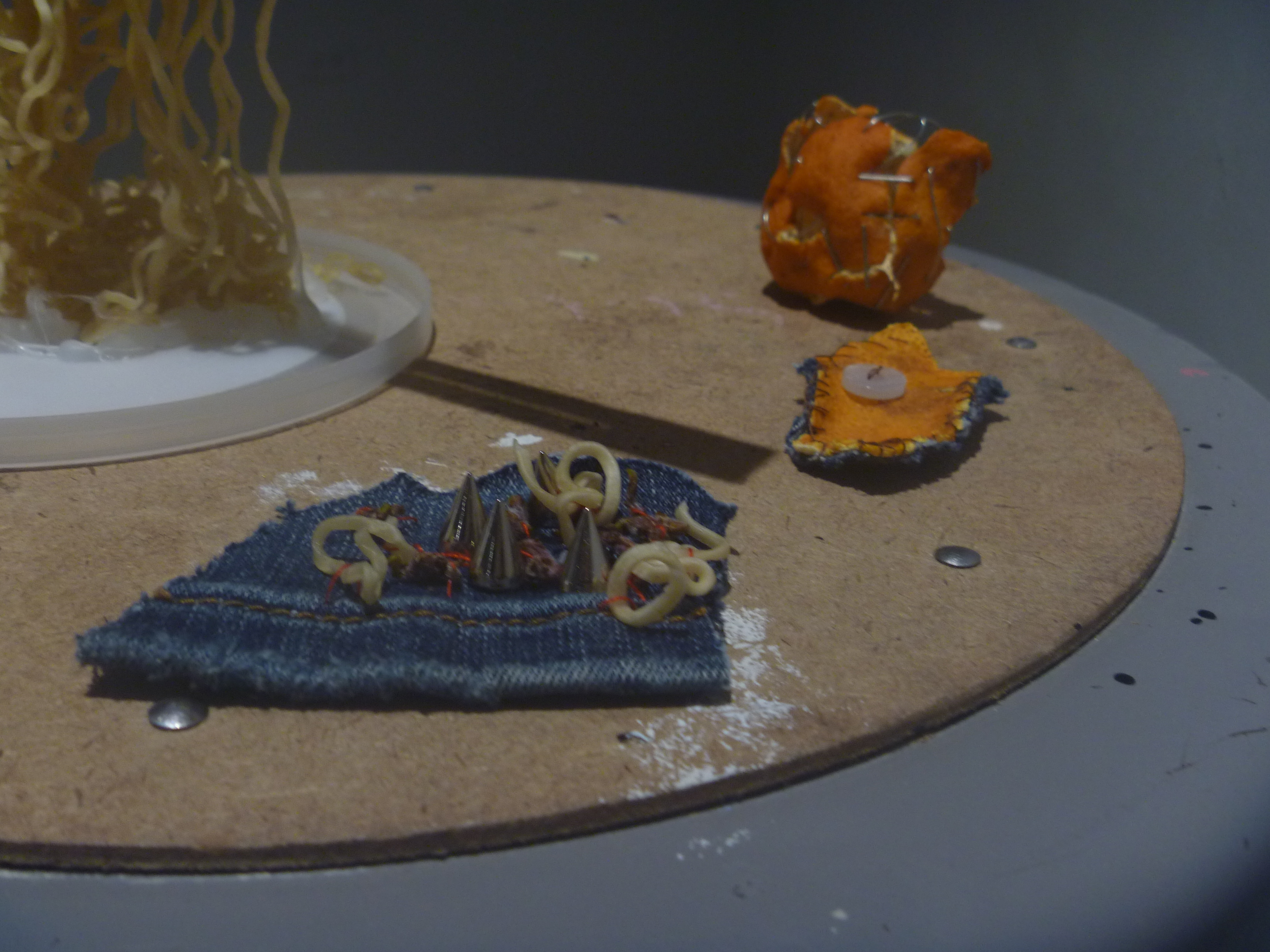
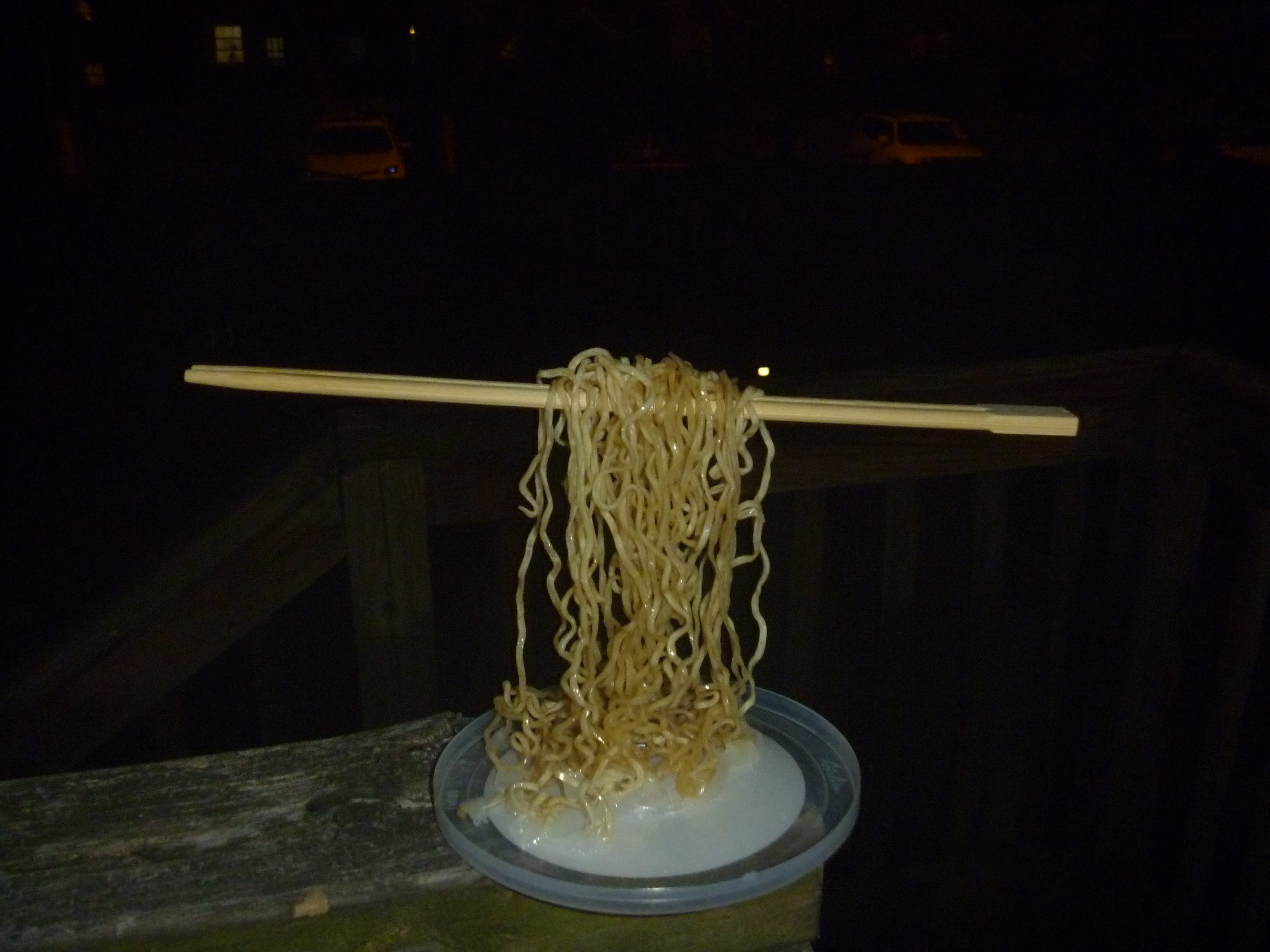
"Miniature involvements series"
January 2026
Ramen egg noodles, wooden chopsticks, clementines, wire, fabric, thread, button, spikes, potato eyes
12 × 12 x 8"
Graphic design, Digital, & Multimedia Art
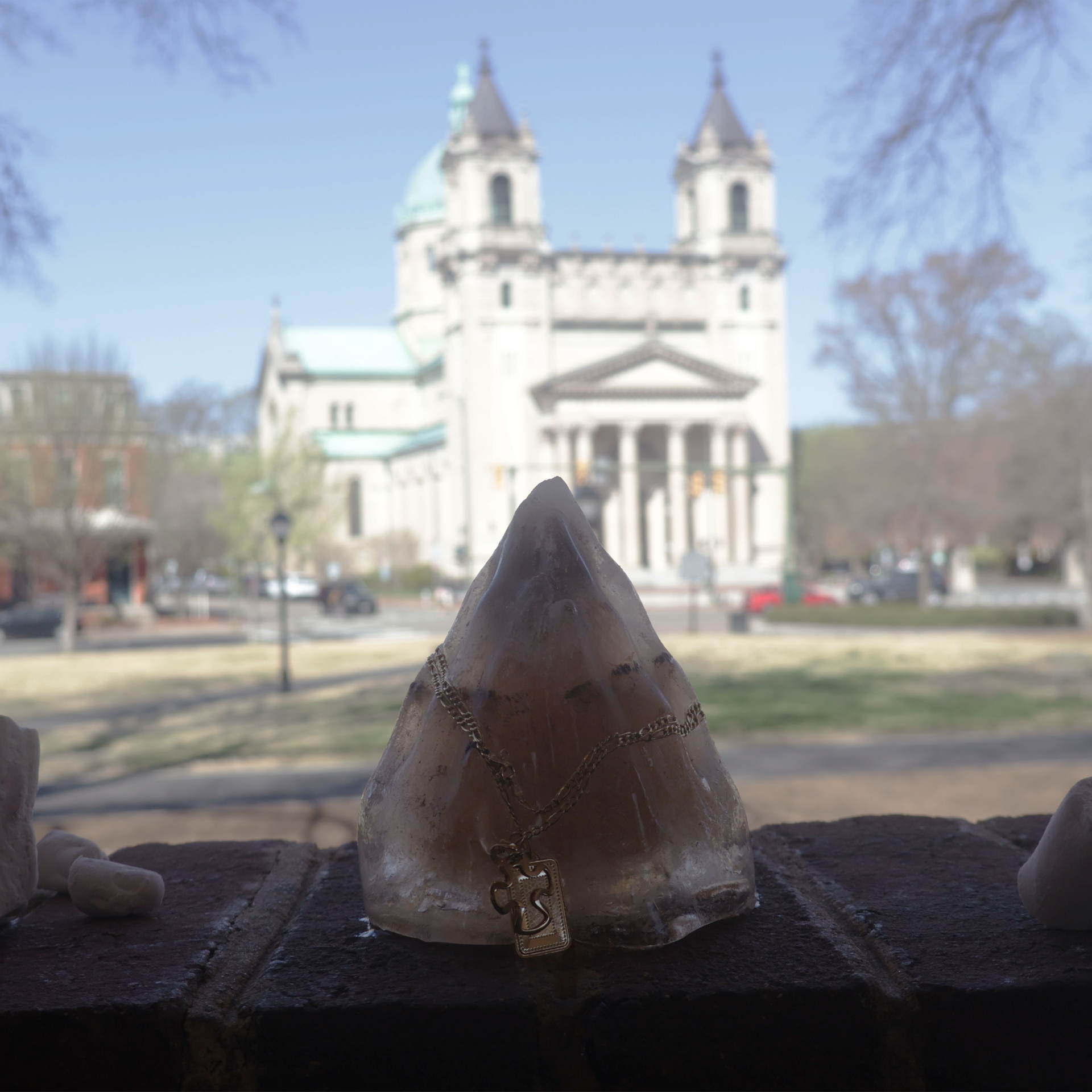
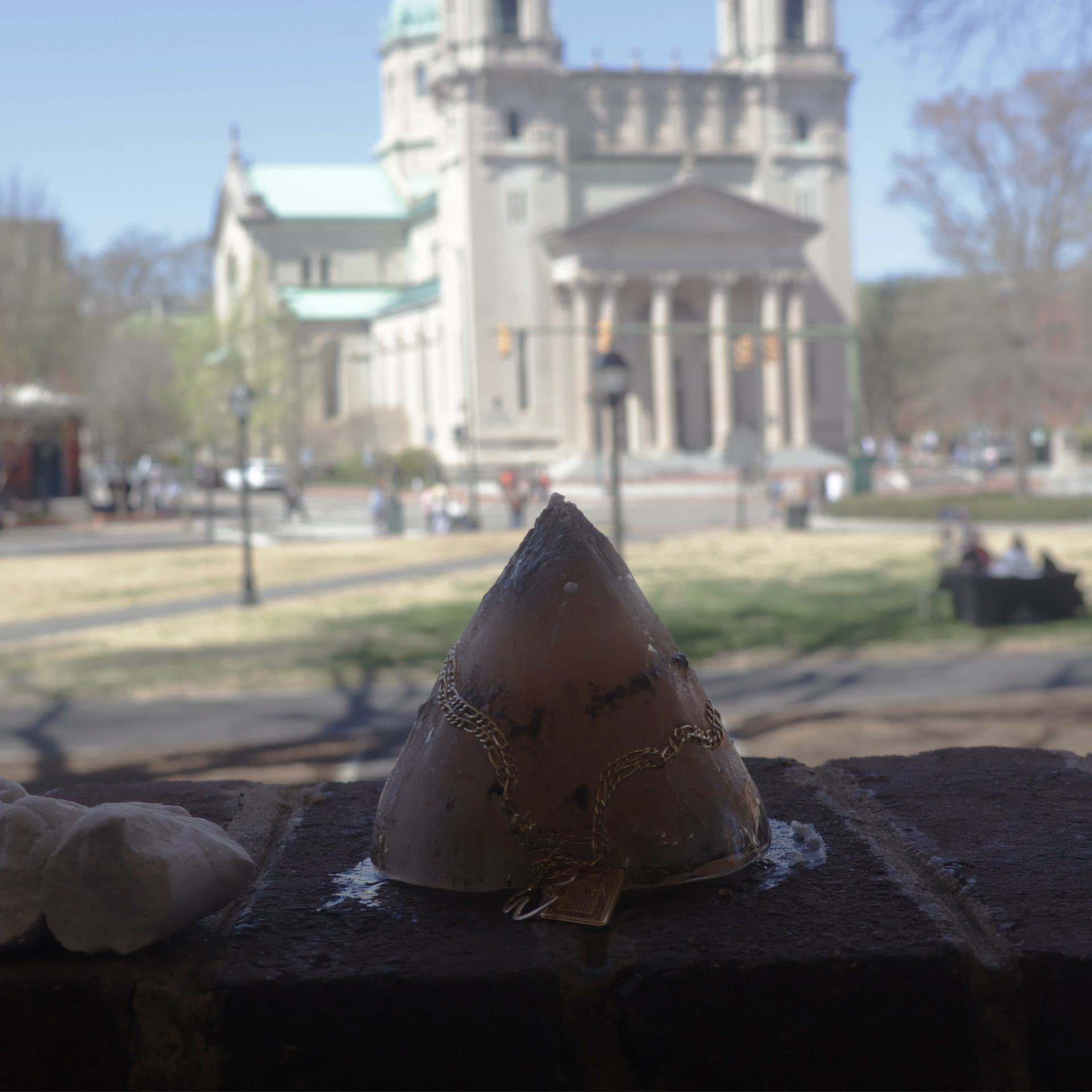
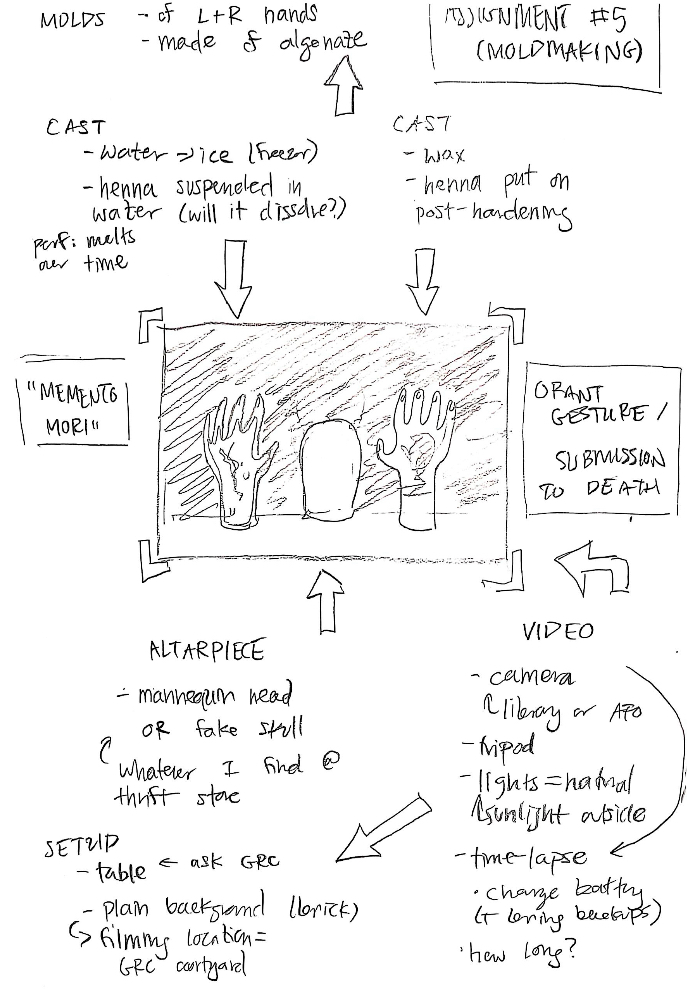
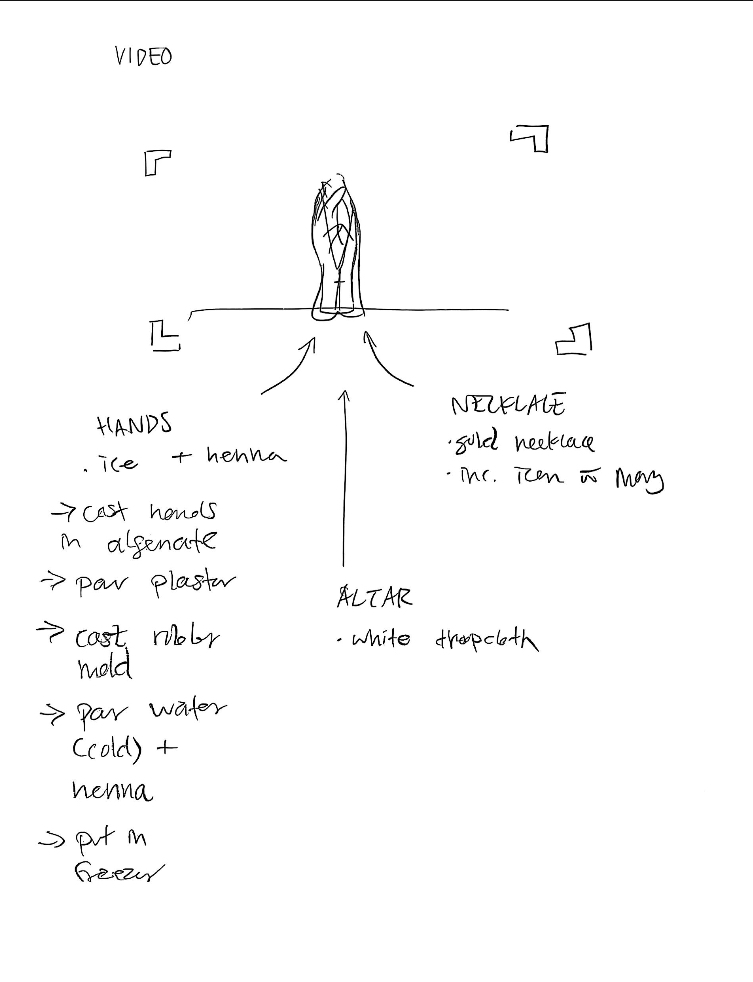
Access a video and audio desciption of the video here.
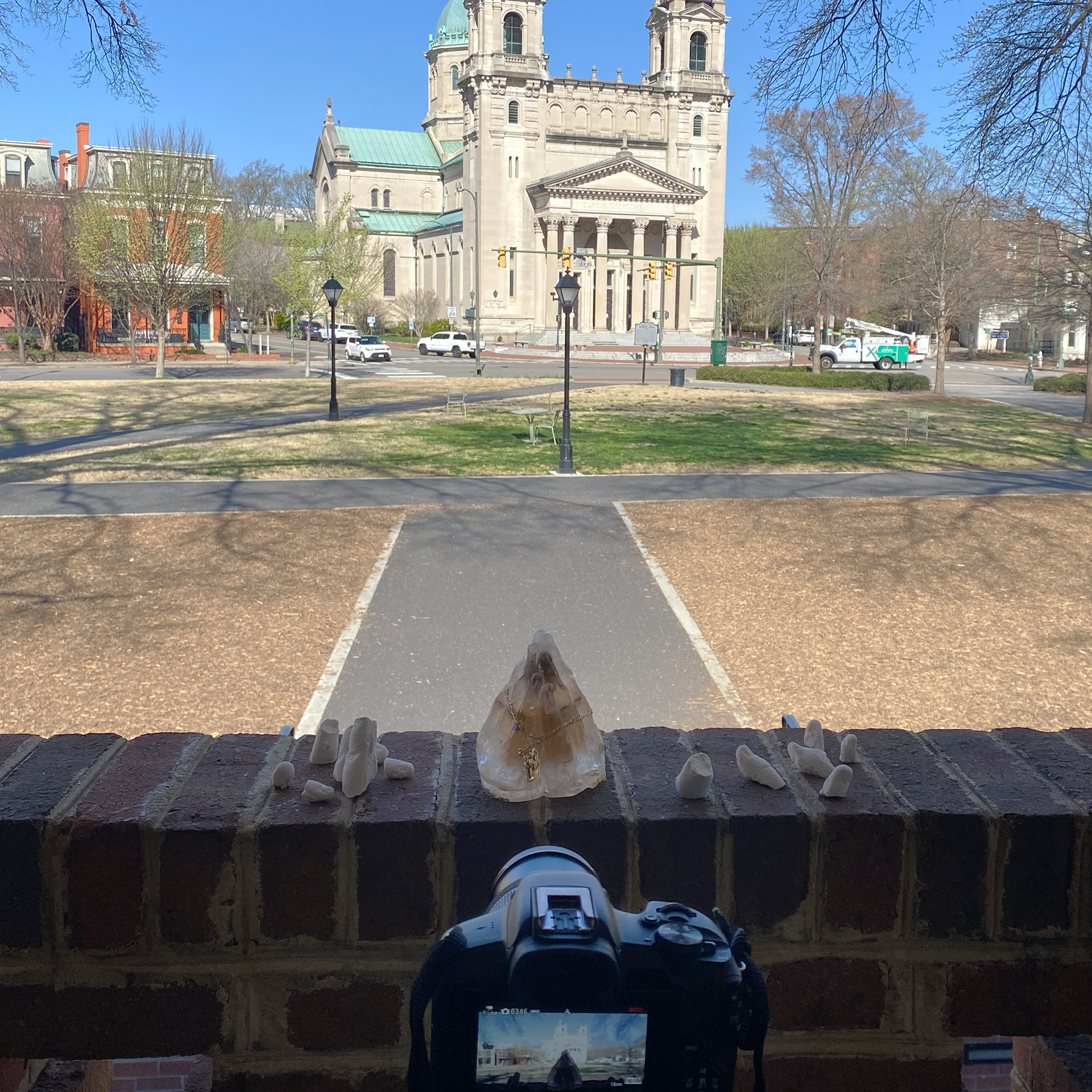
VIDEO & AUDIO DESCRIPTION: Chanting Orthodox choir music plays over a time lapse of ice melting in front of a cathedral. The ice is in the shape of hands clasped in prayer and there is a golden necklace with a cross over it. The video is labeled "Memento Mori" with the caption "performance/sculptural work of Marley Trimble."
"Memento Mori"
March 2025
Ice, henna, gold jewelry, plaster (Sculpture); time lapse (Video art); edited version of Early Chants of the Bulgarian Orthodox Church (Audio art)
26 seconds (Duration); central sculptural piece is 7x3x3" with accessory sculptures ~2" each (Dimensions)
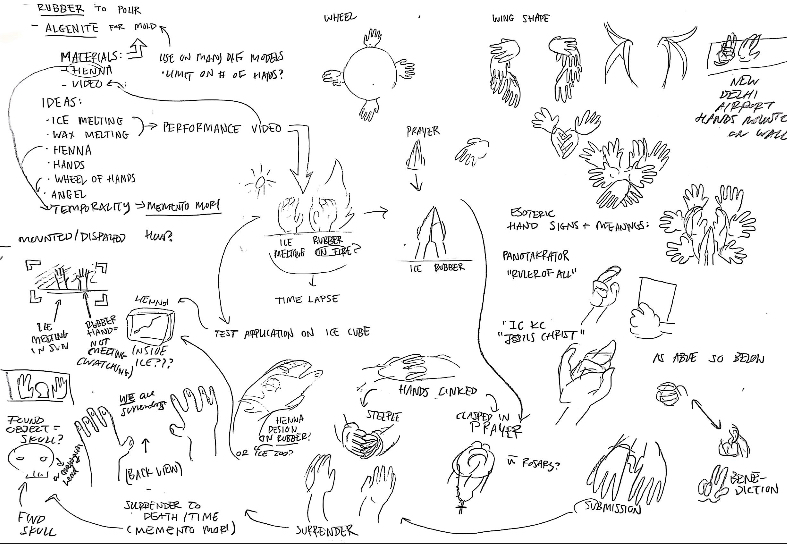
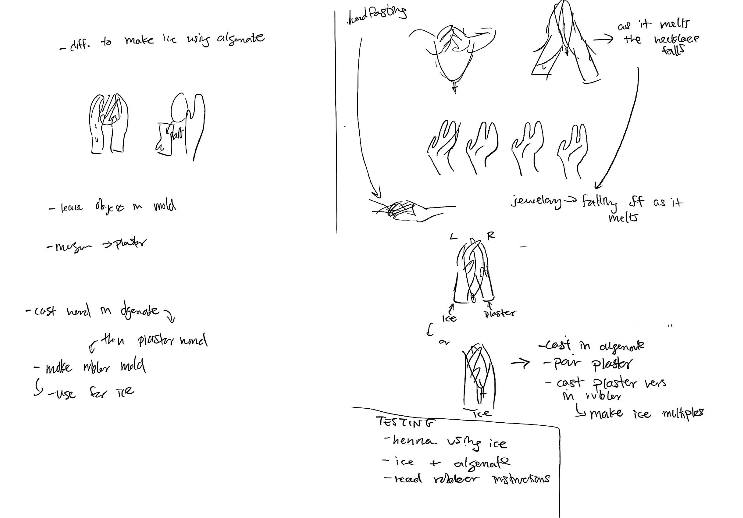
The trope of "Memento Mori" (Latin for "remember you will die") has influenced both Western art and values. The phrase and its representations signify that life is impermanent. My exploration of this concept, prompted by mold-making work, relied on temporary artistic mediums such as henna and ice to communicate this idea in a contemporary manner. I used both enduring and transitory materials and symbols to connect my piece to another kind of genre painting, that being "vanitas". In this trope, faith is everlasting and the pursuit of pleasure and goods is futile. As this time lapse plays out, my hands in prayer turn from recognizable to a husk.
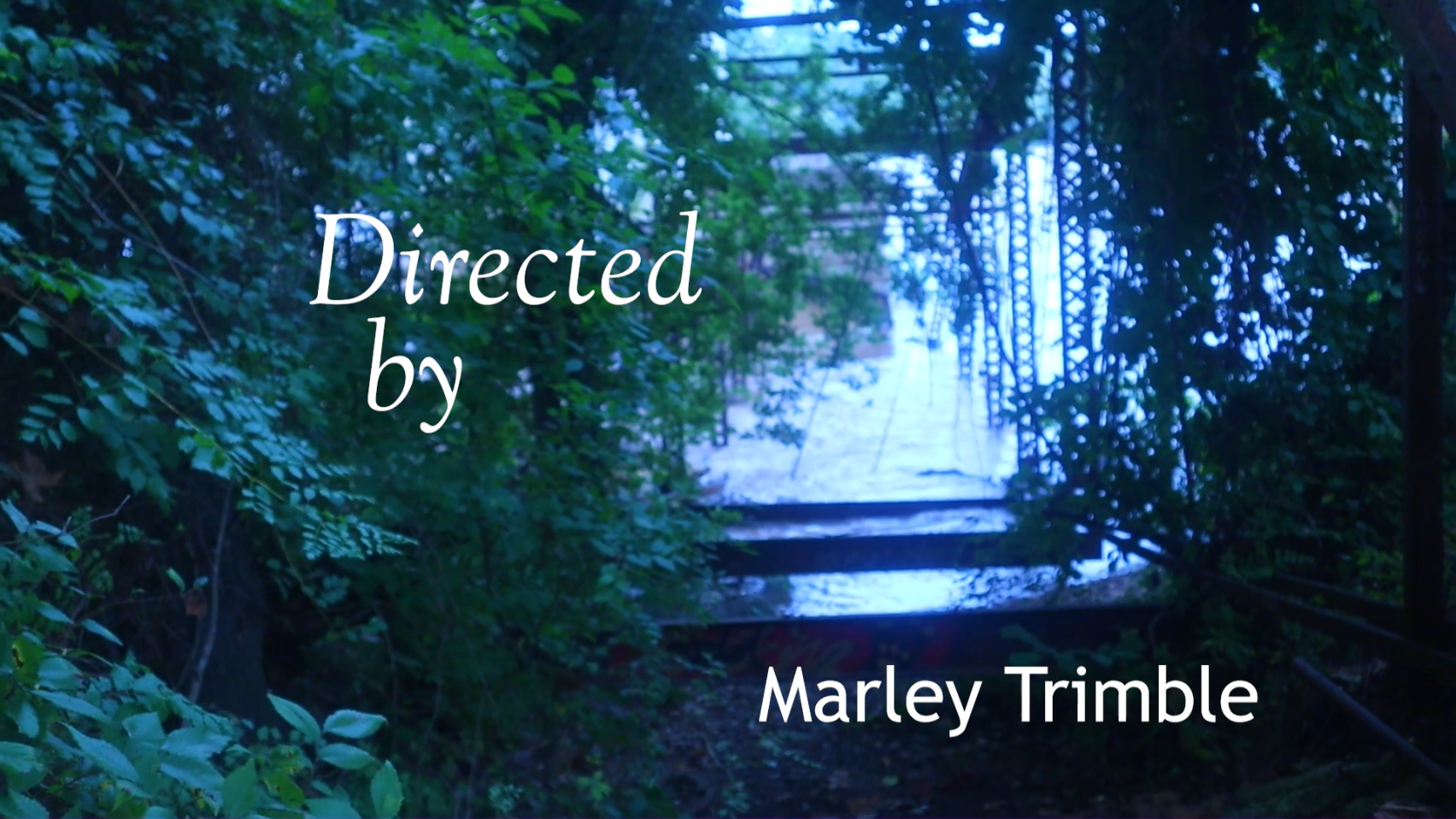
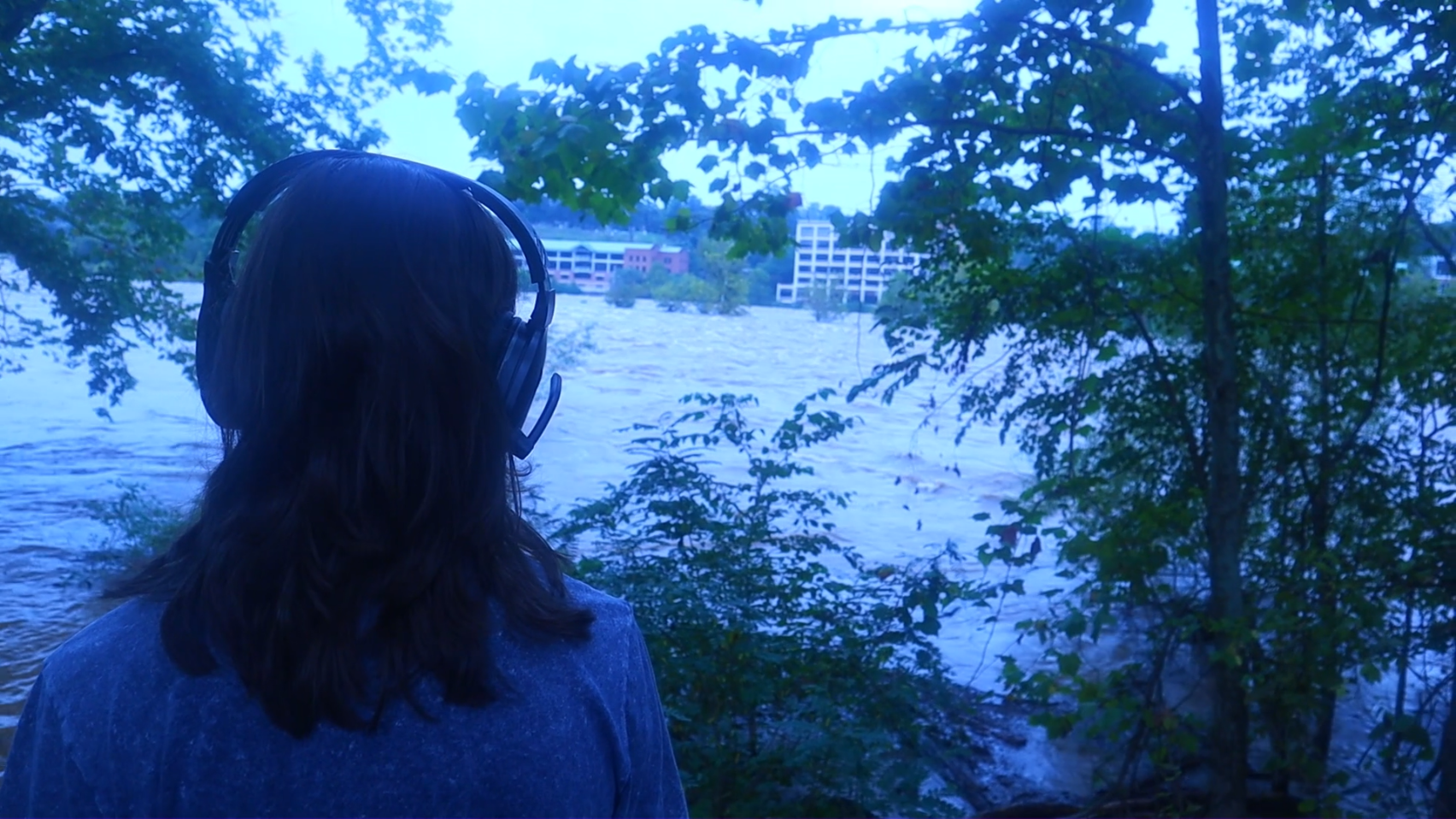
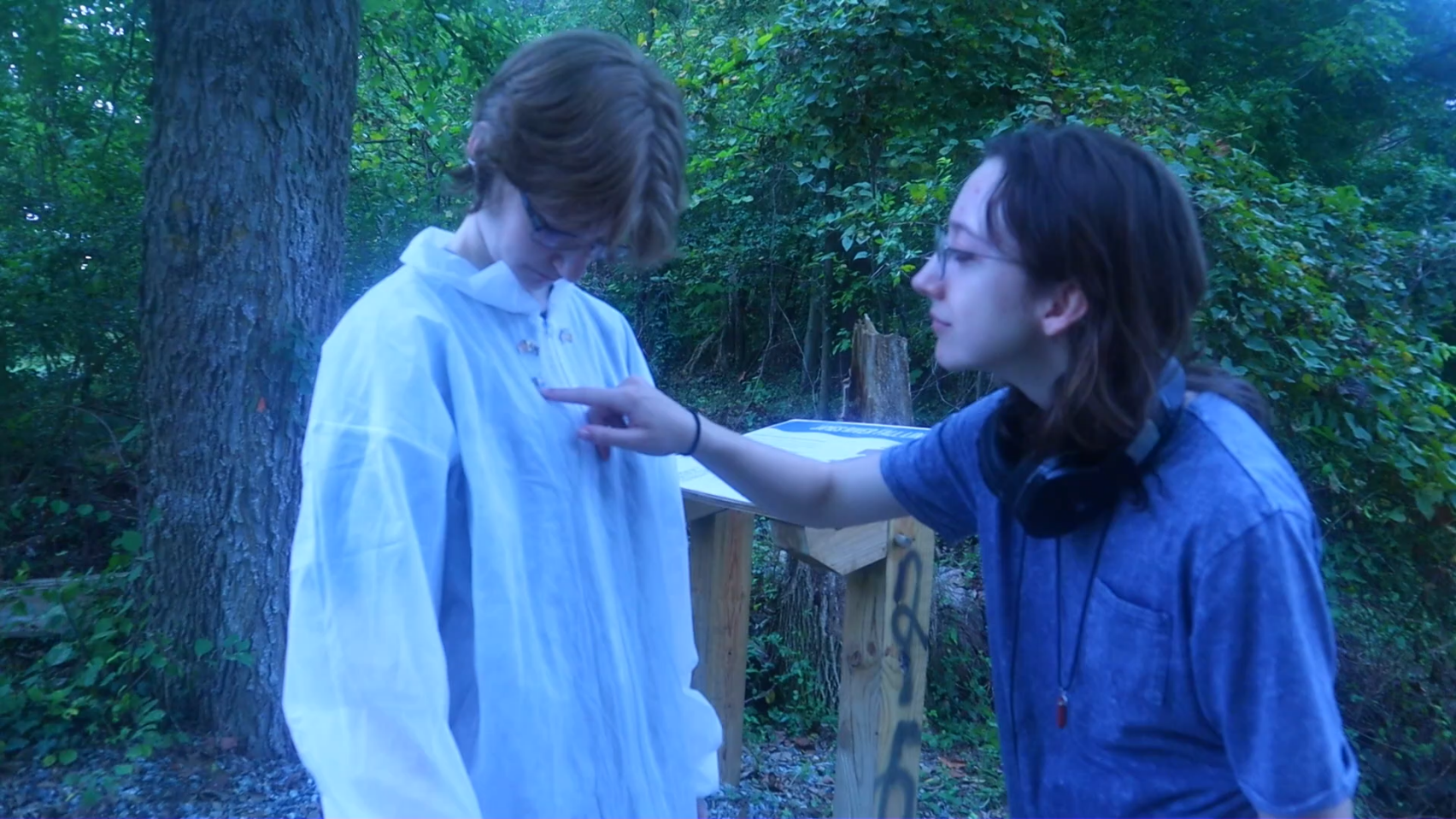
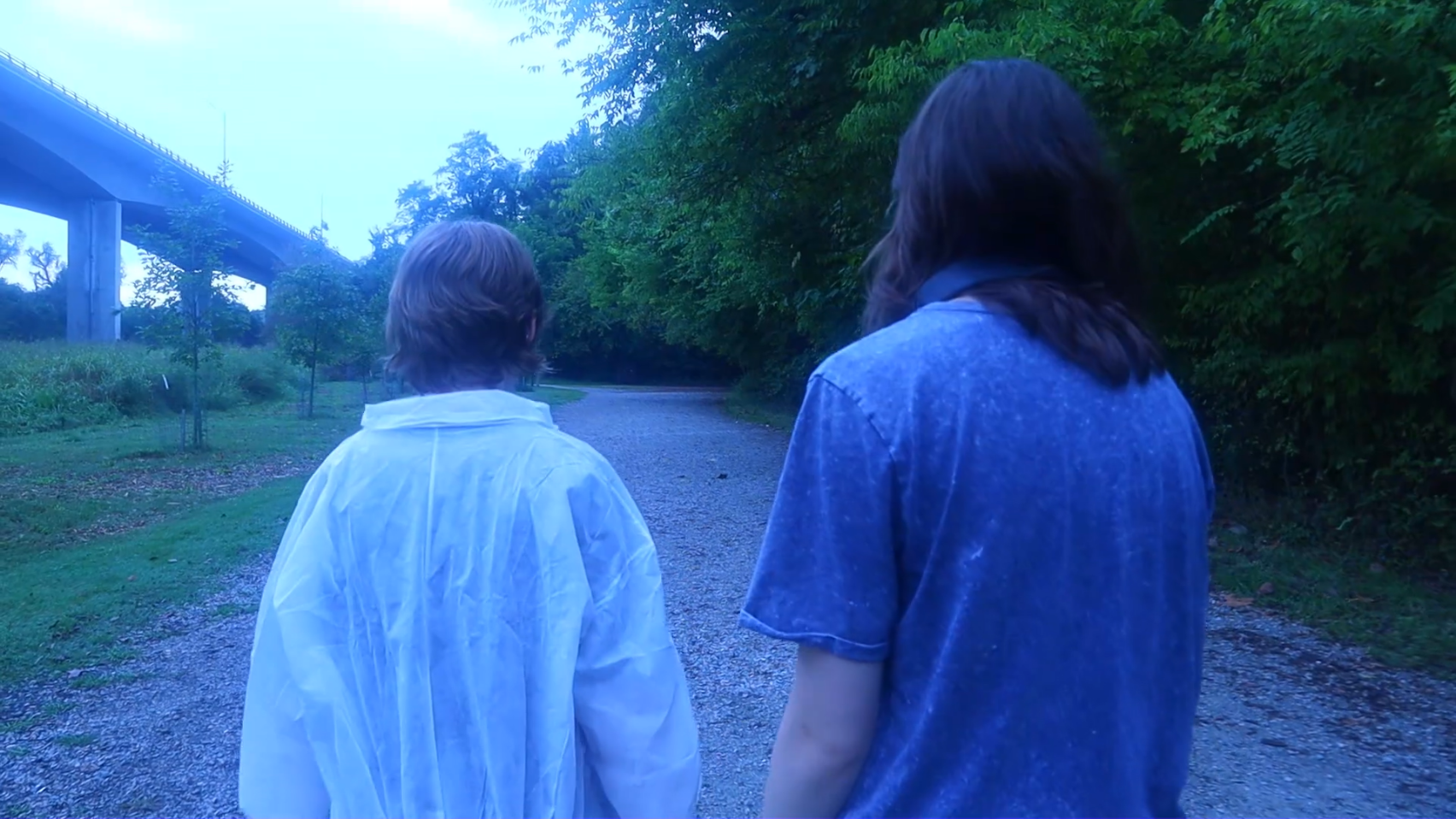
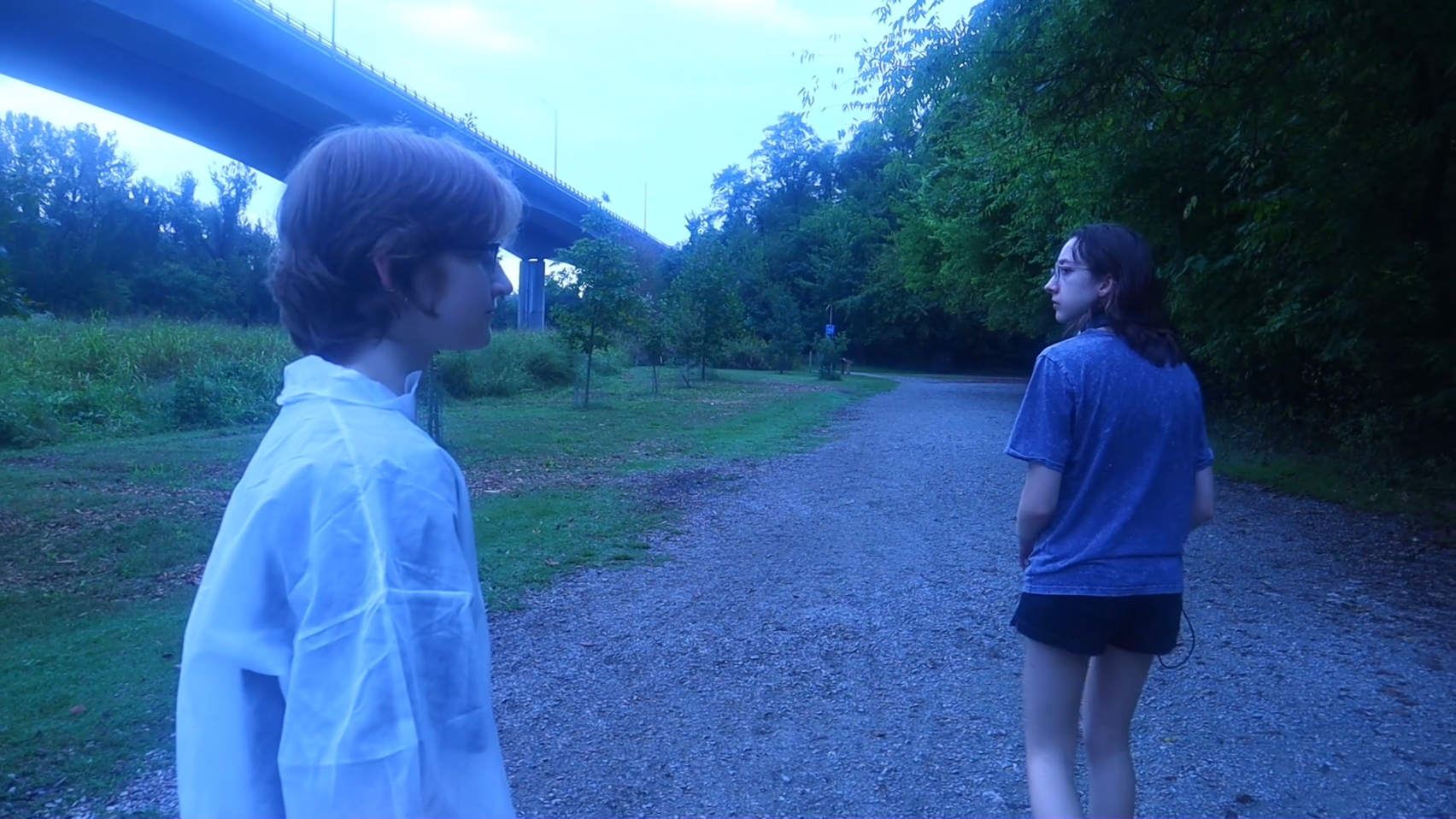
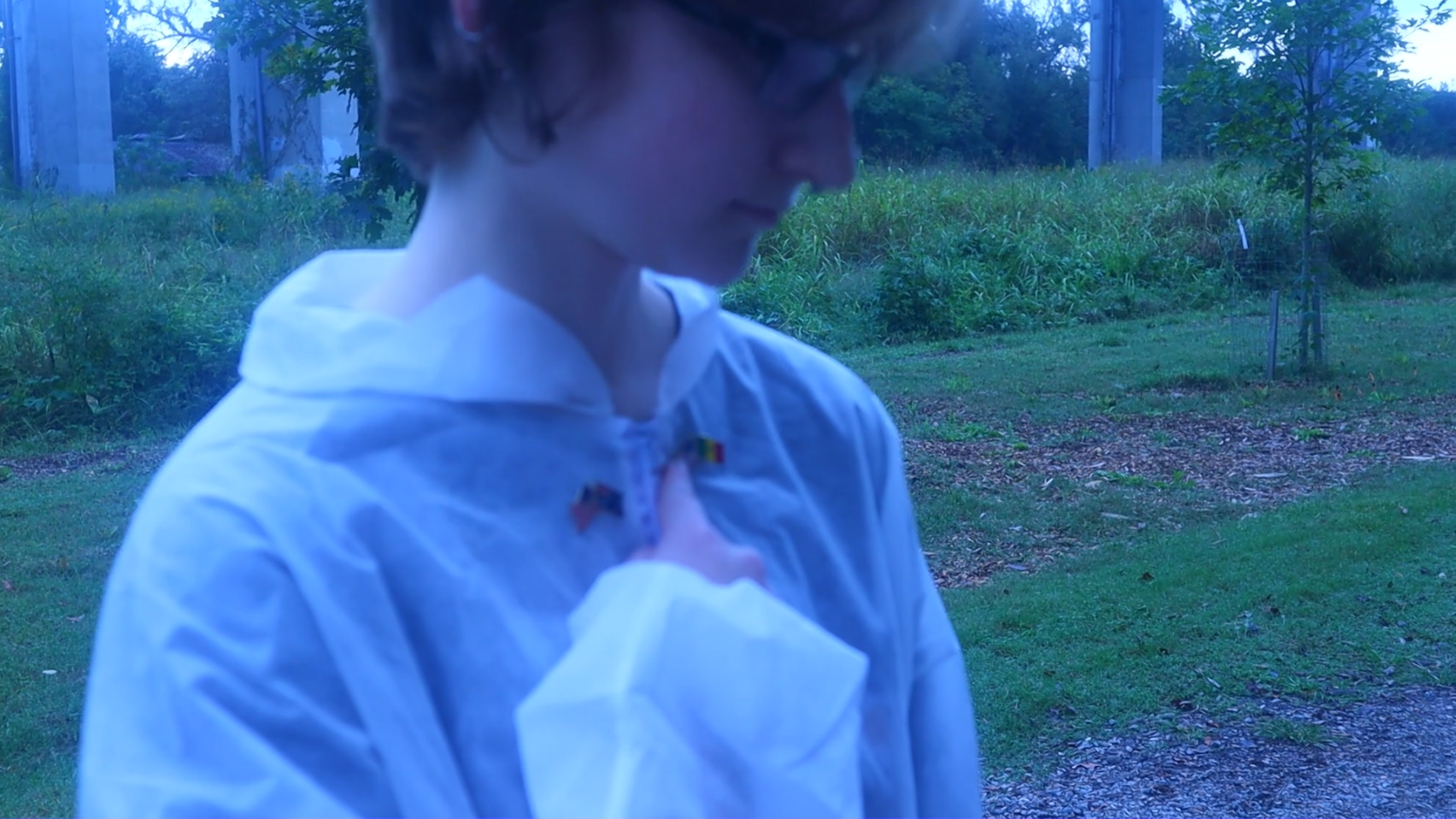
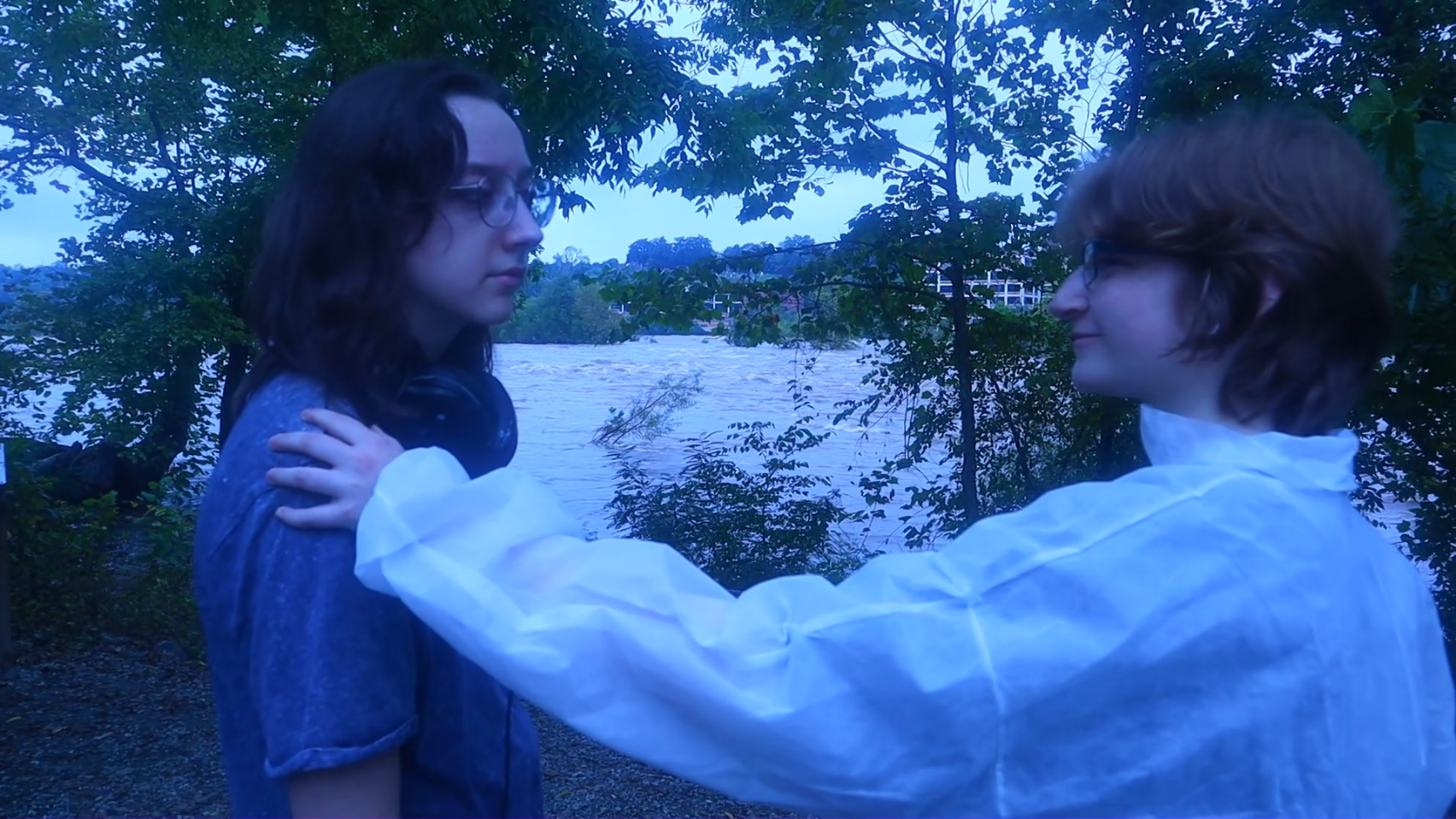
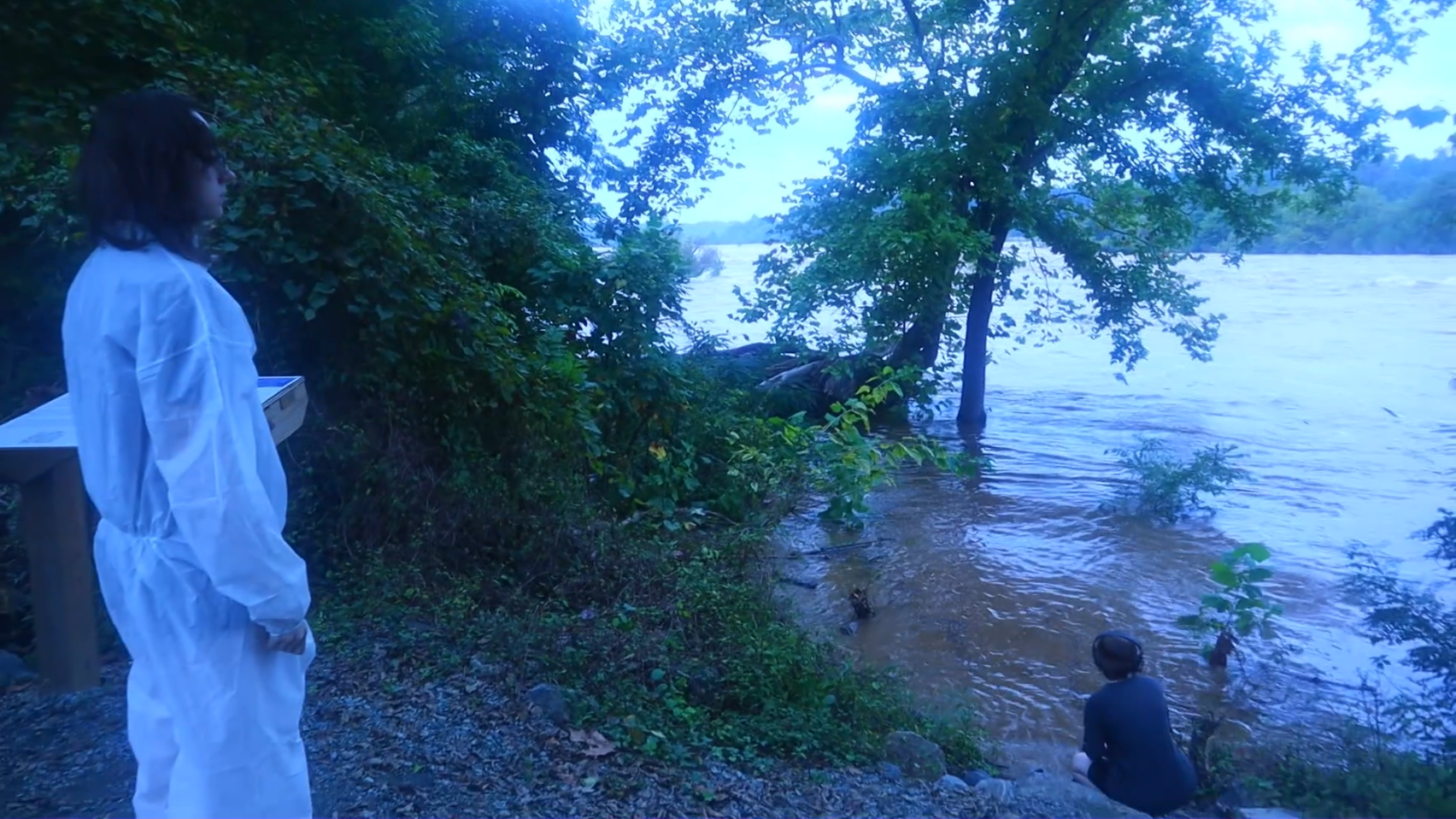
Access a video desciption here. The audio accompanying this video is quite and sounds best when using headphones. Captions have been provided for clarity.
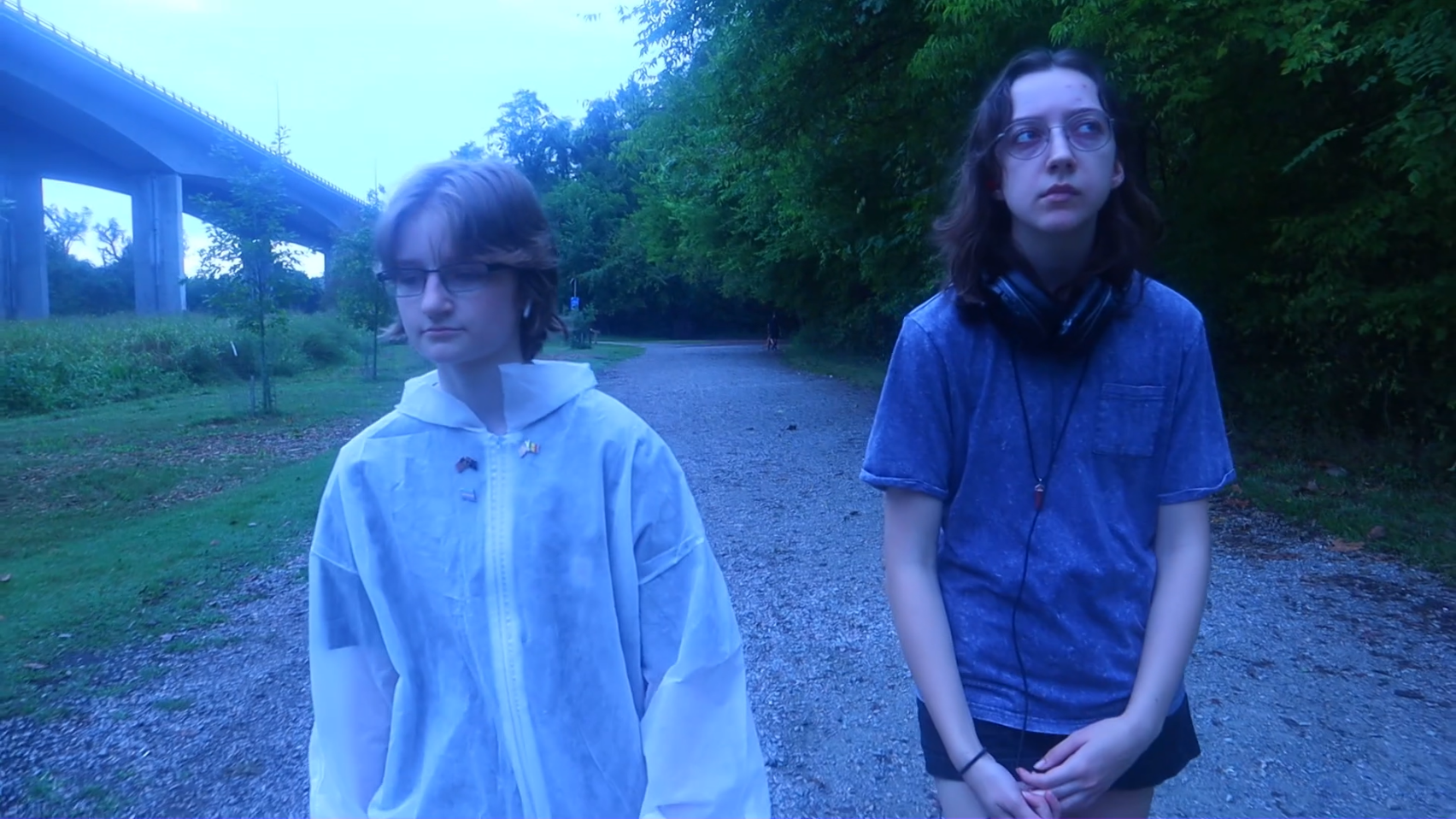
VIDEO DESCRIPTION: One person sits by a river with headphones on listening to a podcast before being approached by another wearing white coveralls with pins on them, who is a time traveler. The two of them have a conversation out loud and then mentally as they walk away from the river before returning to it. The pair swap clothes and the person originally wearing coveralls wears headphones by the river as the first person watches from a distance, now wearing the coveralls.
Warning: Mention of suicide.
"Don't Say Thank You"
September 2024
Video art
5 minutes 14 seconds
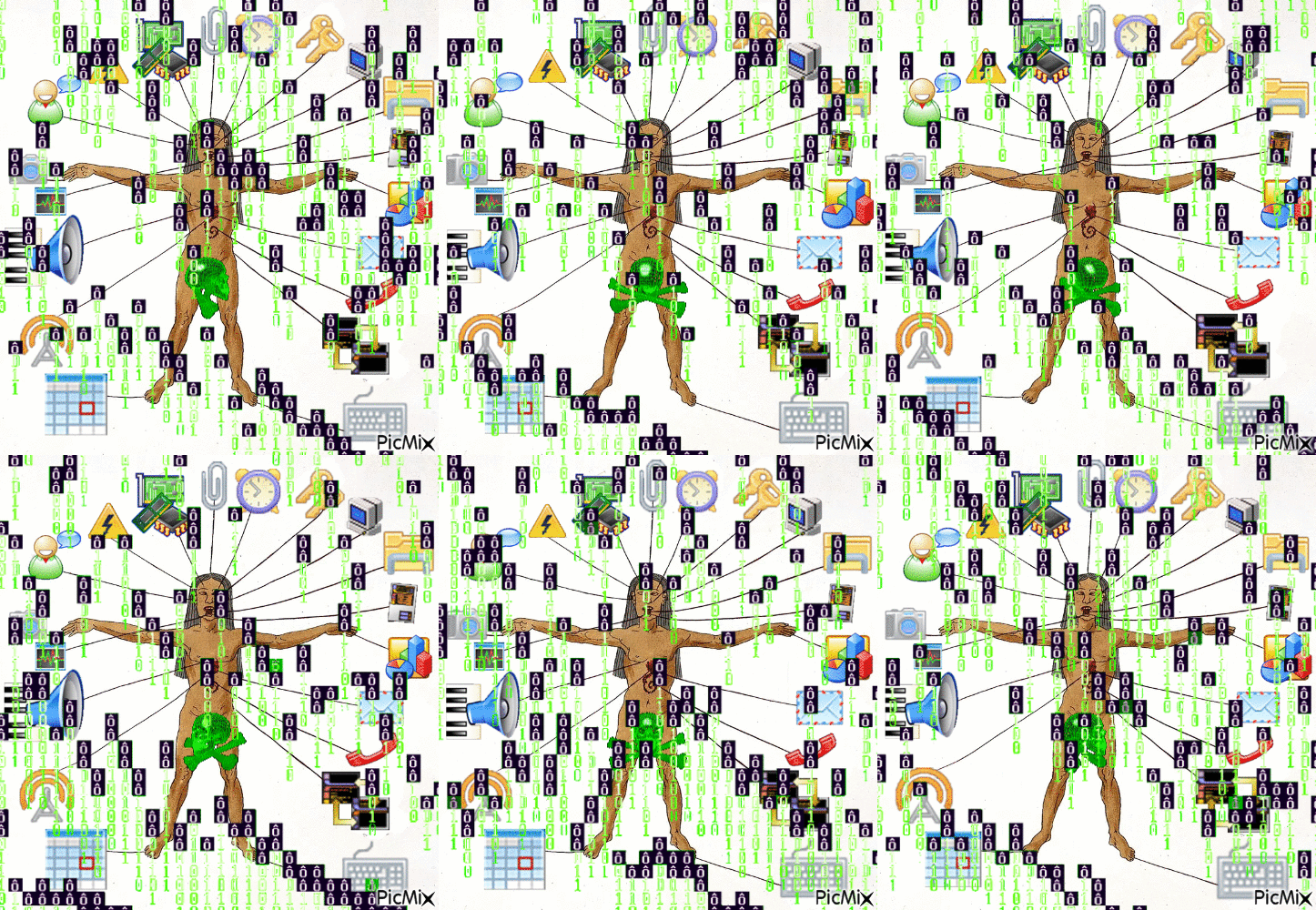
"General Purpose User"
October 2025
Digital GIF
482×500 pixels
This animation was created using the free website PicMix. It is a re-visitation of a previous doodle/blurb created for my class Computer Technology in Art Education. You can access the details of the lesson plan designed parallel to this moving project here.
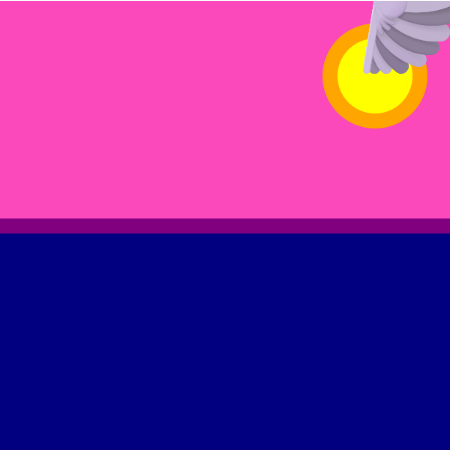
"Sunset"
December 2025
Coded .j5 project
300×300 pixels
When following the demo from p5.js's website, I created this coded "sketch" that is transformative because of its ability to be changed by the input of the mouse. You can access the details of the lesson plan designed parallel to this coded project here.
"Reading Doodle and Blurb #1"
August 2025
Digital
3508x2480 pixels
RE: "Rabbit Hole - Wonderland" and "Art Ed Radio Podcast #469"
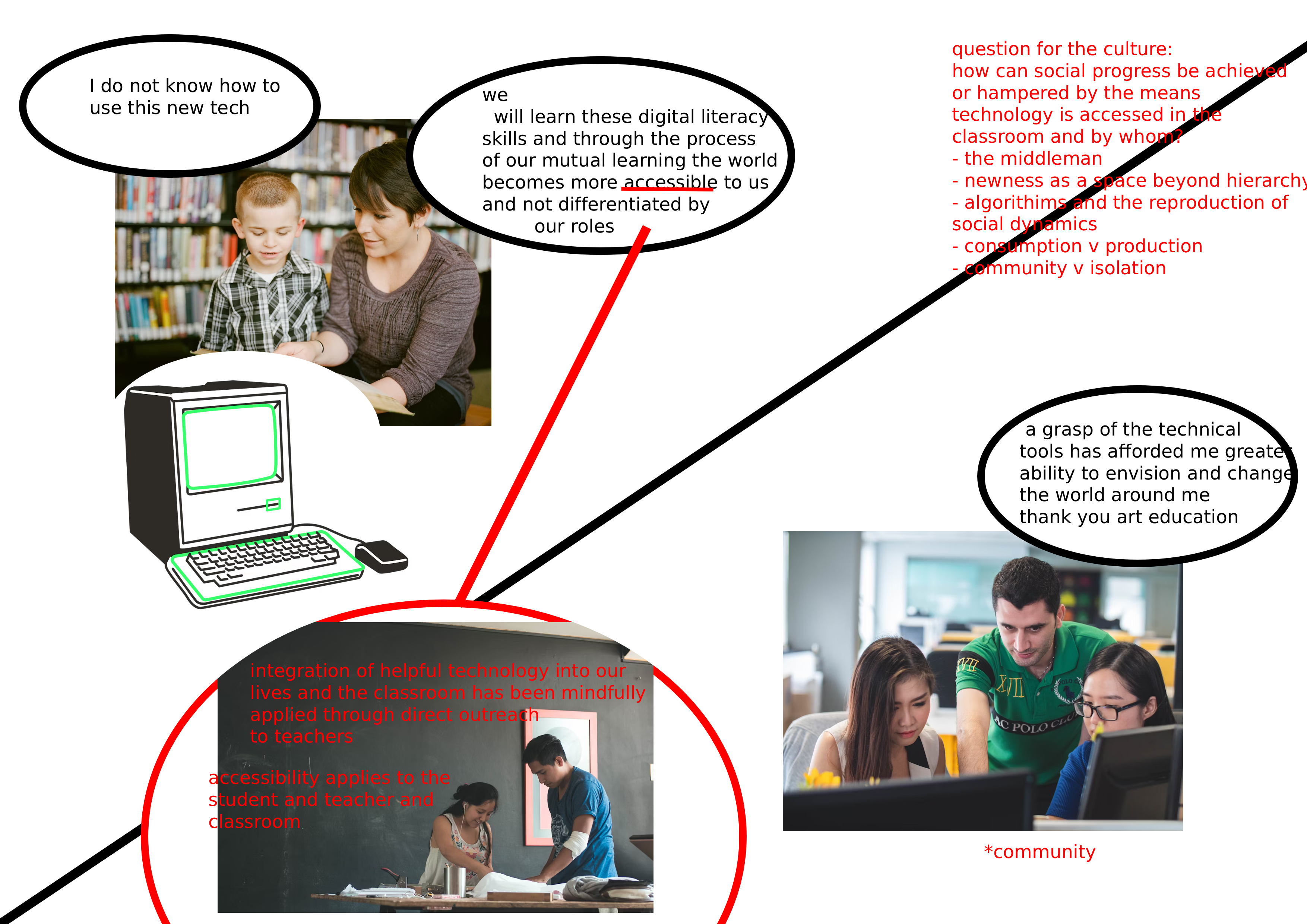
Using photopea and stock images found on unsplash I sought to model my thoughts about the future social and individual possibilities of integrating tech. Something I found poignant (and connected to what we are discussing in ARTE 310) was students and teachers learning alongside each other: "newness as pedagogy". In addition, the social (isolation, polarization, consumption) implications of the internet and algorithms as seen on wonderland episode one also intrigued me.
"Reading Doodle and Blurb #2"
August 2025
Digital GIF
500x500 pixels
RE: "Rabbit Hole - Looking Down" and "Mirror Image" (E 2 + 3)
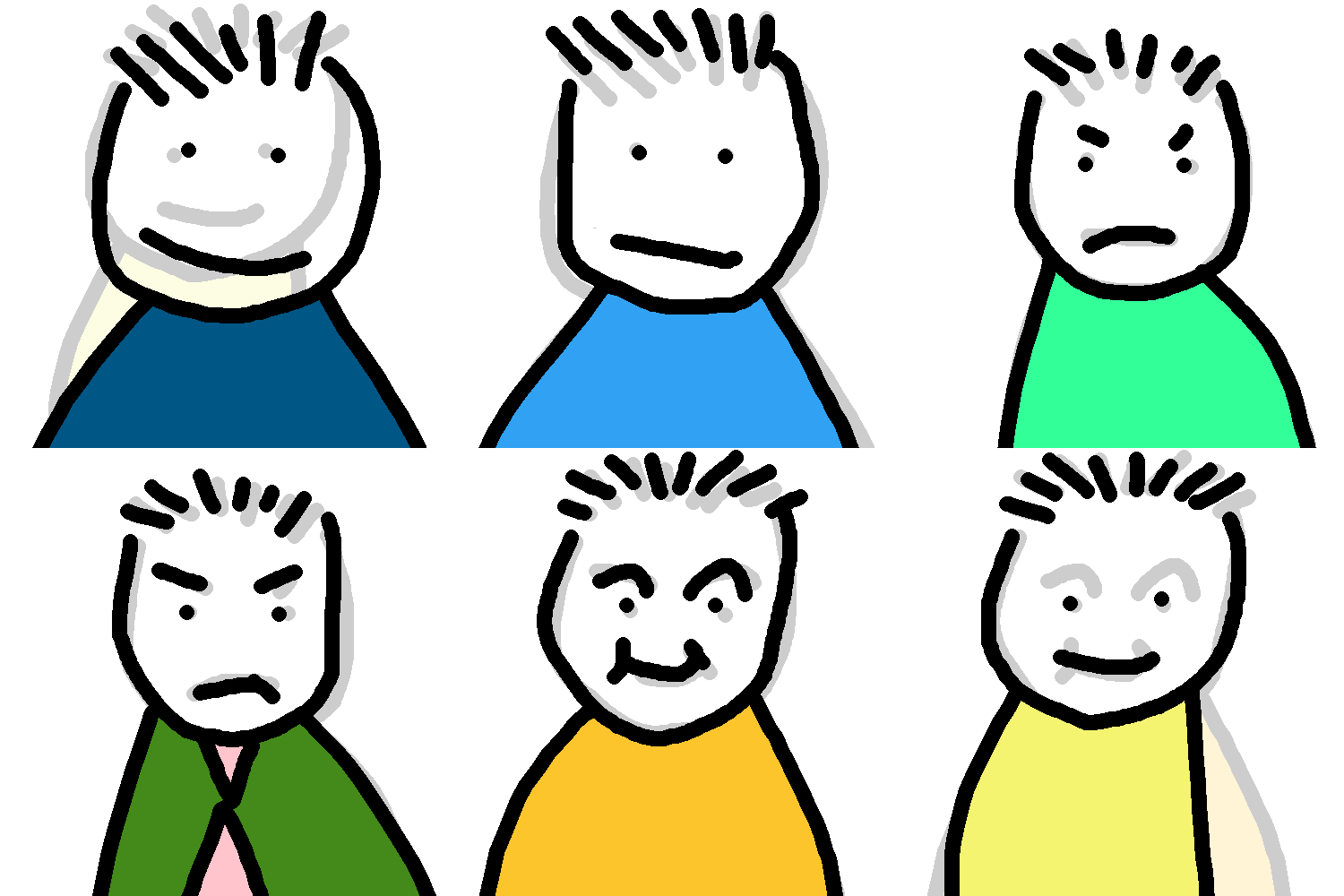
After watching the second episode of Rabbit Hole I was thinking about how in instances where people on the internet propagandize people to their side, they appeal to the aesthetics and dialogue styles of the audience's previous belief systems.
"Reading Doodle and Blurb #3"
September 2025
Digital
1009x639 pixels
RE: "Histories of the Digital Now" by Christiane Paul + "Critically Reframing Post-Internet Art" by Timothy J. Smith + Net Art Anthology
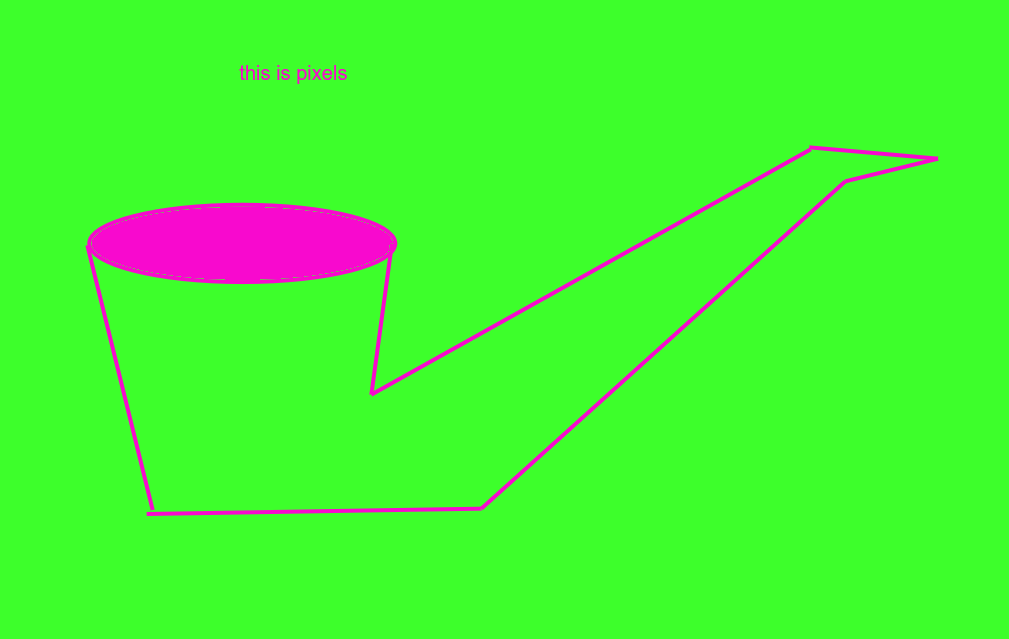
I created this image using Kleki as a callback to the 1929 painting by René Magritte, The Treachery of Images known for it's witty caption "Ceci n'est pas une pipe" (this is not a pipe). The caption(s) of my drawing and Magritte's refer to the fact that this isn't a pipe, it is pixels on a screen or paint on a canvas. This is something both the modern art movement and net art movements touched on, an attention to the medium itself, with art as a vector to explore the characteristics of technology. I also was very moved by the mention that rule-based artmaking could be a form of play to benefit from. I found it fascinating.
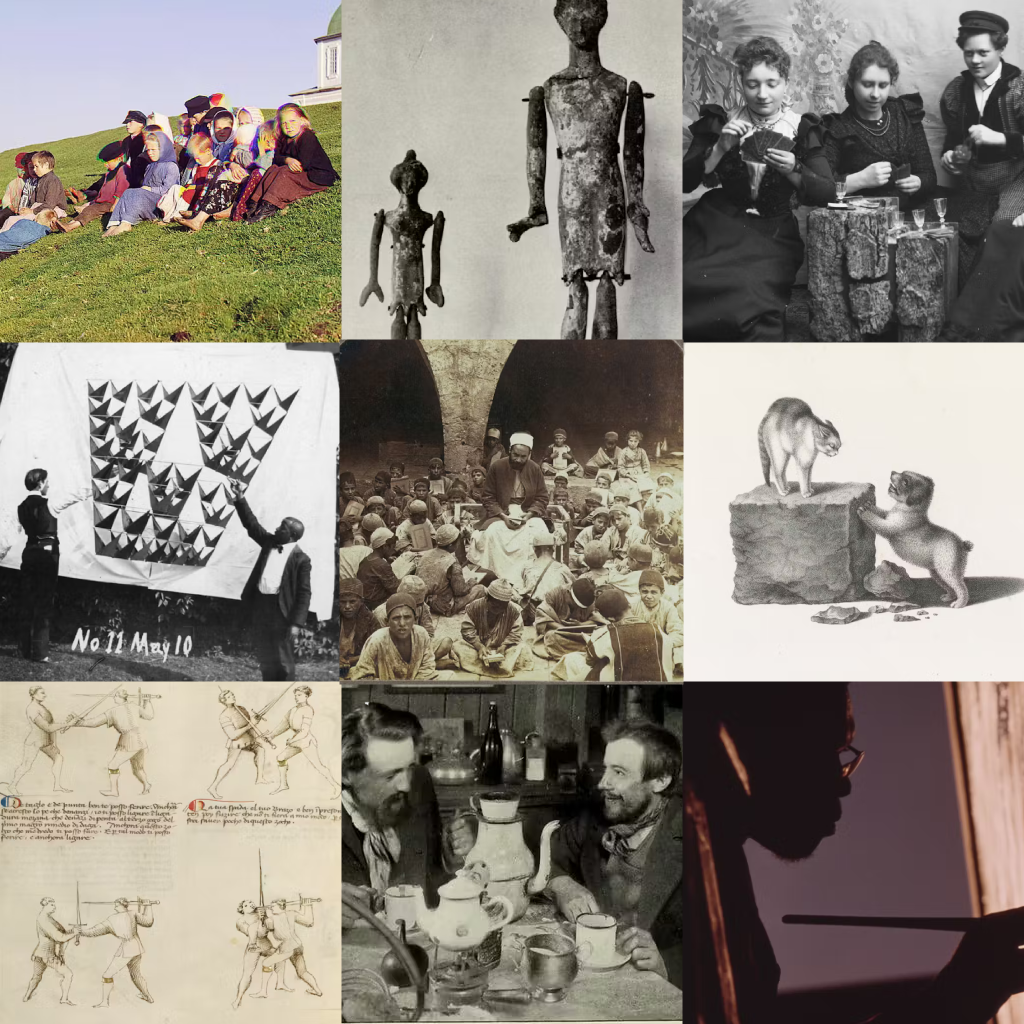
Detailed image description here.
In order, the first photo in the grid is of a group or children on the grass, the second is of two wooden mannequin dolls of a large and small size, the third is of three people playing cards, the fourth is of people demonstrating something, the fifth is of a teacher surrounded by children, the sixth is a cartoon of a puppy bothering a cat, the seventh is an illustration of swordfighting stances, the seventh is of two people at tea, and the ninth is a close up shot of a man painting."Reading Doodle and Blurb #4"
September 2026
Digital collage of photography
1024x1024 pixels
RE: "9 ways online teaching should be different" by Cult of Pedagogy + "Rabbit Hole - Headquarters" (E 4)
Using Photopea and images found on pdimagearchive.org (and Wikimedia Commons), I created a graphic where each square on the grid represents one of the distinct pillars of online teaching according to Melanie Kitchen. Because no image is one-to-one, this allowed me to think about what Kitchen was discussing on a deeper level when I was searching for images.
"Reading Doodle and Blurb #5"
September 2026
Digital
1009x639 pixels
RE: "What the coronavirus reveals about the digital divide between schools and communities" by Nicol Turner Lee + "Program or be Programmed" by Douglass Rushkoff + "Have Smartphones Destroyed a Generation?" by Jean M. Twenge
Drawing with the touchpad on a computer is not easy. But this was a doodle I was thinking about after reading Lee's article on tech being used to teach in the absence of in-person schooling during the coronavirus pandemic. While some students do have those devices that keep them connected, not all homes are equally connected.
"Reading Doodle and Blurb #6"
September 2026
Digital
1009x639 pixels
RE: "The Educational Implications of Godzilla, Ghosts, and Aliens" by Tricia Fuglestad
Reading this article made me think about how empowering it is for students to see their ideas manifested and transformed into reality because of their hard work. I think iPads or other accessible technology can be great vectors for that transformation.
"Reading Doodle and Blurb #7"
October 2026
Digital
772x800 pixels
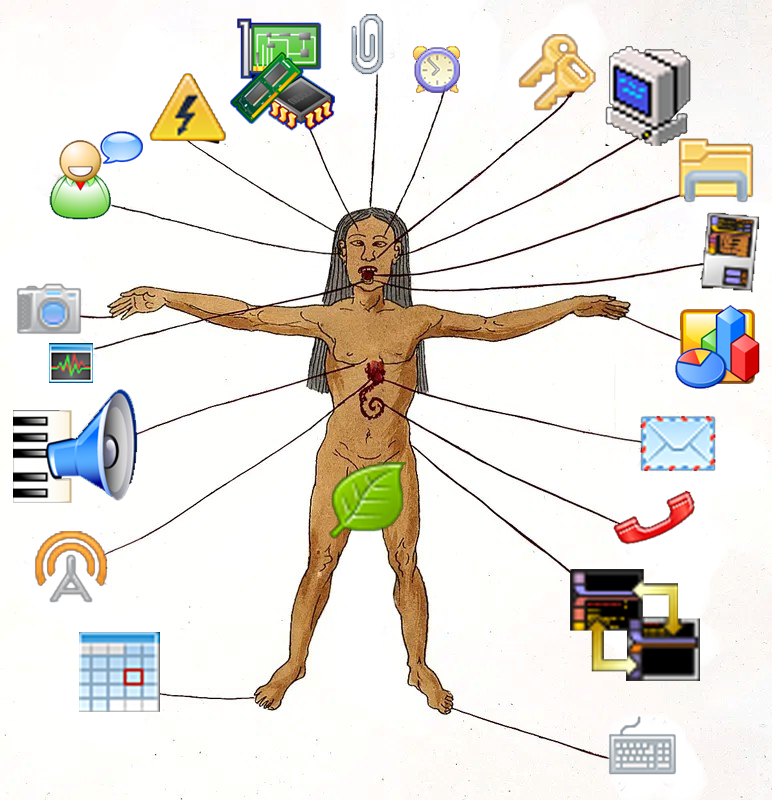
RE: "AI Art, Explained" from Vox + "AI Images" from Last Week Tonight + "This Is What Your Worlds Are Lacking: Artists Are Using AI To Create Fat, Black Sci-Fi And Fantasy Characters" by Cheyenne M. Davis + "System Error" by Luke Meeken
I was inspired by the concept of the general purpose user. A general purpose user is someone who uses computer technology applications in a way that may not be their express or intended use, but in a manner that completes the user's intention. I used these pixel art icons of various apps and an image I found on the public domain image archive of a Mesoamerican zodiac man to create a drawing of someone ostensibly connected to all these basic applications and computer uses.
"Reading Doodle and Blurb #8"
October 2026
Animated GIF
640x480 pixels
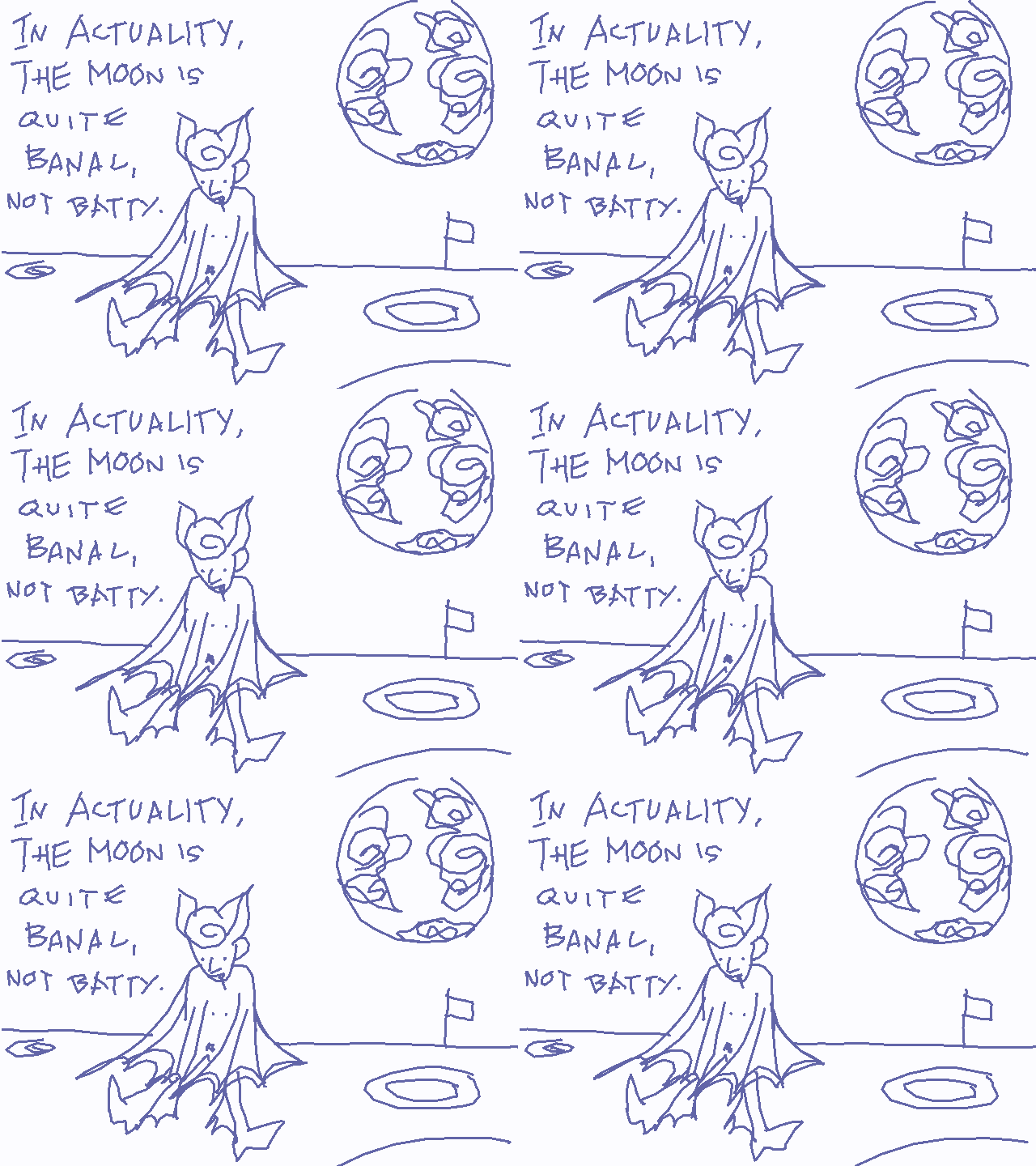
RE: "How Should I Be Using A.I. Right Now?" by Ezra Klein + "Watch - AI in Chinese education" from Wall Street Journal + "A.I. For Education Resources" + "The End of Privacy as We Know It" from the Newy York Times + "The Teen Mental Health Crisis" by Ezra Klein
For my doodle, I did a tiny rendition of the "Great Moon Hoax" which was one of the first incidences of misinformation. The story gained traction and believers because of its scientific packaging, but also, I think people wanted to believe in this fantastical tale. Cool or cathartic stories, even when pretty obviously false, are things you want to believe in. In my opinion, a large part of educating about misinformation is recognizing when you WANT to not/believe something.
"Reading Doodle and Blurb #9"
November 2026
Digital GIF
480x480 pixels
RE: "Misinformation" from Last Week Tonight with John Oliver + "Deep Fakes" module from MIT
I made this GIF using PicMix, which I also used for my make a moving thing. I used this site to make my doodle because it lends itself to the style of Whatsapp grannies/aunties who are going to be trying to send you fake news. But I changed the words usually associated with this kind of GIF or message to align themselves with anti-misinformation.
"Reading Doodle and Blurb #10"
November 2026
Digital GIF
480x480 pixels
RE: "Rabbit Hole - Accidental Emperor" and "Impasse" (E 5 + 6) + "Making Sense of Cancel Culture" from On the Media + "Rise of the Videogame Zinesters" by Anna Anthropy
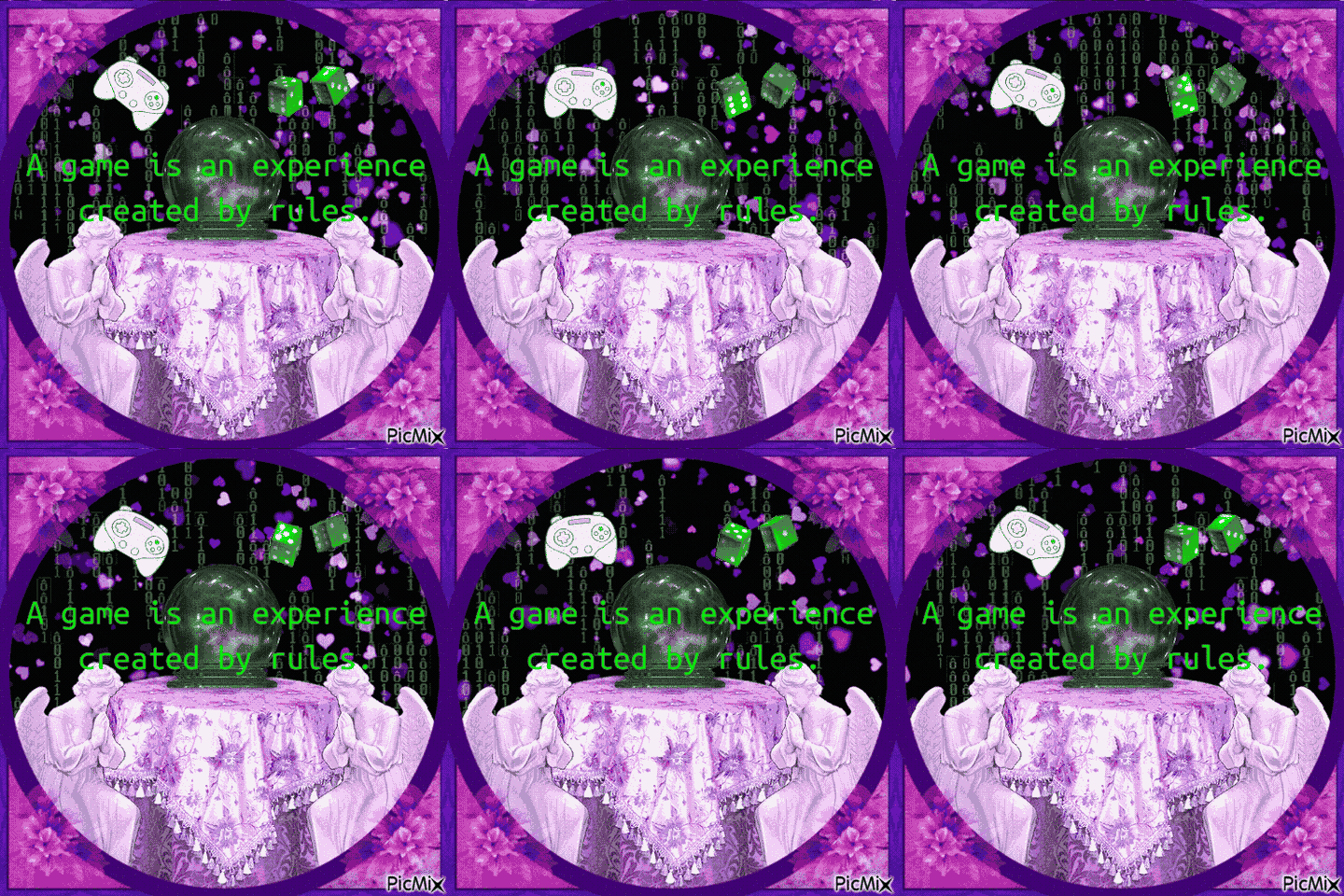
After reading "Rise of the Videogame Zinesters" I created this GIF because I was touched by this quote defining what a game is. It really tied into my make an image thing project from earlier this semester. I think that bringing the ideology of zines and indie/personal sharing of art projects into the digital scene is a great idea. I especially support this because I LOVE zines!
"Reading Doodle and Blurb #11"
November 2026
Animated GIF
32x32 pixels
RE: "The Street Arcade: Creating Social Justice Videogames as a Platform for Community Dialogue" by Steve Ciampaglia + Kerry Richardson On the Media + "AI Pedagogy Project" from Harvard
For my doodle/blurb, I used Piksel to connect to a quote that really inspired me from The Street Arcade. Authors Steve Ciampaglia and Kerry Richardson expand on Paulo Freire's ideology on literacy, connecting it to technological literacy and coding with the statement "You need to be able to read the world in order to remake the world." This reminds me of a previous text in which young people's illiteracy with computer coding and modification was related to low innovation, exploitation, and low efficacy. I think by comprehending using technology, we can manufacture a society that fits our needs more accurately. If we hand off the making of our world to the already literate technocrats, we are rife to be exploited.
"Reading Doodle and Blurb #12"
November 2026
Animated GIF
320x320 pixels
RE: "Forms and Bodies - Using Digital Fabrication" by Luke Meeken + "Everything is a Remix" by Kirby Ferguson
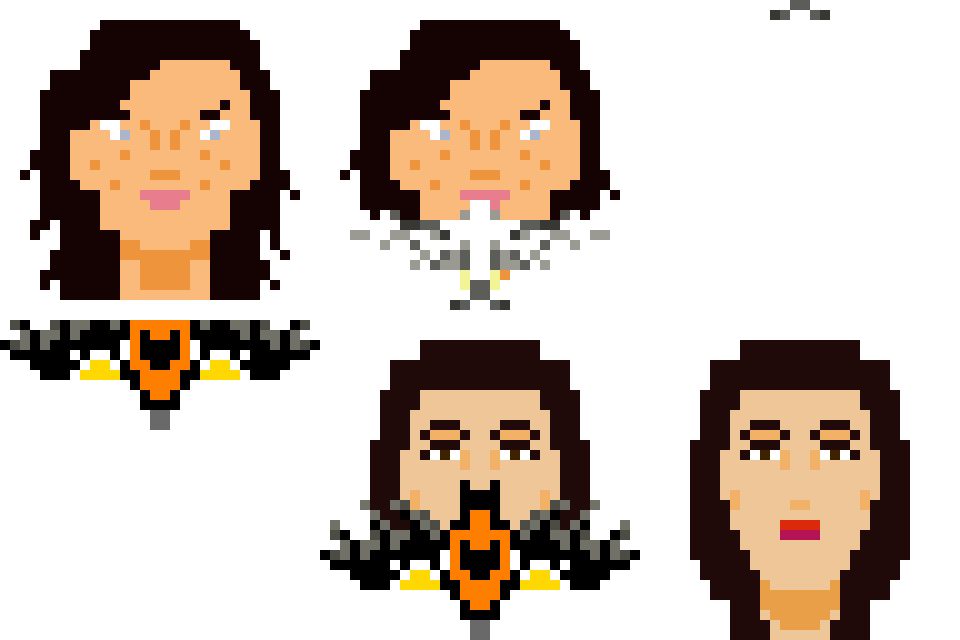
The history of sampling and remixing is an area of interest for me. I took some time to scroll through whosampled.com and was reminded of an artistic collaboration and sampling I admire. In Björk and Arca's Utopia, the artists chose birdsongs from both their native countries, Iceland and Venezuela. I think this shows how the choice of sampling can represent deeper creative thought and connection. After all, we are an amalgamation of everything we have seen/heard/felt/experienced. I used Piksel to depict an Icelandic bird, the gyrfalcon, with Björk and a Venezuelan bird, the Venezuelan troupial, with Arca.
"Reading Doodle and Blurb #13"
December 2026
Animated GIF
1080x1080 pixels
RE: “Human Art Has So Much in Common With AI” Vivian Lam + "How I'm fighting bias in algorithms" by Joy Buolamwini
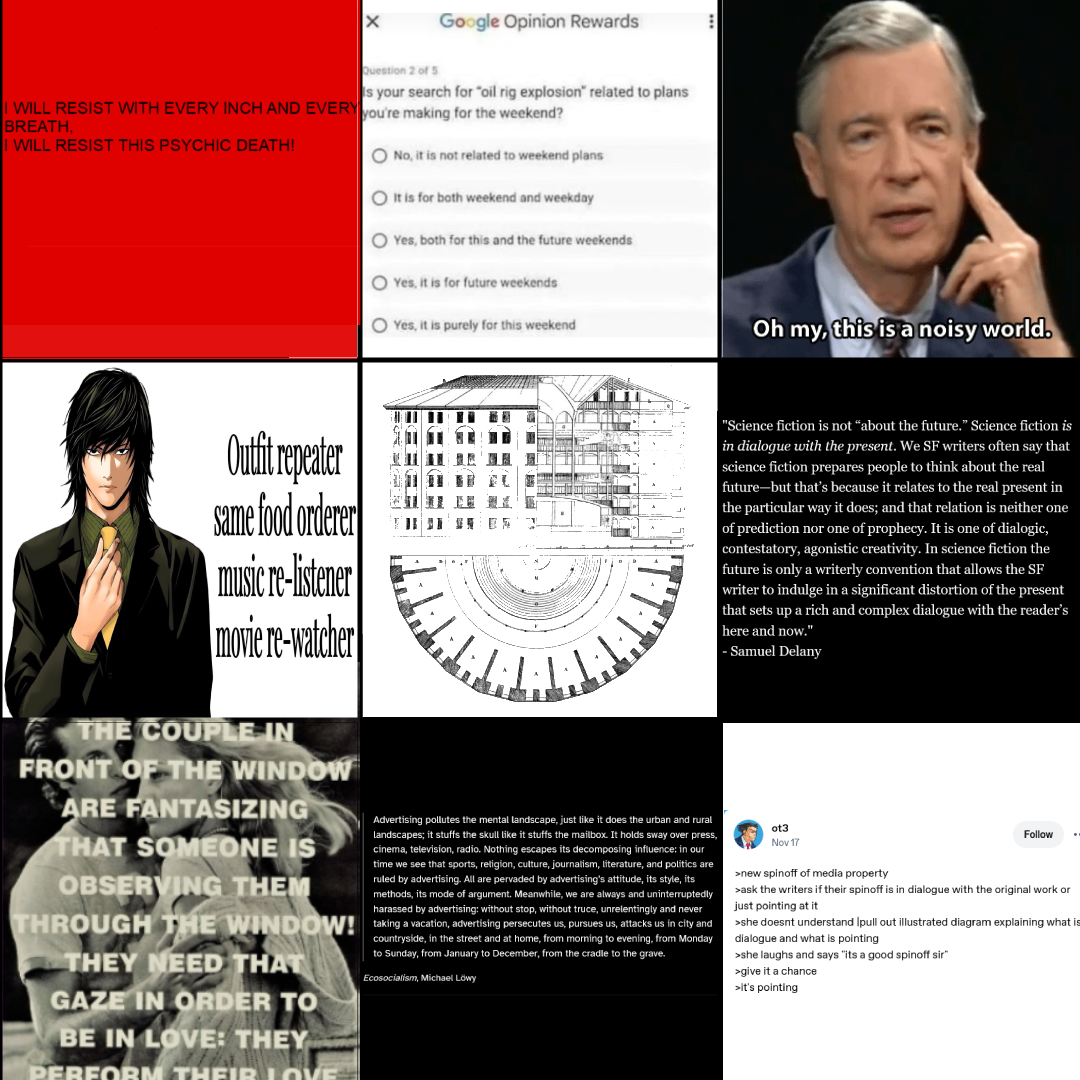
Inspired by webweaving (I had never heard it called that before!) I put together some of my thoughts on algorithms, surveillance, tech, and our current media landscape.